
In the automotive aftermarket, lubricant distribution, and wholesale trade industries, choosing the right supplier is essential to maintaining product quality and staying competitive. For wholesalers, importers, distributors, and private-label brands, a reliable partner can help reduce purchasing risks, control costs, and ensure a stable product supply.
However, not all suppliers offer the same product quality, manufacturing capabilities, or customer support. Before making a purchasing decision, businesses should evaluate several important factors to find an engine oil supplier that meets their current requirements and supports long-term growth.
1. Understand Your Business Requirements Before You Choose an Engine Oil Supplier
Before contacting potential suppliers, identify your target market, customer preferences, and purchasing requirements. Different businesses have different expectations regarding product specifications, packaging, and order quantities.
Identify Your Target Market and Customer Needs
Consider the following customer groups:
l Wholesalers and distributors: Focus on competitive pricing, profit margins, and stable inventory.
l Automotive repair shops: Prioritize product compatibility, consistent quality, and timely delivery.
l Private-label brands: Require customized formulations, packaging, and branding services.
l Importers: Pay particular attention to export experience, shipping arrangements, and compliance documents.
Climate conditions and vehicle specifications should also influence product selection. For example, colder regions may require oils with better low-temperature performance.
Determine Product Types and Purchasing Volume
Identify which products your business needs, such as mineral, semi-synthetic, or fully synthetic engine oils. Common SAE viscosity grades include 0W-20, 5W-30, and 10W-40.
Estimating monthly demand and inventory turnover also helps prevent overstocking and unexpected shortages.
2. Check the Engine Oil Supplier‘s Product Quality and Certifications
Product quality directly affects engine protection, lubricant performance, and customer satisfaction. Therefore, buyers should examine technical specifications rather than relying solely on product appearance or pricing.
Verify API and ACEA Standards
API (American Petroleum Institute) and ACEA (European Automobile Manufacturers’ Association) are important industry organizations that establish engine oil performance standards.
For example, API SP is a gasoline engine oil performance category, while ACEA A3/B4 and C3 cover different European engine oil requirements.
Buyers should verify whether the product specifications match the requirements of their target vehicles and markets.
Review Technical Documents and Testing Reports
A professional engine oil supplier should be able to provide essential product documentation, including:
l TDS (Technical Data Sheet): Provides viscosity, viscosity index, flash point, and pour point information.
l SDS (Safety Data Sheet): Describes product safety, handling, and storage requirements.
l COA (Certificate of Analysis): Shows test results for a specific production batch.
Important technical indicators include:
| Parameter | Purpose |
| Kinematic Viscosity | Measures oil flow characteristics |
| Viscosity Index | Indicates viscosity changes with temperature |
| Flash Point | Evaluates a key thermal property |
| Pour Point | Indicates low-temperature flow characteristics |
These parameters should always be evaluated according to the applicable product specifications.
3. Evaluate the Engine Oil Supplier‘s Product Range and Customization Capabilities
A diverse product portfolio allows businesses to serve different customer segments and expand their market coverage.
Check Product Types and Viscosity Grades
Look for suppliers offering various products, including:
l Fully synthetic engine oil
l Semi-synthetic engine oil
l Mineral engine oil
l Gasoline engine oil
l Diesel engine oil
l High-mileage engine oil
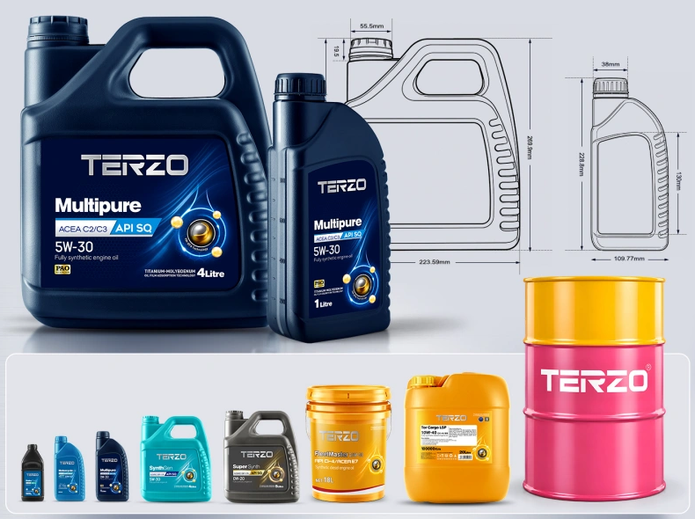
Packaging options are equally important. Common sizes include 1L, 4L, 5L, 20L, and 200L drums, depending on market requirements.
Explore OEM and Private Label Services
For businesses developing their own lubricant brands, OEM and private-label services can provide additional opportunities.
Before cooperation, confirm whether the manufacturer supports customized formulations, bottle designs, label printing, and packaging specifications. Also, ensure that all product performance claims are supported by appropriate technical evidence.
4. Compare Pricing, MOQ, and Bulk Purchasing Options
Purchasing price directly influences profit margins, but the lowest quotation does not always represent the best deal.
Understand MOQ and Bulk Discounts
MOQ (Minimum Order Quantity) determines the smallest order an engine oil supplier accepts. Requirements may vary between standard products and customized orders.
Buyers should clarify:
l MOQ for different product types.
l Availability of mixed-grade orders.
l Discounts for larger quantities.
l Payment terms and deposit requirements.
Calculate the Total Purchasing Cost
For example, purchasing 10,000 liters of engine oil at $2 per liter results in a basic product cost of $20,000.
However, the actual budget should also include packaging, transportation, insurance, and applicable import duties.
Comparing the Total Cost of Ownership (TCO) provides a more realistic basis for supplier selection.
5. Check Production Capacity and Delivery Reliability
A stable supply chain is particularly important for international distributors and wholesalers. Delayed shipments or insufficient production capacity can disrupt inventory planning and affect customer relationships.
Evaluate Manufacturing Capacity and Supply Stability
Before signing an agreement, ask about:
l Monthly or annual production capacity.
l Available inventory and raw material sourcing.
l Standard and customized order lead times.
l Quality management and batch traceability.
l Production planning during peak seasons.
For example, a distributor selling 5,000 liters monthly with a 30-day replenishment period should maintain sufficient safety stock to accommodate unexpected demand.
Confirm International Shipping and Export Support
For overseas buyers, export experience is another important consideration. Check whether the engine oil supplier can provide commercial invoices, packing lists, certificates of origin when applicable, and other required shipping documents.
It is also advisable to clarify shipping arrangements under trade terms such as FOB or CIF before placing an order.
Conclusion
Choosing the right engine oil supplier requires more than comparing product prices. Businesses should consider product quality, industry standards, product diversity, customization options, production capacity, and delivery reliability.
For wholesalers, importers, and private-label brands, a suitable partner should offer consistent product quality, competitive purchasing terms, and dependable long-term support.
By evaluating these factors carefully, businesses can reduce procurement risks, improve supply chain efficiency, and build a stronger foundation for sustainable growth.