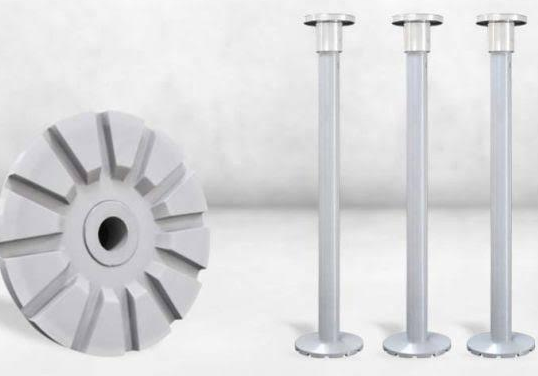

During aluminum melting, molten metal can absorb hydrogen and collect oxide particles and other non-metallic inclusions. These contaminants affect melt cleanliness and may cause porosity, internal defects, and reduced mechanical performance in finished castings. For manufacturers producing automotive components, industrial aluminum parts, and precision castings, controlling melt quality is an important part of production.
A Degassing Rotor helps address these problems by dispersing inert gas throughout molten aluminum. As the rotor spins, it breaks the incoming gas into small bubbles. Dissolved hydrogen diffuses into these bubbles and escapes when they reach the melt surface. The process can also help remove some non-metallic inclusions. Proper rotor operation therefore contributes to cleaner aluminum melt and more consistent casting results.
1. How Does a Degassing Rotor Remove Hydrogen from Molten Aluminum?
1.1 Why Does Molten Aluminum Contain Hydrogen?
Hydrogen is one of the main gas-related contaminants in aluminum melting. Molten aluminum absorbs hydrogen more readily at high temperatures, and several sources can introduce moisture into the melt:
· Wet raw materials: Moisture on aluminum ingots, scrap, and recycled materials can react under high-temperature conditions.
· Damp melting tools: Crucibles, furnace linings, and tools that have not been properly dried may introduce moisture.
· Ambient humidity: Water vapor in the surrounding air can contribute to hydrogen absorption at the melt surface.
· Combustion products: Water vapor generated during fuel combustion may also increase the risk of hydrogen entering the melt.
Hydrogen is considerably more soluble in liquid aluminum than in solid aluminum. As the metal cools and solidifies, excess hydrogen may separate from the melt and form gas pores. These defects reduce casting density and can affect mechanical properties, machining performance, and product reliability.
1.2 How Does the Degassing Process Work?
A Degassing Rotor is usually installed on a rotary degassing unit. The rotating shaft lowers the rotor into molten aluminum while supplying inert gas, commonly argon or nitrogen.
The process involves four main stages:
1. Gas supply: Inert gas enters the rotor through a hollow shaft.
2. Bubble dispersion: The rotating blades break the gas into numerous small bubbles.
3. Hydrogen diffusion: Dissolved hydrogen moves from the molten aluminum into the gas bubbles.
4. Gas removal: Hydrogen-containing bubbles rise to the melt surface and release their contents.
Bubble size plays an important role in this process. Smaller bubbles generally provide a larger total gas-metal contact area than larger bubbles at the same gas volume. This creates more opportunities for hydrogen transfer and can improve degassing efficiency.
2. How Does a Degassing Rotor Reduce Inclusions in Aluminum Melt?
2.1 Removing Non-Metallic Inclusions
Oxides, refractory fragments, and other non-metallic particles may enter aluminum melt during melting, holding, and transfer. If these contaminants remain in the metal, they can contribute to surface defects, internal discontinuities, and inconsistent casting quality.
During operation, a Degassing Rotor creates bubbles that move through the molten metal. Some non-metallic particles can attach to bubble surfaces and rise with them toward the melt surface. These particles may then enter the dross layer and be removed during subsequent cleaning.
The actual removal rate depends on particle size, surface characteristics, bubble distribution, and melt conditions. Not every inclusion can be captured through this process.
2.2 Improving Melt Cleanliness
Hydrogen removal and inclusion control address different aspects of aluminum melt quality. Rotary degassing mainly reduces dissolved hydrogen while assisting the removal of certain inclusions.
For better results, manufacturers often combine degassing with ceramic foam filtration. The degassing unit reduces gas content and helps separate some contaminants, while the filter captures solid particles that remain in the molten metal.
This combination provides more comprehensive melt treatment before casting. It is particularly useful when production requires consistent internal quality and fewer contamination-related defects.
3. How Does a Degassing Rotor Improve Final Casting Quality?
3.1 Reducing Porosity and Internal Defects
Hydrogen-related porosity is a common concern in aluminum casting. As molten metal solidifies, dissolved hydrogen may form gas pores inside the casting. These defects can weaken the structure and create problems during machining or pressure testing.
Using a Degassing Rotor lowers the dissolved hydrogen content before casting. With less hydrogen available to separate during solidification, the risk of hydrogen-related porosity can be reduced.
This is particularly important for automotive components, aluminum housings, and precision castings where internal defects may affect product performance. Better control of melt hydrogen also helps manufacturers reduce scrap and rework caused by porosity.
3.2 Improving Mechanical Properties and Product Consistency
Gas pores and non-metallic inclusions can act as stress concentration points inside castings. Their presence may affect load-bearing capacity, ductility, and long-term reliability.
By improving melt cleanliness, degassing creates more favorable conditions for the subsequent solidification process. Potential benefits include:
· Tensile strength: Fewer internal defects can help preserve the load-bearing capacity of the casting.
· Elongation: Reducing pores and inclusions may improve the consistency of ductility.
· Internal density: Lower hydrogen levels help reduce gas-related voids.
· Production consistency: More stable melt conditions can reduce quality variations between batches.
However, degassing alone does not determine the final mechanical properties. Alloy composition, mold design, cooling rate, and solidification conditions also influence casting performance.
4. What Factors Determine Degassing Rotor Performance?
The performance of a Degassing Rotor depends on more than its physical design. Operating parameters and production conditions also influence gas dispersion and hydrogen removal.
4.1 Rotor Speed and Bubble Distribution
Rotor speed affects gas dispersion and molten metal movement. As the rotor turns, its blades generate shear forces that break incoming gas into smaller bubbles.
A rotational speed of approximately 300–600 rpm is a general reference range for some industrial rotary degassing applications. The appropriate setting depends on rotor diameter, blade geometry, melt volume, and equipment design.
If the speed is too low, gas may not disperse sufficiently, resulting in larger bubbles and less contact area. Excessive speed can create strong surface turbulence, increase oxidation, and cause metal splashing. Higher speed does not necessarily mean better degassing.
4.2 Inert Gas Type and Flow Rate
Argon and nitrogen are commonly used as inert gases for aluminum melt treatment.
· Argon: Its stable chemical properties make it suitable for applications with demanding melt cleanliness requirements.
· Nitrogen: It generally costs less and is used in many conventional aluminum melting operations. Its suitability should be checked against the alloy and process requirements.
Gas flow rate also needs careful adjustment. Too little gas may produce an insufficient number of bubbles, while excessive flow can encourage bubble coalescence and unnecessary melt disturbance.
Manufacturers should determine the flow rate according to rotor design, treatment time, and the quantity of molten aluminum being processed.
4.3 Rotor Design and Immersion Depth
Rotor geometry influences how gas enters and spreads through molten aluminum. Blade shape, rotor diameter, and gas outlet configuration all affect bubble size and distribution.
Immersion depth determines the bubbles’ rising path and contact time with the melt. If the rotor is positioned too close to the surface, bubbles may have insufficient time to interact with the molten metal. An unsuitable position can also result in uneven gas distribution.
Selecting the correct rotor dimensions and operating position helps maintain stable gas dispersion and consistent treatment results.
Conclusion
A Degassing Rotor plays an important role in aluminum melt treatment. By dispersing inert gas into fine bubbles, it helps remove dissolved hydrogen, assists in separating certain non-metallic inclusions, and reduces the risk of gas-related casting defects.
Its actual performance depends on rotor design, rotational speed, gas flow rate, immersion depth, and melting conditions. When properly matched with filtration equipment and other melt treatment processes, a Degassing Rotor can help aluminum manufacturers maintain cleaner molten metal and produce more consistent castings.