

Almost everyone books a dumpster the same way. You look at a picture of a 10, a 20 and a 30 yard container, guess which one your pile of debris would fit inside, and call the number.
That is the wrong first question. Volume is rarely what stops a container from leaving your driveway. Weight is. And the weight limit on your rental is not a number the company invented to sell you an upgrade, it is arithmetic set by federal highway law.
Yardage Is the Least Useful Number on the Quote
Here is something most homeowners never find out until the truck shows up. On a major manufacturer’s roll-off line, the 20, 30 and 40 yard containers all share the same footprint, roughly 263 inches long by 84 inches wide. The difference between them is height.
So going from a 20 to a 30 does not buy you more room on the driveway. It buys you taller walls. That matters in two directions:
- You need the same clearance either way, so a tight side yard is not solved by a smaller yardage
- A taller box is harder to load, and anything you have to lift over the rail instead of walking in through the swing door slows the whole job down
- Taller walls on a heavy material just means more room to exceed the weight limit before you look full
That last point is the one that costs money. A 30 yard box loaded with drywall and carpet is a reasonable rental. The same box half filled with concrete is an illegal load.
The Weight Limit Is Federal Law, Not an Upsell
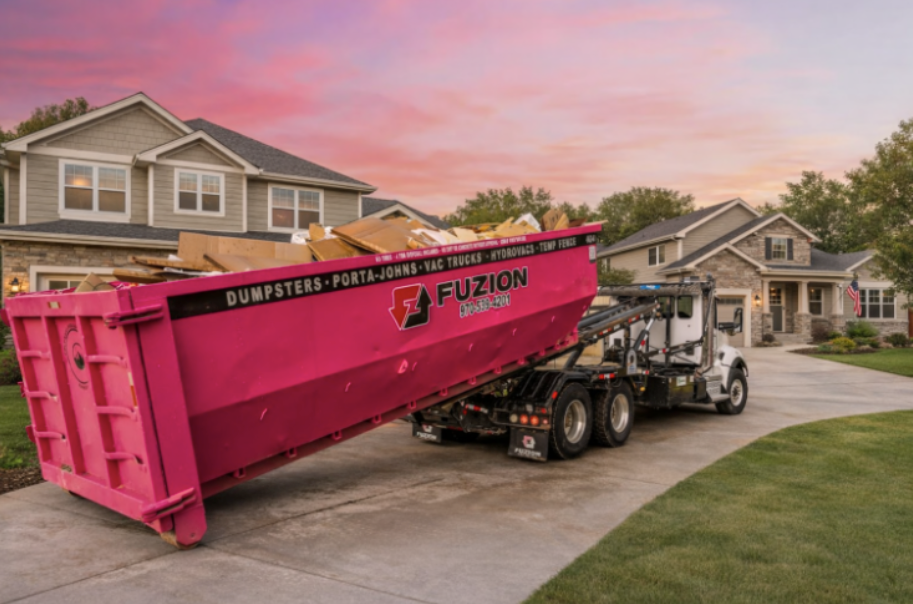
Roll-off trucks are governed by the federal bridge formula, which limits how much weight an axle group can carry based on how far apart the axles sit. A standard three axle roll-off configuration lands somewhere around 52,500 to 54,000 pounds gross, well under the 80,000 pound figure people associate with semi trucks.
Subtract the truck itself and the empty steel container, and what is left over for your debris is roughly 11 to 13 tons. That is the ceiling. Not company policy, not a negotiation, and not something the driver can wave through, because he is the one holding the ticket at the weigh station.
This is why a residential dumpster quote comes with a tonnage allowance attached to it, and why overweight loads get charged separately. The hauler is passing along a limit that was set long before you called. Once you understand that, the sizing conversation changes completely. You are not picking a box that fits your pile. You are picking a box that fits your pile without going over the tonnage the truck can legally carry.
Estimate by Material, Not by Eye
The EPA publishes volume to weight conversion factors for construction and demolition debris, and they are the closest thing to a neutral reference you will find. What they reveal is how far apart materials sit.
- Mixed household junk, furniture and general cleanout debris are light, and volume genuinely is your limit
- Drywall, lumber and roofing sit in the middle, where both volume and weight are in play
- Concrete, brick, asphalt, dirt and tile are heavy enough that published estimates for concrete alone spread from roughly 860 to over 1,800 pounds per cubic yard depending on the source and the form it is in
That spread is the warning. When even the reference tables disagree by a factor of two, you should not be estimating heavy material by eyeballing the pile. For anything masonry, most haulers will steer you toward a 10 yard box specifically because a larger one can be overloaded before it looks a third full.
Roofing is the one job where you can calculate it properly. Los Angeles County uses two pounds per square foot for asphalt shingle, which gives you a formula that works anywhere:
Squares of roof, multiplied by 200 pounds, multiplied by the number of layers coming off.
A 25 square roof with two layers is roughly 10,000 pounds, or five tons, before you add underlayment and the odd sheet of decking. Run that number before you book, not after the tear off starts. If you are still deciding whether you are patching or replacing the roof entirely, the debris weight is a real part of that budget.
What the Hauler Will Refuse to Take

Every landfill has a banned list, and you inherit it the moment you load the box. Some of these are obvious. Others catch people mid project.
- Anything with refrigerant. Under EPA Section 608, the duty to verify recovery lands on the final person in the disposal chain, which is why a refrigerator or an old AC unit tossed in a dumpster becomes the hauler’s legal problem and gets refused
- Paint, solvents, fuel, pesticides, batteries and anything else classed as household hazardous waste
- Tires, which almost universally carry their own handling stream
- Whole categories banned by state rather than by facility. Massachusetts, for example, bans a list of materials from disposal outright, including things most people assume are ordinary construction debris
Check your own state’s ban list before you plan the load, because a banned item does not just get pulled out. It can send the entire container back.
The Permit Nobody Budgets Time For
If the container goes on your own driveway, you generally do not need permission. If it goes on the street, you almost certainly do, and the lead times are longer than people expect.
San Francisco is a useful example of how involved this gets. A debris box permit there runs through Public Works, requires signs posted 72 hours in advance, and takes around 10 business days to process. Your city may be faster or slower, but the lesson holds. Call about the permit when you book the container, not when it arrives.
This is also where planning a container swap schedule pays off on longer jobs, since a second smaller box delivered mid project is often cheaper and more legal than one oversized box you cannot lift.
Book for Weight, Then for Volume
The right sizing process runs backward from how most people do it:
- Identify what material is actually going in the box
- Estimate its weight using a published factor rather than a guess
- Check that number against the tonnage allowance written into the quote
- Only then pick a yardage that gives you room to work
Do that and the heavy jobs land in a small container and the bulky ones land in a large one, which is the opposite of what instinct tells you. Get the sizing right at the booking stage and it stays a line item. Get it wrong and it becomes the part of the renovation nobody planned for.
Call your hauler with the material list in hand and ask what tonnage is included before you ask what size they recommend. You will get a better answer and a better price.