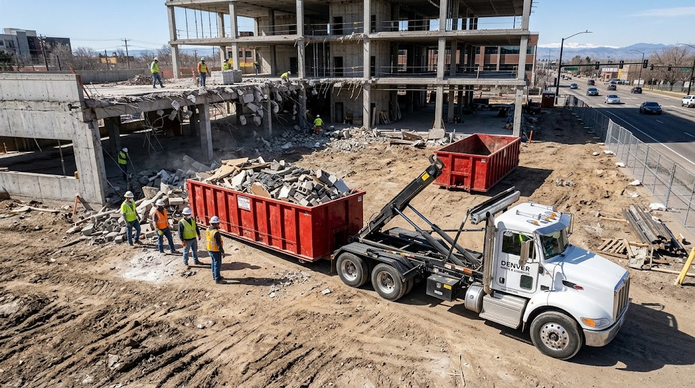

A demolition crew of six works through interior partitions on schedule until noon, when the container reaches its fill line. The swap is requested. The truck arrives at four. For most of an afternoon, six people move debris into staging piles rather than removing structure, and the piles have to be handled a second time the next morning.
The labor cost of that afternoon exceeds the container rental for the week. It shows up in the schedule rather than the disposal invoice, which is why it rarely gets attributed to waste logistics at all.
Debris Generation Is Not Steady
Demolition produces material in bursts tied to what is being removed.
Interior strip-out generates high volume at low density: drywall, ceiling grid, insulation, casework, flooring. The material fills containers rapidly and weighs relatively little.
Structural demolition inverts this. Concrete, masonry, and tile generate lower volume at high density, filling weight allowances before visible capacity.
Site work and excavation produce dirt and rubble that reach weight limits almost immediately, since soil and aggregate are among the heaviest material a container will hold.
A project moving through these phases has a debris profile that changes several times. Container sizing and swap frequency set at the start of a project against an average will be wrong during most of it.
Fill Rate Determines Swap Interval
The scheduling variable that matters is how many hours a crew of a given size takes to fill a container of a given size on the current work phase.
That number is knowable. A crew doing interior demolition fills containers at an observable rate, and after the first two or three swaps the interval becomes predictable within a few hours.
Once known, swaps can be scheduled ahead rather than requested at capacity. The difference is between a container arriving as the current one fills and a container arriving hours after work stopped.
The measurement is straightforward and almost never taken, because the person requesting the swap is generally the person who noticed the container was full.
Swap Requests Enter a Route
Container swaps are not dispatched individually on demand. They enter a hauler’s route schedule for the day, and the route is built from requests received before a cutoff.
A request made in the morning typically gets serviced that day, subject to route capacity and travel distance. A request made in the afternoon frequently gets serviced the following morning.
Providers handling construction debris container rental in Denver and similar markets operate routes covering substantial geographic areas, which means a same-day swap depends on where the site falls relative to the day’s existing route rather than on how urgently it is needed.
The practical consequence is that requesting a swap when a container is full guarantees downtime. Requesting it before the cutoff on the day before it fills does not.
Two Containers Cost Less Than Idle Crews
The standard arrangement places one container on site and swaps it when full. An alternative places two, allowing work to continue in one while the other is serviced.
The second container adds a rental line item. It also removes swap timing from the critical path entirely, since a crew never waits for a truck.
The comparison is a container rental against crew hours. On a project with a six-person crew, a single afternoon of stoppage represents roughly twenty-four labor hours. Whether the second container is justified depends on crew size and how often swaps occur.
Larger projects sometimes run three or more containers, separated by material type, which addresses both the timing problem and the sorting question simultaneously.
Separation Changes Disposal Cost
Mixed construction debris goes to a landfill and bills at the mixed rate. Separated material can go to recycling facilities, and some streams generate credit rather than cost.
Clean concrete and masonry are the clearest example. Crushed and recycled as aggregate, they carry lower disposal rates than mixed debris and in some markets are accepted at minimal cost.
Scrap metal has value. Copper, aluminum, and steel recovered from mechanical and electrical demolition can offset disposal expense, sometimes substantially on projects with significant mechanical systems.
Clean wood, cardboard, and gypsum have market-dependent disposal paths that generally price below mixed debris.
Separation requires containers dedicated to each stream and a crew disciplined about placement. On sites where separation is attempted with one container and good intentions, the result is contaminated material that bills as mixed.
Jurisdictional Diversion Requirements
Some municipalities require construction and demolition projects above a size threshold to divert a specified percentage of debris from landfill, with documentation submitted as a condition of permit closeout.
Where these requirements apply, separation is not optional and the documentation trail matters. Weight tickets showing material delivered to recycling facilities constitute the proof, which means the containers must be separated and the tickets retained from the start.
Retroactive compliance is not available. A project that mixed everything and landfilled it cannot produce diversion documentation after the fact.
Placement Constrains Everything
Container placement is decided early and affects the entire project.
A container needs truck access for delivery, service, and removal, which requires overhead clearance, approach room, and a surface that supports a loaded vehicle. Sites where the obvious placement location becomes inaccessible as work progresses generate expensive problems mid-project.
Distance from the work face determines haul time for every load of debris. A container placed for truck convenience but far from the building adds carrying distance to every trip a laborer makes, and those trips number in the hundreds.
Where the work face moves during a project, as it does on phased demolition, placement that worked in phase one may not work in phase three.
What Planning Requires
The information needed to sequence containers correctly is available before mobilization.
The material types each phase will produce, roughly how much, the crew size working each phase, the hauler’s route cutoff time, and the disposal or recycling rates for each stream.
From those, container sizing and swap intervals follow. The alternative is discovering the fill rate through experience, one full container and one idle afternoon at a time.