
Start With Your Outage Profile
The best home backup power system is the one matched to your situation, not the biggest one on the shelf. Before you compare products, answer three questions:
- How long do outages usually last where you live: an hour, a night or several days?
- What must keep running: communications, medical equipment, food storage, heating or cooling?
- Do you want to plug devices in directly, or power household circuits?
Your answers point to a size class. Short, occasional outages with a few critical devices call for a compact unit. Multi-day storms with a refrigerator, medical equipment and some comfort loads call for a larger one.
List Your Essential Loads
Write down what you will actually run, with its wattage and daily hours. The figures below come from the appliance list in OUPES’s runtime calculator, plus one assumption for the refrigerator.
| Load | Draw | Notes |
|---|---|---|
| Wi-Fi router | about 10 W | Stays on all day |
| CPAP machine | about 40 W | Overnight |
| Laptop | about 65 W | A few hours |
| 50-inch TV | about 105 W | Optional |
| Fan | about 75 W | Summer comfort |
| Refrigerator | about 100 W average | Compressor cycles; peaks near 330 W |
A minimal set (router, CPAP, phones and a refrigerator) averages about 170 W. Adding a laptop, lights and a fan pushes the average to 300 W or more. Heating and cooling loads, such as a space heater at about 1,500 W, change the plan entirely.
Capacity vs. Output: Two Different Questions
People often shop for a single number and miss that there are two.
- Output (watts) answers: can it run these devices at the same time? Add up what will be on together, then leave headroom for motor startup.
- Capacity (watt-hours) answers: for how long? Divide usable capacity, about 85 percent of the label, by the average draw.
Example: a 170 W essentials load running overnight for 10 hours needs about 1,700 Wh. That is within reach of a 2,048 Wh unit but beyond a 1,024 Wh unit if you want to keep the refrigerator going the next day as well.
Outage Length and Recharging
A short outage can be covered by a full battery. A multi-day outage needs a way to refill it. Look at the maximum solar input, AC charging speed and any alternator or car options. Fast charging also helps in a rolling-blackout situation, where power returns for an hour or two and you need to top up quickly.
Two habits help. Keep the unit full before storm season, and use any backup-reserve setting in the app so that scheduled use does not drain the battery you want for an outage.
Expandability
Needs change. A system you can grow protects your investment. The Mega 2 Pro, for example, expands to 10.24 kWh with B2 extra batteries. Always check which extra batteries a specific model supports, because they are not interchangeable across lines. If you do not expect to grow, a fixed-capacity unit can be lighter and cheaper.
Connection: Plug-In or Transfer Switch
There are two ways to connect.
- Plug-in: run an extension cord from the unit to your refrigerator, router and lamps. It needs no installation and works with any outlet-equipped unit.
- Transfer switch or inlet box: a licensed electrician connects the unit to your electrical panel so selected household circuits run on battery power. Some units are listed as transfer-switch ready, but you still need a professional installation and compliance with local code.
Never back-feed a house through a wall outlet. It is dangerous for you and for utility workers.
Safety, Noise and Placement
Battery systems have an advantage over fuel generators: no exhaust, so they can run indoors or in a garage. Still keep them in a dry, ventilated space away from heat sources. The Mega 2 Pro, for instance, lists an IP21 rating and a working range of 0 to 40 °C (32 to 104 °F), so avoid unheated sheds in winter and sealed hot garages in summer. Look for LiFePO4 chemistry, a battery management system and published safety certifications.
Two OUPES Options for Different Needs
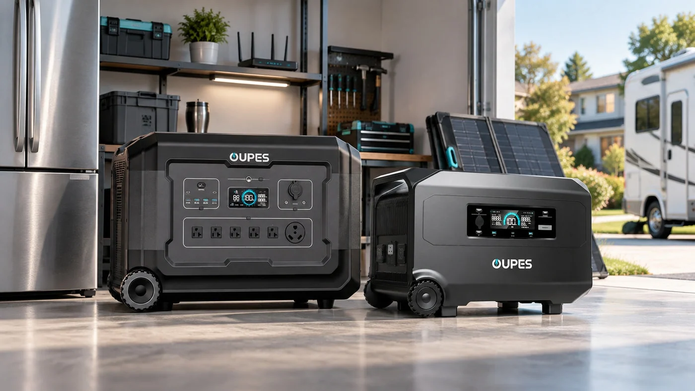
For short outages and critical devices. The OUPES Mega 1 Lite offers 1,024 Wh, a 2,000 W pure sine wave inverter with a 4,500 W surge and nine outputs. It weighs 26.8 lb, switches over in under 20 ms, and recharges in about 46 minutes on 1,400 W AC. It suits a router, a CPAP, a laptop and a refrigerator for several hours.
For overnight and day-long outages. The OUPES Mega 2 Pro offers 2,048 Wh, a 2,500 W inverter with a 3,600 W boost, up to 1,000 W of solar input, a 20 ms UPS and optional expansion to 10.24 kWh. At 48.8 lb it is heavier but covers more.
| Mega 1 Lite | Mega 2 Pro | |
|---|---|---|
| Capacity | 1,024 Wh | 2,048 Wh |
| Output | 2,000 W (4,500 W surge) | 2,500 W (3,600 W boost) |
| Max solar input | 800 W | 1,000 W |
| Weight | 26.8 lb | 48.8 lb |
| Standard warranty | 5 years (+1 with registration) | 5 years (+1 with registration) |
| List price at writing | $599 | $749 ( Sale price ) |
In runtime terms, a 170 W essentials load would last roughly five hours on the Mega 1 Lite and about ten hours on the Mega 2 Pro, before any solar help.
Although the Mega 1 Lite and Mega 2 Pro list UPS switchover times of under 20 ms and around 20 ms, respectively, these ratings alone do not guarantee that every CPAP machine or refrigerator will continue operating without interruption during a switchover. Compatibility depends on the specific device and its tolerance for brief power interruptions. Before relying on a power station for essential equipment, test the actual setup under realistic conditions and confirm the device manufacturer’s requirements. For medical equipment such as a CPAP, follow the manufacturer’s backup-power guidance.
Planning Your Budget
Budget by the job, not just the unit. Compare cost per watt-hour (about $0.58 for the Mega 1 Lite and about $0.37 for the Mega 2 Pro at the prices above) and add the extras you need: solar panels, extra batteries, cables and an electrician for a transfer switch. Prices change with promotions, so confirm them when you buy.
Visit OUPES for the current lineup and the brand’s runtime calculator.
FAQ
How much battery capacity do I need for home backup? Start with your essential loads and the outage length. A minimal setup for one night often needs about 1,500 to 2,000 Wh.
Do I need a transfer switch? Not for plug-in use. You need one, installed by a licensed electrician, to power household circuits.
Can I run a refrigerator and a CPAP on the same unit? Yes, provided the combined running wattage and refrigerator startup surge are within the power station’s limits. However, a UPS response time alone does not guarantee uninterrupted operation for every refrigerator or CPAP machine. Test your specific devices with the power station before relying on them during an outage, and follow the CPAP manufacturer’s backup-power recommendations.
Is it safe to use indoors? Battery power stations produce no exhaust, but they should be kept dry, ventilated and within their working temperature range.
Can I add more capacity later? Some models can, with the right extra batteries. Check compatibility before you buy.