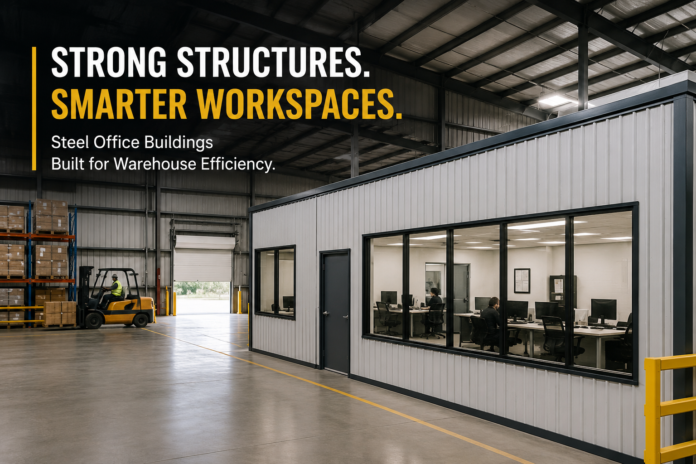

Warehouse operations sometimes require a practical office area that supports inventory management, employee coordination, and daily administration. Steel office buildings make that integration process far more efficient because they provide adaptable layouts, dependable structural support, and long-term functionality within industrial environments.
Modern metal office buildings also support streamlined warehouse planning by allowing office sections to fit naturally beside production, shipping, and storage zones. Their durable framing systems create usable interior space without unnecessary structural obstacles, which helps businesses maintain smoother operational flow throughout the facility.
Flexible Layouts Support Daily Warehouse Operations
Steel structures allow office areas to be designed around the exact needs of warehouse activity. Open-span framing creates more usable floor space for workstations, meeting rooms, dispatch counters, and staff areas without disrupting warehouse movement.
Businesses sometimes require office sections near receiving bays, storage aisles, or loading areas. Steel construction supports these practical layouts while maintaining clear separation between administrative and operational spaces.
Efficient Interior Planning
Well-planned office integration improves communication between warehouse teams and office staff. Steel framing allows straightforward placement of:
- Dispatch and logistics offices
- Employee break rooms
- Inventory control stations
- Administrative workspaces
- Customer service counters
Faster Construction Reduces Operational Delays
Warehouse expansion projects sometimes operate on strict timelines. Steel office buildings simplify integration because prefabricated components help speed up construction and reduce lengthy on-site adjustments.
Faster assembly allows warehouse facilities to continue operating with fewer interruptions during building additions or office expansions. This practical advantage helps businesses maintain shipping schedules, inventory management, and staff productivity throughout the project timeline.
Steel framing systems also support accurate installation because components are manufactured to precise measurements. That consistency helps simplify alignment between warehouse sections and attached office areas.
Durable Structures Improve Long-Term Performance
Warehouse environments experience constant activity from equipment movement, product handling, and changing temperatures. Steel buildings provide reliable structural durability that supports long-term office functionality within these demanding settings.
Properly engineered steel structures resist moisture damage, pests, and warping, which helps maintain stable office conditions over time. This reliability supports safer working environments for office employees operating inside industrial facilities.
In many warehouse projects, metal office buildings also allow for future interior modifications without major structural disruption. Businesses can expand office areas, add partitioned rooms, or reorganize workspace layouts as operational requirements change.
Clear-Span Design Creates Better Space Efficiency
Clear-span construction remains one of the most practical advantages for warehouse office integration. Steel framing systems reduce the need for interior support columns, which helps maximize floor efficiency throughout the building.
This design flexibility supports better traffic flow between the warehouse and office sections. Forklift routes, storage systems, and employee walkways can remain organized without awkward structural barriers affecting movement.
Better Integration for Multi-Use Facilities
Many industrial properties combine warehousing, administration, shipping, and customer interaction within a single structure. Steel construction supports this multi-use approach by allowing integrated layouts that remain functional and visually organized.
Key integration advantages include:
- Simplified warehouse-to-office access
- Consistent structural design across the facility
- Adaptable expansion opportunities
- Improved workflow coordination
- Efficient use of interior square footage
How Experienced Constructors Simplify Warehouse Office Integration
Experienced constructors simplify warehouse office integration through accurate planning, proper steel framing coordination, and efficient on-site execution. Their service-specific knowledge helps create practical office layouts inside active warehouse spaces while supporting safe installation, smoother workflow, and long-term building use.
Warehouse facilities sometimes evolve as storage demands and staffing requirements increase. Steel office buildings simplify integration because they support future planning without requiring entirely separate structures. Expandable layouts, durable framing, and adaptable interior configurations allow warehouse offices to grow alongside daily operations. This flexibility helps businesses maintain organised work environments while supporting long-term industrial efficiency.