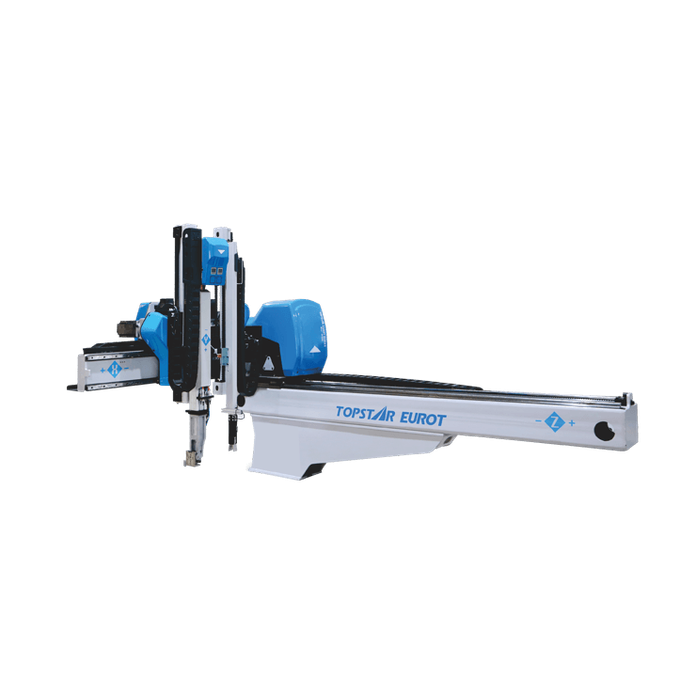

Deep-cavity molds are widely used in industries that require complex geometries, such as automotive housings, medical components, and precision enclosures. However, these molds pose unique challenges during part extraction challenges that traditional manual or semi-automated methods often struggle to overcome. The root of the problem lies in the geometry itself. Deep cavities restrict the space available for extraction tools, increase surface contact between the part and the mold, heighten the risk of vacuum adhesion and sticking, and make the process more susceptible to imbalances in ejection forces.
When operators rely on traditional methods or basic automation, various issues frequently arise. Parts may become deformed, scratched, or fail to demold smoothly. This is where advanced injection molding robots become indispensable. Unlike manual handling, Cartesian robot or linear robot enable controlled, repeatable, and precisely timed extraction operations. Rather than relying solely on brute force, they depend on coordination, timing control, and motion precision.
Injection Molding Robot Precision: Controlled Entry into Deep Cavities
One of the most critical steps in the deep-cavity extraction process is the robot’s entry into the mold. Any misalignment during this stage can result in damage to the part or a failed pick-up. High-performance injection molding robot address this challenge through precise positioning and controlled motion. Unlike manual tools—which rely on operator skill—linear robots can execute movements along a pre-programmed trajectory with a repeatability accuracy measured in microns. Key advantages include precise alignment with the cavity geometry, smooth insertion free from collision risks, and consistent positioning maintained throughout every cycle.
With deep-cavity molds, even a minute deviation can result in contact with the mold walls. Over time, this not only damages the parts but also accelerates mold wear. In contrast, Cartesian robots ensure that every entry into the mold follows the exact same path, thereby minimizing deviations. Furthermore, advanced robots can dynamically adjust their entry speed into the cavity. Decelerating as they approach the cavity reduces the risk of impact, while accelerating once outside the cavity helps maintain overall cycle efficiency.
Injection Molding Robot Gripping Systems: Safe Operation in Confined Spaces
Once inside the cavity, the next challenge is to securely grip the part without causing deformation. This step is particularly challenging because deep cavities typically limit the space available for the end effector (gripper). Injection molding robots overcome this limitation through specialized gripping systems designed specifically for confined environments. These systems may include slim-profile grippers suitable for narrow spaces, vacuum suction systems for delicate surfaces, and multi-point gripping mechanisms designed to distribute force evenly.
The key advantage of a Cartesian robot lies in its ability to position these tools with extreme precision. It ensures that the grippers engage the workpiece at the optimal angle, thereby minimizing stress and preventing damage. Furthermore, injection molding robots can dynamically adjust their gripping force based on the part’s temperature. For instance, a freshly molded part may still be hot and require gentle handling; the robot can adjust its grip force to keep the part stable and free from deformation.
Motion Control: Overcoming Vacuum and Adhesion Forces
Deep-cavity parts often exhibit strong adhesion to the mold surface. This phenomenon can be attributed to vacuum effects, material shrinkage, or surface friction. Simply applying greater force is not an effective solution; in fact, it often leads to part defects. High-performance injection molding robots address this challenge through advanced motion control strategies: controlling the pulling angle to minimize resistance, gradually accelerating to avoid sudden shocks, and executing synchronized movements to break the vacuum seal.
Unlike manual extraction, which may result in uneven force application, linear robots execute meticulously programmed motion sequences. For example, a robot might perform a slight lateral shift before lifting, thereby effectively breaking the vacuum seal. Additionally, injection molding robots can synchronize their movements with the mold’s ejector pin action. This coordinated effort ensures a smooth release of the part, minimizing the risk of sticking or tearing. Compared to Cartesian robots utilizing basic programming, advanced systems offer multi-step extraction routines tailored to specific mold conditions. This level of control is critical for maintaining part integrity in deep-cavity molding applications.
Maintaining Speed Without Sacrificing Performance
A common challenge in deep-cavity extraction is the inherent trade-off between precision and speed. While slower movements may enhance reliability, they can negatively impact the overall operational cycle time. Optimized injection molding robots eliminate this compromise by balancing both precision and efficiency. They achieve this through several methods: optimizing motion paths to minimize travel distances, executing parallel operations (such as simultaneous lifting and rotation), and reducing idle time between extraction and placement tasks. For instance, while extracting a part, the robot can simultaneously begin reorienting it in preparation for the subsequent process. This eliminates the need for subsequent repositioning during downstream operations. Unlike basic linear robots—which can only execute actions sequentially—advanced Cartesian robots integrate multiple actions into a single, fluid motion. This approach reduces overall cycle times without compromising extraction quality.
Coordination with Molds and Machine Systems
Efficient extraction from deep cavities requires seamless collaboration between the robot and the injection molding machine. Any deviation in timing could result in incomplete demolding or damage to parts. The injection molding robot integrates tightly with the following machine functions: mold opening and closing sequences, ejector pin timing, and the cooling and solidification phases. This integration ensures that the robot enters the mold cavity only when it is safe to do so, and withdraws before the start of the next cycle. It also enables precise synchronization with auxiliary systems, such as conveyor belts or inspection units.
Compared to standalone systems, integrated Cartesian robots can adapt to changing production conditions. For example, if cooling times change due to material adjustments, the robot can adjust its operational timing accordingly. Furthermore, advanced linear robot systems support various communication protocols, enabling real-time monitoring and optimization. This contributes to enhanced overall system reliability and reduced downtime. In a fully optimized production line, the robot no longer operates as an isolated unit. Still, it becomes an integral component of the molding process itself.
Long-Term Benefits for Complex Molding Applications
Advanced injection molding robots designed for deep-cavity molding applications deliver significant long-term benefits. While the initial setup may require meticulous planning, the return on investment becomes evident in improved efficiency and product quality. Key advantages include: reduced defect rates from consistent extraction; extended mold life by minimizing mechanical stress; lower labor costs and reduced reliance on manual intervention; and enhanced capability to handle complex, high-value components. Compared to traditional methods or basic linear robot systems, high-performance Cartesian robots offer superior flexibility and reliability, enabling them to adapt to evolving production demands while maintaining consistent performance.