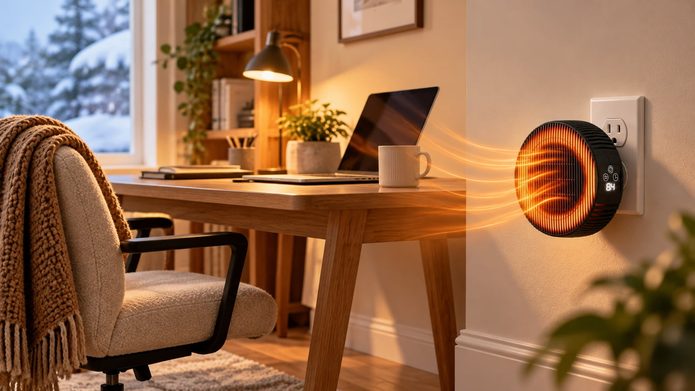

There are plenty of winter mornings when turning up the heat for the entire house feels unnecessary. Maybe you are working at a desk for a few hours, spending the evening in one bedroom, or using a small room that always feels colder than the rest of the home.
That is where a Portable Space Heater can make sense. It gives you another way to deal with a cold room without treating every heating problem as a whole-house problem.
The useful question is not whether a portable heater can produce heat. It is whether it fits the way you actually use the room.
When Is Supplemental Heating More Practical?
A portable heater is most useful when the cold is limited to a particular place or part of the day.
If the entire home is cold all the time, the main heating system or insulation may deserve more attention. But if one room is the problem, supplemental heat can be a much more focused response.
Home Offices Are a Good Example
Someone working from home may spend six or seven hours in one room while most of the house sits empty.
Raising the central thermostat just to make that office warmer can feel excessive. A small heater nearby gives you more control over that one space.
The same idea applies to a hobby room, reading corner, or spare bedroom that is only used occasionally.
Cold Spots Do Not Always Mean the Whole House Is Cold
Rooms beside garages, exterior walls, or large windows often feel cooler than interior rooms.
Even a few degrees of difference can be noticeable when you sit in the same place for a long time.
Before adding heat, it is worth checking for drafts or blocked vents. But once those obvious issues are ruled out, local heating may be the simplest answer.
What Should You Consider for a Bedroom?
A portable space heater for bedroom needs to fit into a room where people usually want steady warmth rather than a sudden blast of heat.
Bedrooms also bring a few practical concerns that matter less in other rooms.
Quiet Operation Becomes More Important at Night
A sound that goes unnoticed during the day can feel much louder when everything else is quiet.
If the heater uses a fan, pay attention to how much noise it makes at the settings you are likely to use most often.
There is no need to chase complete silence, but the heater should not make the room harder to relax in.
Controls Should Be Easy to Adjust
Nobody wants to get out of bed repeatedly because the room has become too warm or too cold.
Straightforward heat settings, thermostat control, and a timer can make bedroom use easier.
More buttons are not necessarily better. What matters is being able to set the heater without thinking too much about it.
Why Does Room Size Matter So Much?
A heater that works well in one room may feel disappointing in another.
The reason is simple: every room loses heat differently.
Small Rooms Can Still Be Hard to Warm
A small room with a drafty window may lose heat faster than a larger, better-insulated room.
That is why choosing a heater based only on square footage can be misleading.
You also need to think about:
- insulation
- windows
- exterior walls
- ceiling height
- door openings
- normal room temperature
These details help explain why two similar-looking rooms can need very different amounts of supplemental heat.
Bigger Is Not Automatically Better
It is easy to assume that more power is always safer as a choice.
In reality, a heater that is well matched to the room is usually easier to live with.
For a compact room, controllable heat is often more useful than maximum output.
What Makes a Small-Room Heater Practical?
A portable electric heater for small room should be easy to place without taking over the room.
This matters in bedrooms, apartments, dorm-style spaces, and small offices where floor area is already limited.
Placement Should Be Simple
The heater needs a stable position with open space around it.
If the only available spot is pressed against a curtain, wedged between furniture, or hidden under a desk full of cables, it is probably not a good spot.
It is better to choose a location first and then decide what size of heater actually fits there.
Moving It Should Not Feel Like a Chore
Portability matters most when you genuinely plan to move the heater.
You might use it beside a desk during the day and in another room in the evening.
A design that is awkward to carry will probably stay in one place, no matter how portable it looked on the product page.
Do Extra Features Really Matter?
Some features are genuinely useful. Others sound better on a specification sheet than they feel in everyday use.
For most people, the basics matter more.
Focus on Features You Will Use
Useful functions may include:
- adjustable heat settings
- thermostat control
- timer settings
- overheat protection
- tip-over protection where applicable
- clear controls
- easy portability
Think about your normal routine before deciding what matters.
If you only use the heater for an hour while working, a complicated program schedule may not matter. If you use it every evening, easy temperature adjustment probably will.
A Portable Space Heater Is Most Useful When the Heating Need Is Specific
Portable heating works best when you can clearly describe the problem.
One room feels cold. You use it for a few hours. You want extra warmth there without changing the temperature everywhere else.
That is a much better reason to use a portable heater than simply buying one because winter has arrived.
Start with the room, check for obvious heat loss, and then choose a heater that suits the space and your routine. When those pieces line up, supplemental heating becomes a practical part of everyday comfort rather than just another appliance taking up space.