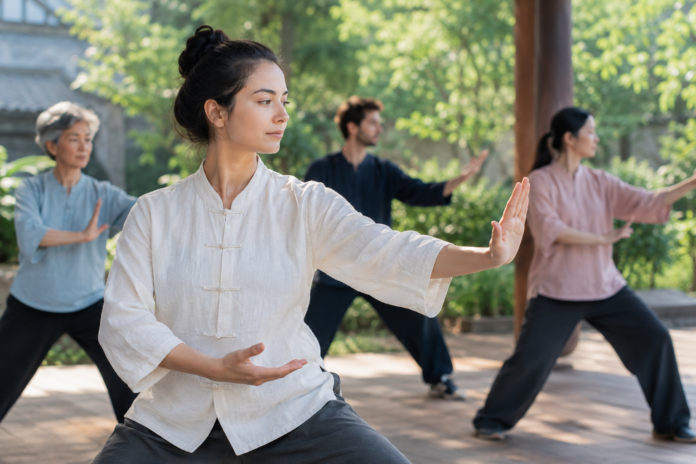

A first tai chi class can feel unfamiliar even if you have watched a demonstration or tried a few movements at home. You may be wondering whether you need to memorise a sequence, keep up with everyone else or arrive with special equipment. Usually, the more useful questions are practical: what will the session involve, how is it taught and will the setting work for you? A little preparation can make it easier to notice whether a class suits your needs without expecting to get everything right on day one.
Before booking, look beyond the class name
“Beginner” can describe several different experiences. One class might introduce a short sequence slowly, while another welcomes newcomers into a continuing group. Neither approach is automatically better, but the distinction affects what you can expect on arrival. Ask whether there is a set start date, whether new participants join at any time and whether the teacher explains movements as the group goes along. If a description mentions a particular style or program, ask what that means for someone with no prior experience.
A listing of tai chi classes for beginners can help you identify possible sessions, but it cannot tell you everything about the room, pace or teaching approach. Contact the organiser to confirm current details rather than relying on a listing alone. In Australia, a nearby class that fits around work, caring responsibilities or public transport may be easier to attend regularly than one whose description sounds ideal but whose timetable is difficult.
It is also worth asking what the advertised session includes. Is there an introductory conversation, a warm-up or time to ask questions? How long does the class run, and is there an opportunity to pause or sit down? These are reasonable questions for any newcomer, not requests for special treatment. If you have a health condition, a recent injury, concerns about balance or uncertainty about whether particular movements are appropriate, seek advice from a qualified health professional about your circumstances. A class organiser can explain the format, but should not be expected to assess your medical needs.
Details worth confirming ahead of time
- Access: Check for stairs, seating, toilets and the distance from parking or public transport if these affect your visit.
- What to wear: Ask about footwear and clothing so you can move comfortably without guessing at a dress code.
- Participation: Find out whether movements are generally taught standing, seated or with options, and how the teacher handles different levels of experience.
- Arrangements: Confirm the venue, session time, booking process and any payment or cancellation terms directly with the organiser.
On arrival, pay attention to the learning environment
Getting there a little early allows time to find the room and introduce yourself without interrupting a session. You need not give a detailed personal history. It is enough to say that you are new, ask where to stand and mention any practical concern you want the teacher to know about, such as needing a chair nearby. If you would rather discuss a health-related issue privately, ask for a suitable moment before class instead of raising it in front of the group.
During the session, observe how instructions are given. Can you see the teacher clearly? Are unfamiliar terms explained? Is there enough time to try a movement before the group moves on? Tai chi often involves shifting weight and coordinating movement with attention, so it may take time to follow a sequence. Missing a step does not, by itself, mean you have chosen the wrong class. What matters more is whether you feel able to ask for clarification and practise at a pace that is manageable for you.
Notice, too, how the class responds to differences between participants. People arrive with varied mobility, confidence and experience. A useful beginner setting leaves room for questions without making anyone feel that they must push through discomfort to keep up. If a movement causes pain, dizziness or another concerning symptom, stop and respond to what you are experiencing rather than trying to match the group. Seek appropriate medical advice where needed. General class instruction is not a substitute for individual healthcare guidance.
After the session, separate nerves from practical fit
It is easy to judge a new activity by whether you could remember the movements immediately. A more helpful review starts with what happened around the learning. Did the instructions make sense by the end of class? Could you follow enough to participate without feeling rushed? Did you have a chance to ask what you should focus on next time? You can enjoy the atmosphere and still decide that the location, timing or format is not workable.
Consider the ordinary logistics as well. Think about how you felt travelling to and from the venue, whether the class length suited your day and whether attending again would require an unrealistic rearrangement of other commitments. These details can matter more to an ongoing practice than an impressive first impression. If you are unsure, ask whether another introductory session is possible and what, if anything, a newcomer is expected to practise between classes.
You might jot down two or three observations while they are fresh: one thing you understood, one question you still have and one practical factor that would affect a return visit. That gives you something concrete to consider rather than relying on a vague feeling that you were either “good” or “bad” at tai chi. Learning a sequence takes time; choosing a class is a separate decision about instruction, access and fit.
A first session does not need to settle whether tai chi will become a lasting habit. Its value may simply be that you now know what the teaching feels like and what questions to ask next. Compare that experience with your own circumstances, and decide whether to return, try a different format or pause until you have the advice or arrangements you need.