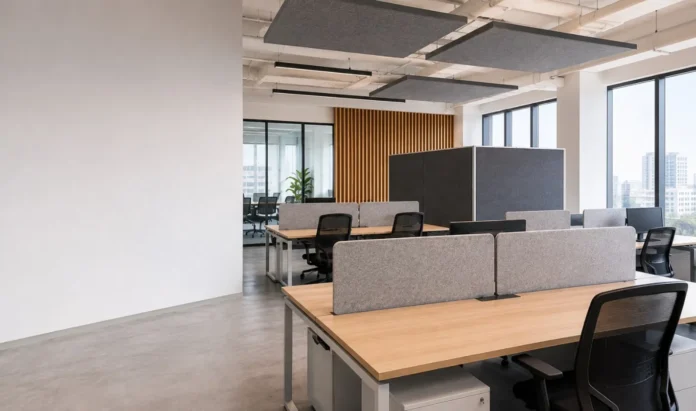

Most people working in an open-plan office have had the same experience. You sit down to focus on something, and within ten minutes you are listening to someone else’s phone call, a conversation happening three desks away, and the general hum of a room full of people trying to get things done.
It is exhausting in a way that is hard to explain. You are not being asked to do anything differently. The room just feels like it is working against you.
The frustrating part is that most open-plan offices are not noisier than they need to be because of the people in them. They are loud because of how they are built. Understanding that difference is the first step to doing something about it.
The Real Reason Open-Plan Offices Are So Loud
Sound needs somewhere to go. In a room with hard floors, bare walls, and a flat ceiling, it bounces. Every conversation, keyboard tap, and phone notification reflects off those surfaces and travels across the room before it finally fades.
Open-plan layouts make this worse because there is nothing in the way to slow sound down. No walls, no doors, no natural breaks. The bigger and more open the space, the further noise travels, and the longer it lingers.
What Noise Actually Does to a Workforce
This is not just about comfort. Research consistently shows that unwanted noise is one of the biggest drains on concentration and productivity in office environments.
When people are interrupted by noise, it does not just pause their focus. It takes several minutes to recover. In a busy office where distractions are constant, many people never get into the kind of focused work where they do their best thinking. There is a wellbeing side to this too. Working in persistent noise is mentally tiring, and people often leave at the end of the day feeling drained without quite knowing why.
What Actually Works and Why
The most important thing to understand about treating office noise is that you are not trying to block it. You are trying to absorb it. Blocking sound completely requires thick, airtight construction. Absorbing it simply means introducing materials that stop sound from bouncing. That distinction matters because it means you can make a real difference to how an office sounds without any building work at all.
Start at Desk Level With Acoustic Screens
Most noise in an open-plan office travels horizontally, which is why what happens at desk level matters so much. Acoustic screens placed between workstations interrupt that path and absorb a portion of the sound before it can travel.
They are not a total solution on their own, but they make a meaningful difference to the people closest to the noise source. In offices where desks are close together, and calls happen throughout the day, acoustic screens tend to be the most impactful first step.
Address the Ceiling With Acoustic Rafts
The ceiling is one of the most overlooked surfaces in any acoustic treatment plan. Sound rises, reflects off the ceiling, and comes back down across the room. Acoustic rafts hung horizontally from the ceiling intercept that reflected sound before it can travel.
Because they hang above the workspace rather than taking up floor or wall space, they are a practical option for offices that do not have room to spare. They also tend to work particularly well in rooms with high ceilings, where sound has more space to build before it eventually fades.
Used alongside acoustic screens at desk level, rafts treat the room from two directions at once, and most offices that combine both notice a more significant improvement than either achieves on its own.
Create Physical Breaks With an Office Partition Wall
If certain areas of your office generate more noise than others, a more defined separation can help contain it. An office partition wall does not need to be permanent or expensive. Freestanding options give you a solid visual and acoustic break between zones without touching the building itself.
This works well for separating a collaborative area from a quieter zone where focused work happens, or for giving a phone-heavy team their own contained space rather than letting call noise drift across the whole floor.
Where to Start if the Problem Feels Overwhelming
You do not need to treat the entire office at once. Start by identifying where the noise is coming from and who it is affecting most. Usually there is one team or one area that is the biggest source of disruption.
Fix that first. Get acoustic screens around the noisiest desks. If the room has a hard ceiling and a lot of echo, add a few rafts above the worst-affected area. Then see how it feels before doing anything else.
Most businesses are surprised by how much targeted treatment changes a space before they have even touched the rest of it. That first improvement usually makes the next steps much clearer.
Frequently Asked Questions
Will acoustic screens completely block out noise between desks?
Not completely. Acoustic screens absorb and reduce noise rather than block it entirely. They make a noticeable difference to sound travelling between workstations, but for full soundproofing you would need enclosed walls and doors.
How many acoustic rafts does a typical office need?
It depends on the room size and how much echo is present. Focusing rafts above the noisiest areas first is usually more effective than spacing them evenly across the whole ceiling. You can always add more once you see the difference.
Is an office partition wall difficult to install?
Freestanding office partition walls are straightforward to set up without specialist tools or contractors. Most can be moved and reconfigured by your own team, which makes them practical if your layout is likely to change.
Can these solutions work in a small office as well as a large one?
Yes. Smaller offices can actually benefit faster from acoustic treatment because there is less room for sound to disperse. Even one or two acoustic screens can noticeably change how a compact office feels.
How quickly can acoustic products be delivered across the UK?
Lead times vary by product and supplier. Many acoustic screens and partition options are available on short lead times or next-day delivery. It is worth checking the product page or contacting the supplier directly if you have a specific deadline.