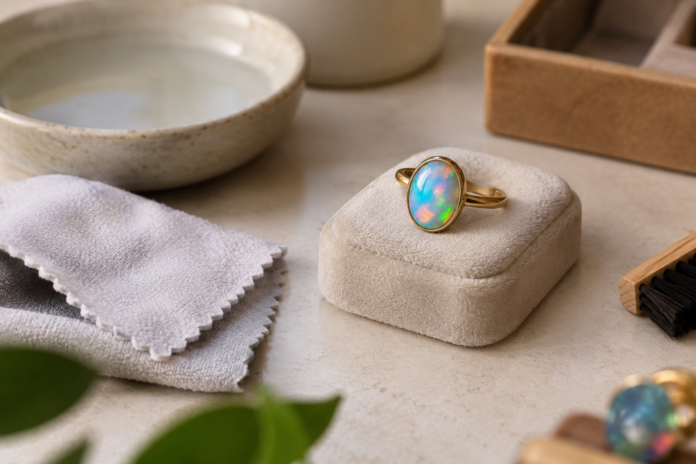

One person says to keep an opal away from water; another says a gentle wipe is fine. Both may be describing an experience with a different kind of opal. Advice also changes with the stone’s setting, previous repairs and how the piece is worn. For an Australian buyer or owner, the most useful approach is not to collect every care rule and follow the strictest one. It is to establish what you have, identify the risks that matter most, and ask for advice specific to the piece.
First priority: find out what the piece contains
“Opal” describes the gemstone, but it does not describe the whole item. A solid opal is a single piece of opal, while an assembled stone may combine opal with a backing or protective cap. Doublets and triplets are examples of assembled stones. Their layers and joins introduce considerations that may not apply in the same way to a solid stone.
Start with any invoice, description or earlier assessment. If it says “opal”, ask whether that means solid opal or an assembled stone. If you are unsure, avoid trying to identify layers by scratching, soaking or taking the piece apart. A jeweller or gemmologist can examine the item and explain what can and cannot be determined from its current condition.
Also ask whether the advice concerns the stone alone or the complete piece of jewellery. A cleaning method that seems mild for a loose stone may be unsuitable for a ring with a vulnerable setting, another gemstone or an older repair.
Next, clarify origin without turning it into a care rule
Origin can be relevant, but it is not a shortcut to a complete set of instructions. Australian opals and opals from elsewhere may be discussed differently because their properties and treatments can vary. Even so, a country name on a sales description cannot tell you everything about an individual stone’s construction, stability or history.
Ask what the seller or assessor knows about origin, how they know it, and whether the opal has been treated or assembled. It is reasonable to distinguish between a documented fact and a best estimate. If the answer is uncertain, care for the piece cautiously until someone qualified has examined it rather than relying on a general rule about stones from one location.
Put cleaning advice in the context of ordinary wear
Most owners need a safe routine for fingerprints and everyday grime, not an aggressive way to restore a badly affected stone. Before using a cleaner, ask which parts of the item it would contact and whether the person giving the advice has seen the actual piece. Be especially wary of blanket recommendations to use heat, prolonged soaking, ultrasonic equipment or harsh chemicals. These may create avoidable risks for an opal, its layers, its setting or other materials in the jewellery.
The different opals Australia produces do not all suit the same cleaning routine: the word opal alone cannot establish how a particular piece should be cleaned. A practical question is, “What is the least intensive way to remove normal surface dirt from this item?” Follow it with, “Should any part of it be kept dry, and what should I do if moisture reaches it?” Specific answers are more useful than a rule copied from another stone.
Do not assume that every change in appearance is dirt. A dull surface, a mark beneath a clear cap or a visible line at a join calls for a different conversation from an ordinary smudge. Trying stronger cleaning methods before identifying the cause can make the problem harder to assess.
Separate essential precautions from personal preferences
Some decisions are about avoiding damage; others are about how much inconvenience you are willing to accept. Storing jewellery so it does not rub against harder items is a sensible basic precaution. Choosing not to wear an opal ring during gardening, gym sessions or other hands-on activities is a practical way to reduce knocks, especially if the setting leaves the stone exposed. Wearing it only for special occasions is a preference, not a universal requirement.
Ask how the setting protects the stone and whether any claws, bezels or other components appear loose. Those questions matter as much as a debate over the opal’s origin. A pendant worn occasionally faces different everyday pressures from a ring worn daily, even if the stones are similar. Your routine should reflect the item you own and the activities you actually do.
Know when to pause rather than try another remedy
If the stone becomes loose, develops a new visible crack, shows a change between layers or changes appearance unexpectedly, stop wearing the piece until it can be assessed. Describe what happened, including any recent impact, cleaning or exposure to moisture or heat. That history may help a professional evaluate the problem, although it may not reveal a single clear cause.
Before agreeing to cleaning or repair, ask what the proposed work involves, what outcome is realistic and whether it could affect the stone’s appearance. For a sentimental item, you may value preserving its current character over making it look newly polished. Clarifying that preference in advance is better than assuming everyone means the same thing by “restore”.
Keep the answer with the jewellery
Once you have advice tailored to the piece, keep a short record alongside its description or receipt. Note whether it is solid or assembled, any known treatments or repairs, the suggested everyday cleaning approach and signs that should prompt reassessment. If an important detail remains uncertain, record that too. Good opal care is less about memorising one universal instruction than knowing which questions have been answered for your stone—and which still need an expert look.