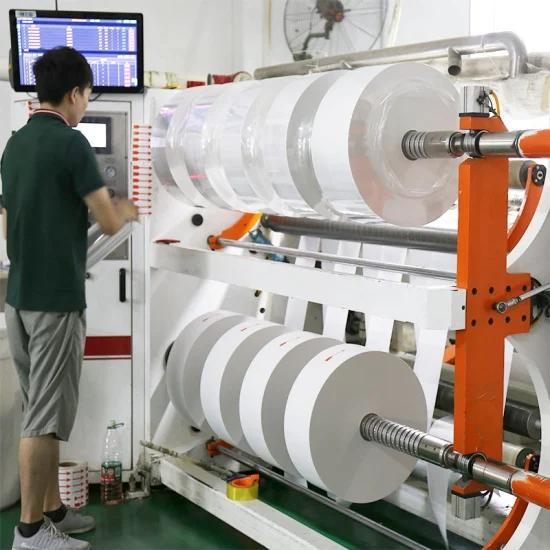

A thermal label roll telescopes when inner layers shift sideways and form a cone or stepped edge. Uneven unwinding includes loose wraps, tight bands, dishing, wandering edges, and sudden changes in web tension. The main causes are poor rewind alignment, incorrect winding tension, weak or distorted cores, uneven material thickness, temperature changes, and impact during transport.
Do not force a telescoped roll back into shape and expect reliable printing. The shifted layers may have damaged edges, changed tension, or exposed adhesive. Separate shipping damage from manufacturing defects, preserve the roll condition, and test whether the web can unwind straight without rubbing or pulling sideways.
What Is Roll Telescoping?
Telescoping occurs when successive layers move laterally relative to the core. A small shift may make one roll face convex and the other concave. Severe movement creates a cone that no longer fits the printer or sits flat in its carton. The web may then steer toward one side as it unwinds.
Measure the maximum side displacement and note whether the core moved with the web. Photograph both roll faces, the carton, and any crushed packaging. If several rolls show the same direction and amount of shift, the pattern may point to rewind alignment or pallet orientation rather than an isolated impact.
How Does Winding Tension Cause the Problem?
A roll needs enough tension to remain stable, but too much tension can compress the construction, deform the core, squeeze adhesive, and create hard bands. Too little tension allows layers to slip during handling and acceleration. Tension that changes abruptly across the roll produces alternating tight and loose zones.
Converters should control tension as roll diameter increases and use suitable taper tension rather than a single uncontrolled setting. The required profile depends on facestock, liner, adhesive, width, core, and roll diameter. A thin film liner behaves differently from a thicker paper liner under the same winding force.
Can Poor Alignment Create Uneven Rolls?
Yes. If the web enters the rewinder at an angle or the core is not square to the shaft, each layer can move slightly sideways. Misaligned slit edges, worn guides, uneven nip pressure, and a core that is wider or narrower than specified can add to the shift.
The finished roll should have reasonably flat, parallel faces and the web should be centered on the core as specified. Edge tapping may improve appearance temporarily but does not correct internal tracking. A roll that was forced square can return to a telescoped shape during storage or unwinding.
How Do Core Problems Affect Roll Shape?
A crushed, oval, soft, or moisture-damaged core cannot support a uniform roll. The web may be tight on one side and loose on the other. A core with rough edges can catch a holder, while an incorrect width can let the roll move laterally between guides.
Inspect the core opening before loading. It should be round, clean, and free of delamination. Confirm the wall strength is appropriate for roll weight and shipping. Large industrial rolls generally need a more rigid core than short desktop rolls, even when both use the same inside diameter.
Can Temperature and Humidity Tighten a Roll?
Paper components change dimensions with moisture. High humidity can make a paper liner or face swell, increasing internal pressure and altering roll hardness. Heat can soften adhesive and encourage edge ooze, while low humidity can dry the paper and increase static. Rapid changes create uneven movement across the roll.
Keep thermal labels wrapped and boxed until needed. Store them upright in the orientation recommended by the supplier, away from concrete floors, direct sun, heaters, and loading doors. Allow sealed rolls to acclimate to the print area before opening, especially after winter or refrigerated transport.
How Does Shipping Damage Appear?
A dropped carton may produce a flattened roll, cracked core, offset layers, or edge dents. Pallet overhang and excessive stacking can load one side of the carton. Vibration can loosen a poorly restrained roll and let it strike the box repeatedly.
Use cartons that support the roll without crushing it, with dividers or end pads where needed. Large or heavy rolls may need individual suspension or vertical support. Inspect cartons before acceptance and record damage immediately. Do not mix visibly damaged rolls into production before their condition is documented.
What Problems Occur in the Printer?
An uneven roll can rub the printer wall, bind on the holder, steer against a guide, or vary the load on the drive roller. The result may be skewed printing, registration drift, wrinkles, liner breaks, premature label peeling, or inconsistent print darkness caused by changing web contact.
If a printer works with an approved roll but fails with a telescoped roll, keep printer settings unchanged while comparing the media. Changing darkness, pressure, or calibration may hide the physical problem and create new issues when a correctly wound roll is loaded.
What Should Be Checked During a Complaint?
- Record lot number, roll position in the carton, storage conditions, core condition, roll diameter, and maximum side shift.
- Unwind several meters by hand and note tight spots, loose wraps, adhesive ooze, edge damage, and lateral web movement.
- Compare unopened rolls from the same lot and a known-good lot on the same printer without changing settings.
Retain the carton, core, and affected roll. A short strip alone cannot show whether the root cause was winding, core strength, packing, or transport.
How Should the Supplier Control Roll Quality?
A reliable label supplier should control slit alignment, rewind tension, roll hardness, edge quality, core dimensions, and final packing. Inspection should cover both roll faces, outside diameter, width, and free unwinding. Production records should connect the finished roll to material and converting lots.
Define acceptable roll-face variation and handling requirements before production. Test a full roll from its largest diameter to the core at normal printer speed. Approve the order only when the web tracks consistently, the core remains stable, and roll changes can be performed without reshaping or forcing the media.