Three organisational failure modes account for most of the shortfall — and the minority that succeed share a recognisable shape. Almost none of it is about the technology.
| QUICK ANSWERAround 70% of digital transformations fall short of their goals, and almost never because the technology failed. They stall for three organisational reasons: no measurable definition of success, ownership handed to IT when the change is a business one, and people left out of a change being done to them. The successful minority define outcomes in numbers first, put business leadership in charge, fund the human side properly, and deliver value in stages they can measure. |
Companies have spent more than a decade and trillions of dollars on digital transformation. Most of it hasn’t worked.
The number that should stop any executive is this: research consistently puts the share of digital transformations that fail to reach their goals at around 70%, with only about 30% delivering what they set out to. That’s not a rounding error on an emerging technology. It’s a decade-long pattern of well-funded, well-intentioned programs stalling out — and the striking part is why they stall. It’s almost never the technology.
The failures trace back to the same handful of organizational causes over and over: no clear definition of what success looks like, culture and change resistance the program never addressed, and treating transformation as an IT project when it’s really a business one. Understanding those failure modes is the whole game, because they’re preventable once you can see them coming. Here’s what actually derails these programs, and what the successful minority do differently.
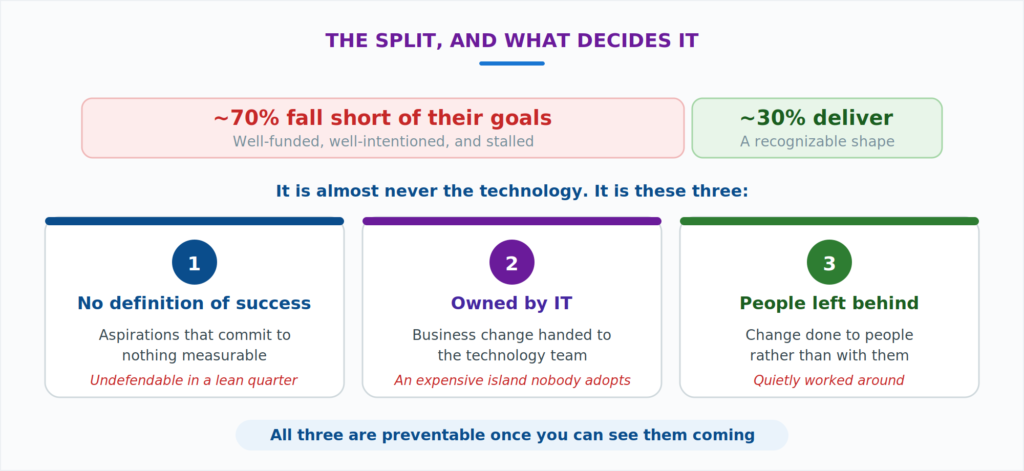
A decade-long pattern with organisational roots. Each cause is visible in advance, and preventable.
Failure one: “go digital” is not a goal
Aspirations that commit to nothing, and the numbers that replace them
The most common reason transformations stall is that nobody defined what winning looks like.
Initiatives launch with aspirations like “improve efficiency” or “become digital-first” — phrases that sound like objectives but commit to nothing measurable. When there’s no concrete target, teams can’t tell whether they’re succeeding, leadership can’t see progress, and the program drifts until someone cuts its budget in a lean quarter. A goal you can’t measure is a goal you can’t defend, and undefendable programs are the first to die.
The fix is unglamorous: define outcome-driven targets tied to real business value before anything is built. Not “modernize the platform” but “cut order-processing time from three days to one.” Not “improve customer experience” but “reduce support resolution time by 30%.” When the outcome is specific and measurable, the program has something to steer by and something to point to when the CFO asks what the money bought.
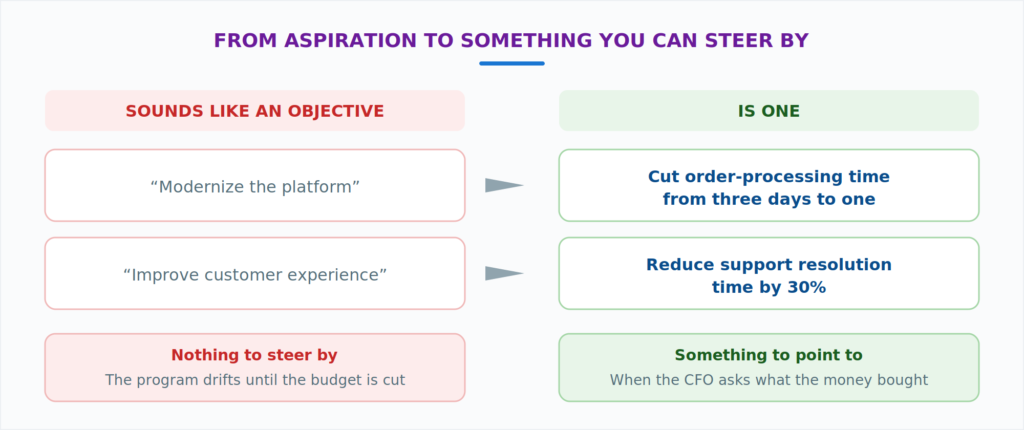
The same intent, stated two ways. Only one of them survives a budget review.
Failure two: treating it as an IT project
Business, process and culture change that happens to involve technology
This is the trap that sinks technically excellent programs.
Digital transformation gets handed to the technology team, a platform gets built, and then everyone is surprised when the organization doesn’t change. But transformation is business, process, and culture change that happens to involve technology — not technology change that happens to involve the business. The tech is usually the easy part. Getting people to work differently is the hard part, and it’s the part that lives outside IT’s authority.
Programs that succeed are owned at the business level, with technology as an enabler rather than the point. The systems that keep transformations running well also depend on solid foundations underneath — clean, connected, trustworthy data being chief among them, which is why serious data engineering services so often sit quietly behind a transformation that actually delivers. But the ownership has to be business-led, or the technology just becomes an expensive island nobody adopts.
Failure three: ignoring the people
The barrier research keeps naming, and budgets keep underfunding
Culture is the barrier that research keeps naming as dominant, and it’s the one budgets keep underfunding.
You can deploy flawless technology and still fail if the people expected to use it weren’t brought along — not trained, not consulted, not given a reason to change how they already work. Resistance isn’t irrational; it’s what happens when change is done to people rather than with them. Yet organizations routinely pour money into tools and allocate almost nothing to the change management that determines whether those tools get used.
The successful minority invest in the human side deliberately: bringing affected teams in early, explaining the why and not just the what, and treating adoption as a metric that matters as much as deployment. Change the organization does is durable. Change that happens to the organization gets quietly worked around.
The four failure modes, side by side
| FAILURE MODE | WHAT IT LOOKS LIKE | WHAT THE 30% DO INSTEAD |
|---|---|---|
| Vague goal | Aspirations that sound like objectives but commit to nothing measurable | Outcome-driven targets tied to real business value, set before anything is built |
| IT ownership | A platform gets built and the organisation does not change | Business-level ownership, with technology as the enabler rather than the point |
| People ignored | Money into tools, almost nothing into whether they get used | Teams brought in early, told the why, with adoption treated as a real metric |
| One big push | A multi-year bet that is obsolete before it lands | Stages that each deliver visible, measurable value |
What the successful 30% do differently
Four habits shared by the programmes that actually deliver
Strip away the specifics and the programs that work share a recognizable shape.
They start with a clear, measurable business outcome rather than a technology wish. They put business leadership in charge and use technology to serve the goal instead of leading with it. They invest seriously in the people side — communication, training, adoption — rather than treating it as an afterthought. And they sequence the work into stages that each deliver visible value, instead of betting everything on one enormous multi-year push that’s obsolete before it lands. Well-run digital transformation services are essentially disciplined about exactly these habits: outcome first, people alongside the technology, value delivered in stages you can measure.
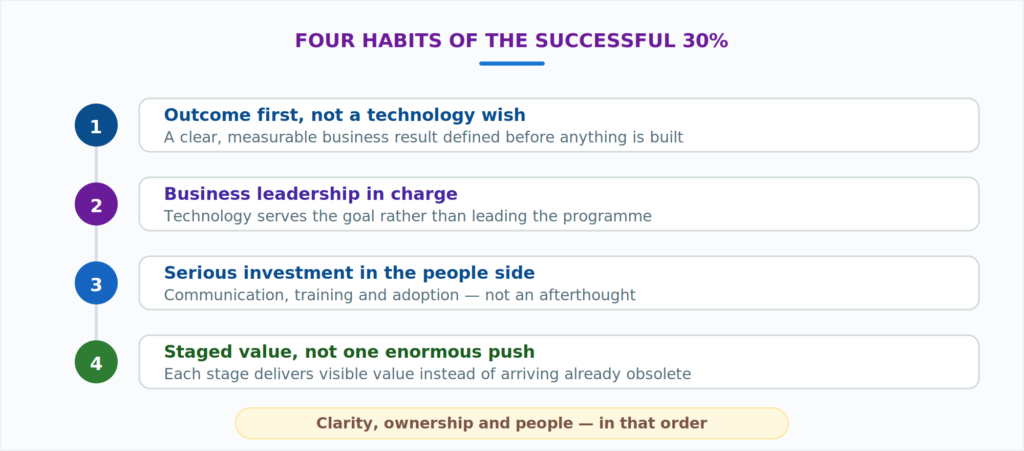
Strip away the specifics and the same four habits appear in the programmes that work.
Conclusion
What to fix, in the order that matters
Digital transformation fails around 70% of the time, and almost never because the technology didn’t work. It fails because the goal was vague, the effort was treated as IT’s problem, or the people were left behind. Define what success looks like in numbers, own it at the business level, invest in the humans who have to change, and deliver value in stages you can measure.
The technology has never been the hard part. Keeping a transformation moving is about clarity, ownership, and people — and the companies that understand that are the ones in the 30% who get their money’s worth.
| KEY TAKEAWAYS | |
| 1 | Around 70% fall short — and almost never because the technology failed |
| 2 | Replace aspirations with numbers: three days to one, not “modernize the platform” |
| 3 | Own it at the business level; technology enables the goal, it is not the goal |
| 4 | Fund the change management, and deliver value in stages you can measure |
Frequently asked questions
Why do most digital transformation projects fail?
Rarely for technical reasons. The recurring causes are organisational: no clear definition of what success looks like, culture and change resistance the programme never addressed, and treating transformation as an IT project when it is really a business one. The technology is usually the easy part; getting people to work differently is the hard part.
What percentage of digital transformations succeed?
Research consistently puts the share reaching their goals at roughly 30%, with around 70% falling short. The figure is widely cited from consulting research, and while the exact number varies by study and by how success is defined, the broad pattern of most programmes underdelivering has held for more than a decade.
How should digital transformation goals be defined?
As outcomes tied to real business value, in numbers, before anything is built. Not “modernize the platform” but “cut order-processing time from three days to one.” Not “improve customer experience” but “reduce support resolution time by 30%.” A goal that cannot be measured cannot be defended, and undefendable programmes are the first to lose their budget.
Who should own a digital transformation programme?
Business leadership, not the technology function. Transformation is business, process and culture change that happens to involve technology, rather than technology change that happens to involve the business. When it is handed to IT, a platform gets built and the organisation carries on as before, leaving an expensive system nobody adopts.
Why does change management matter so much in digital transformation?
Because flawless technology still fails if the people expected to use it were not trained, consulted, or given a reason to change how they already work. Resistance is what happens when change is done to people rather than with them. Organisations routinely fund the tools generously and the adoption work barely at all, which is what decides whether the tools get used.
| ONE QUESTION TO ASK ON MONDAYTake your current transformation programme and try to state its goal as a number with a deadline attached. If the best anyone can manage is a phrase like “become digital-first”, the programme has no way to prove its worth when the next lean quarter arrives — and that is a problem to fix before any more of the budget is spent. |