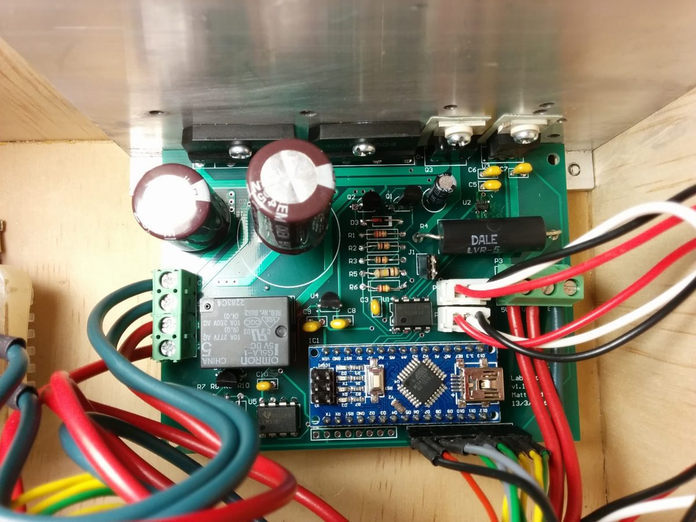

A power conversion module can inch its way toward a finished design on nothing more than the most basic prototype-test-revise loop.
Round one: the team sends the design files to a prototype assembly partner, who runs DFM (design for manufacturability) checks, builds the boards, and delivers them on schedule. Samples in hand, the team runs its own efficiency-curve and thermal-rise measurements, revises the design based on the data, and moves on to the next round. The process is clear, executable, and every step has a clear owner.
Then the power density goes up.
Thermal design around the power inductor and MOSFET gets a lot more sensitive. The efficiency curve starts showing fluctuations at certain load ranges that aren’t easy to explain at a glance. Placement accuracy on a key current-sense component starts becoming a variable that actually affects control-loop performance. The prototype assembly partner still delivers samples on time. The team still tests carefully and analyzes carefully. The problem shows up in the space between all of that: nobody is systematically connecting the design perspective with the manufacturing perspective.
For this kind of project, simply speeding up prototype turnaround tends to hit diminishing returns. What’s actually missing is getting the prototype assembly partner’s process expertise systematically woven into design decisions and test-data interpretation — which is exactly what helped compress a project from a planned 5 rounds down to 3, on a high-power-density DC-DC converter module we supported for a power electronics company.
Why a Standard Prototype Workflow Quietly Turns Into a Pile of Information Silos
A small, structurally simple board can get by on informal coordination — the design team draws it up, the prototype partner builds it as specified, the team reviews the test data itself, and fixes whatever’s wrong. That works because there just aren’t that many connections that need to be made.
But once a product’s electrical performance requirements get complicated — efficiency, thermal rise, ripple, metrics that need repeated real-world measurement and tuning — the number of connections that need to be made grows faster than any single system on its own. That gives rise to a category of work that rarely shows up on a formal deliverable list:
Deciding whether an experience-based suggestion from the prototype assembly partner is worth folding into the formal design input Connecting an anomaly in the test data back to actual solder quality or placement accuracy Whether anyone proactively flags that a critical current-sense component needs tighter placement-tolerance requirements in the design Getting the prototype assembly partner to understand the project’s iteration history, rather than treating every round as an isolated task
Each item looks minor on its own. Together, they form the layer that determines whether a prototype iteration cycle converges efficiently or not. A project can have competent process engineers, reliable test equipment, and a complete simulation workflow, and still run far more iteration rounds than expected purely because this layer of coordination is missing.
When a Project Overruns Its Planned Iteration Rounds, the Problem Rarely Announces Itself
An iteration count creeping up rarely gets recognized in the form of “we need deeper collaboration here.” It usually shows up as recurring, seemingly unrelated friction.
Thermal performance falls short of expectations, but only gets caught once the first round of samples has already been fully tested — not before. An efficiency curve shows a fluctuation at a certain load range, gets filed by default under “the design itself has a flaw,” and the team starts adjusting the topology or compensation parameters, without realizing the actual root cause might just be a slight placement offset on a sense resistor. That kind of offset sits well within normal placement tolerance and isn’t a manufacturing defect on its own — but it can end up completely outside the field of view during root-cause troubleshooting.
Prototype delivery can stay perfectly on time the whole while. That distinction matters: prototype assembly itself is built to complete a clearly defined production task. Whether each round of prototyping carries higher information density — pointing more precisely to what actually needs to change next — is a separate thing that somebody has to actively make happen.
Breaking Down Round One: Is DFM Feedback a Formality, or Part of the Design Input?
When this project submitted its first round of prototypes, the team followed the usual process and sent the design files to our team for standard DFM review. Beyond checking basic routing rules and manufacturability, our process engineer specifically flagged a concrete optimization for the thermal via layout around the core power inductor and power MOSFET — the original design’s thermal via density and placement met basic manufacturability requirements, but based on experience with similar high-power-density power products, that layout likely wouldn’t provide adequate thermal conduction path for that power device.
Once that suggestion was raised, who decides whether it’s worth adopting? Does it get filed under “a formality manufacturability comment,” attention limited to whether there’s a hard issue that would outright fail production — or does it get evaluated seriously as an experience-based, performance-relevant piece of constructive input? This project’s team chose the latter, and adjusted the design accordingly before the first round of prototypes was even built.
In hindsight, this was the first key move that reduced the number of iteration rounds the project ultimately needed. Without that adjustment, the team likely would have discovered the underwhelming thermal performance only after measuring the first round of samples, triggering an entire additional round dedicated specifically to fixing the thermal issue. A solution doesn’t adopt itself — somebody always has to actively decide whether it’s worth folding into the design.
Breaking Down Round Two: Whose Perspective Governs the Test-Data Interpretation?
After the first round of prototypes was completed and the team had real measurement data, our process engineer was invited to join the joint analysis meeting on that round’s test results. The team shared the measured efficiency curve and thermal-rise data — thermal performance had improved from the round-one thermal-via optimization, but was still slightly above the ideal target, and the efficiency curve showed an unexpected fluctuation at a specific load range.
Drawing on knowledge of the board’s actual assembly condition — solder quality, real component placement accuracy — our process engineer offered an observation that wasn’t obvious from the design team’s internal vantage point: the fluctuation range on the efficiency curve happened to correlate with a slight placement offset on a specific current-sense resistor. That offset was within normal placement tolerance, but it could still be affecting the current path around that resistor, and by extension, the related control-loop performance.
That observation reframed a problem that could easily have been misdiagnosed as “a flaw in the design itself” into a much more specific and solvable one: “these kinds of critical sense components need tighter placement-tolerance requirements built into the design.” The design team’s simulation lens can confirm circuit logic is sound, but it can’t necessarily catch a variable like placement tolerance that only shows up in actual manufacturing. The prototype assembly partner’s process-side view filled exactly that gap. Each side is competent within its own scope — but somebody still has to actively connect the two perspectives for a problem to get pinned down precisely, rather than misdiagnosed and sent down an unnecessary iteration path.
Breaking Down Round Three: Turning Precise Information Into Design Convergence
With the precise information accumulated across the first two rounds — the thermal optimization from DFM and the placement-accuracy insight from test-data interpretation — the team made a targeted adjustment in round three: further fine-tuning the thermal vias and tightening the placement-tolerance requirement for the critical sense components. After that round of prototypes, both the efficiency curve and thermal-rise performance hit the team’s final targets. The design converged and finalized in that round, without needing the fourth or fifth rounds originally planned.
There’s an easy-to-overlook precondition here, though: process-experience judgment doesn’t turn itself into a design optimization. The thermal-via suggestion, the placement-offset insight — both needed someone to translate them into a concrete design action: deciding whether to adopt it, how to adjust it, and whether the change needed to be re-validated against simulation. That translation step is what actually determines whether an iteration count can be compressed or not.
Standard Service and High-Information-Density Collaboration Are Fundamentally Different Kinds of Investment
A prototype assembly partner can deliver a complete, professional standard service: build to the file, run basic DFM checks, deliver samples on time. Nothing wrong with that work on its own. But if a team wants to compress its iteration count, what it needs to proactively pursue is a different kind of investment — turning the partner’s process feedback and the team’s own test-data interpretation into genuine information exchange, rather than two independent lines of work.
A few specific things help build that:
Don’t treat DFM review as a box-checking formality. Ask the prototype assembly partner’s process engineer directly whether, based on experience with similar products, they see any constructive optimization worth suggesting for the current design — even if it falls outside the strict question of “can this be built.” It’s worth taking seriously.
After every round of test data comes in, proactively invite the prototype assembly partner’s process engineer into the team’s test-data analysis discussion — especially when the results show an anomaly that’s hard to fully explain from a pure circuit-design perspective.
Build a continuous working relationship with your prototype assembly partner, rather than switching vendors every round. Continuity lets them understand the product’s design intent and iteration history in real depth, making their feedback more targeted and consistent over time. For power projects involving multilayer boards, staying with the same multilayer pcb manufacturer over the long term is especially valuable — it cuts down on having to re-explain the stack-up structure and thermal considerations from scratch every round.
At project kickoff, communicate the expected iteration cadence and key performance targets clearly with the prototype assembly partner, so they understand the project’s context up front — rather than treating each round of prototyping as an isolated task with no context attached.
Deeper Collaboration Doesn’t Mean Paying More or Switching to a Pricier Supplier
Recognizing this gap in collaboration doesn’t mean a team needs to immediately upgrade to some kind of premium service tier.
Some prototype assembly partners with a mature customer-service model treat this kind of collaboration as part of their standard service, especially for customers with an ongoing working relationship. In other cases, this level of technical collaboration might require additional coordination or a corresponding service fee. That needs to be clarified up front, at the start of the partnership — rather than assuming “a pricier supplier automatically means deeper collaboration.”
Even a team with strong signal-integrity or power-integrity expertise still gets real value from manufacturing- and assembly-side input, because that information often covers execution details a design file simply can’t capture on its own — something a pure design-simulation perspective can’t substitute for. Service tier and price are secondary; information density is what actually determines iteration efficiency.
Prototype Iteration Cadence Needs to Be Designed Deliberately, Not Left to Chance
A product’s prototype iteration cycle rarely stretches out because of one dramatic mistake. What actually happens is complexity accumulating quietly: one more thermal path that needs recalculating, one more easily-overlooked placement-tolerance variable, one more round of test-data interpretation that “doesn’t look like a big deal” but ends up dragging out the overall timeline.
Eventually, an informal working style that relies purely on the team’s own trial and error stops scaling.
The effective response is to build a collaboration mechanism between the design team and the prototype assembly partner before this kind of information gap becomes a permanent drag on the project. Standard prototype delivery still plays an irreplaceable role, and more complex performance tuning genuinely does require deeper technical judgment — but between the two sits a layer of work that matters just as much: making every round of prototyping carry higher information density, so it’s clearer what actually needs to change next. Once a project deliberately builds out that layer, its dependence on trial-and-error by the team alone, vendors each working in their own lane, and ad hoc coordination whenever a problem falls through the cracks, drops noticeably.