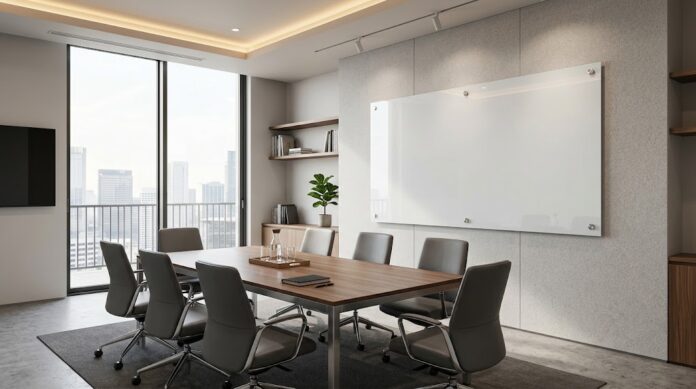

A conference room whiteboard looks fine for about eighteen months. Then the ghosting starts: faint grey shapes of old diagrams that will not wipe off, a permanent-marker incident someone tried to fix with solvent, a dull patch where the coating has worn through from repeated use in the same spot.
The board still works. It just looks like it has been worked on, which in a room where clients sit is not neutral.
Melamine surfaces are porous. Ink penetrates the coating, and once it does, no cleaning product reverses it. Glass has no coating to penetrate.
Non-Porous Is The Whole Argument
A glass writing surface is a sheet of glass. Marker ink sits on top of it and comes off completely with a dry cloth, indefinitely.
There is no coating to wear through, which means the surface does not degrade with use. A heavily used glass board looks the same after five years as after five weeks. A heavily used melamine board does not, and the difference is why glass ends up cheaper over a reasonable service life despite the higher initial cost.
Permanent marker comes off glass too, with solvent. On melamine it usually does not, which is the failure that retires most whiteboards early.
The surface is also hygienic in the way any non-porous material is, which matters in shared rooms and healthcare settings where the board gets handled constantly.
Back Painting And Why Low Iron Matters
Glass boards are back painted: the color goes on the rear face and is viewed through the glass thickness.
That protects the color completely. Nothing touches the paint, so it cannot scuff, fade from cleaning, or wear at the edges the way a surface-applied finish does.
It also means the color reads with depth rather than flatly, because there is a layer of glass in front of it.
The specification detail that matters is glass type. Standard float glass carries a green tint from its iron content, which is visible across pale colors and obvious at the edges. On a white board that tint shifts the color toward green, noticeably.
Low-iron glass is near-colorless and renders the paint accurately. For any white or pale board, it is the correct specification, and the difference between the two is not subtle when they sit side by side.
Color Choice Is A Functional Decision
White is the default and it is not always the right answer.
A custom glass dry erase board can be back painted to any color, which means the board can match a brand palette, coordinate with the room, or disappear into a wall rather than interrupting it.
Dark boards, in charcoal or deep tones, read as architectural rather than as office equipment. They work well in client-facing rooms and in open-plan areas where a white rectangle would dominate. Marker contrast is lower on dark surfaces, so they suit rooms where the board is used occasionally rather than constantly.
Colored boards matched to a brand turn up in agency and studio environments, where the board is part of the room’s identity.
The trade with any non-white surface is legibility. Black marker on white is the highest contrast available, and anything else reduces it. For a room where people write small and read from the back, white remains the practical choice.
Magnetic Or Not
Glass is not magnetic, so magnetic function requires a steel backing layer laminated behind the glass.
That adds weight, thickness, and cost, and it constrains the glass options slightly. It also changes the mounting requirement, since a magnetic board is substantially heavier than a plain one.
Magnet strength is lower through glass than on a steel board, because the magnet is working across the glass thickness. Standard fridge magnets underperform; rare-earth magnets are usually needed, and that is worth mentioning to whoever will use the room rather than letting them discover it.
For rooms where nothing is ever pinned up, the non-magnetic version is lighter, cheaper, and adequate.
Frameless Mounting And Wall Requirements
Most glass boards mount frameless, standing slightly off the wall on concealed standoffs. The shadow gap that creates is part of the appearance, and it reads considerably better than a framed board.
The weight is the practical issue. Toughened glass at typical board thickness is heavy, and a large board with a magnetic backing is heavier still. Standoff fixings transfer that load into whatever is behind the wall surface.
Plasterboard without blocking will not hold a large board reliably. Blocking, or fixings specified for the actual weight into structure behind, is the requirement, and it needs establishing before the wall is finished rather than after.
Edge treatment matters at close range. Polished edges on a frameless board are what make it read as a finished piece rather than as a cut sheet.
The glass should be toughened. A board is at head height in an occupied room and is subject to impact; annealed glass in that position is a hazard.
Size, Format, And Wall-Scale Applications
Custom fabrication means the board fits the wall rather than the wall accommodating a stock size.
Full-wall installations run multiple panels across an entire elevation, turning a wall into a writing surface. Panel joints are the consideration: they are visible and they interrupt writing, so their placement should be deliberate rather than driven by material yield.
Long horizontal formats suit collaborative spaces where several people work at once. Tall vertical formats suit narrow walls and circulation areas.
Sizing against the room matters more than maximizing area. A board that runs to the ceiling has a top section nobody can reach, and a board that starts too low has a bottom section nobody can read from a seated position at the back.
Practical Points Before Ordering
Toughened glass, not annealed, given the location.
Low-iron glass for any white or pale color.
Magnetic backing decided upfront, since it cannot be added later and it changes the mounting requirement.
Wall construction confirmed as capable of carrying the finished weight.
Panel joint positions agreed for multi-panel installations.
Lead time accounted for, since custom-sized back-painted glass is made to order and cannot be trimmed on site.
The reason glass boards are specified is not that they write better. It is that in three years they still look like the day they went in, which a melamine board does not.