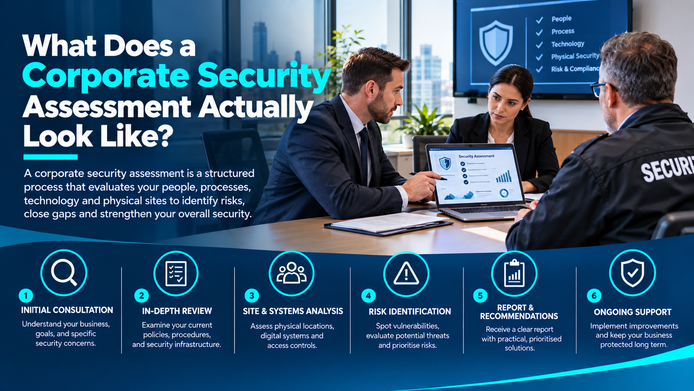

“Security assessment” is a phrase that gets used loosely, and many businesses sign up for one without a clear idea of what they’ll actually receive at the end of it. A proper corporate security assessment isn’t a checklist ticked off in twenty minutes — it’s a structured review of how people, property, and information move through your workplace, and where that movement creates risk.
Reviewing Access Control First
The assessment typically starts with how people get into the building. Who has keys, fobs, or access codes, and is that list current or does it still include former employees? Assessors look at whether visitor access is logged and supervised, whether after-hours access is genuinely restricted, and whether shared entry points — like a loading dock used by multiple tenants — create gaps that a single-tenant building wouldn’t have.
Physical Site Walkthrough
An assessor will physically walk the site, much like a warehouse audit but focused on office and workplace-specific risks: reception area design and sightlines, whether sensitive areas like server rooms or executive offices are properly secured, fire exit compliance, and whether emergency lighting and signage meet current standards. Parking areas and after-hours entry points are reviewed with particular attention, since these are common locations for incidents involving staff safety.
Evaluating Existing Security Systems
If you already have CCTV, alarms, or access control in place, the assessment reviews whether these systems are actually doing their job — camera placement and coverage, alarm zoning, and whether monitoring is live or simply recorded footage nobody reviews unless there’s already been an incident. It’s common for businesses to discover systems installed years ago that no longer reflect how the space is actually used.
Looking at Staff Safety Procedures
A thorough assessment goes beyond physical infrastructure to review procedures: how staff are trained to handle an intruder, what the protocol is for a lone employee working late, and whether there’s a clear reporting path when something feels off but doesn’t rise to the level of an emergency call. These procedural gaps are often more consequential than physical ones, because even excellent security infrastructure fails if staff don’t know how to use it.
Assessing Risk by Business Type
The specific risks assessed shift depending on the nature of the business. A professional services firm handling confidential client data has different priorities to a business with cash handling on site, or one storing valuable equipment overnight. A generic assessment template applied to every business type tends to miss the risks that actually matter for yours.
The Deliverable: What You Should Receive
At the end of a proper assessment, you should receive a written report — not just a verbal summary — that ranks identified risks by severity and likelihood, and pairs each one with a practical recommendation. Vague findings like “improve lighting” aren’t useful; a good report specifies where, why, and roughly what it would take to fix it.
How Long a Proper Assessment Should Take
Business owners are often surprised by how much time a genuine assessment requires. A single-floor office with straightforward access might be reviewed in half a day, while a multi-tenant building, a site with shift work, or a business handling cash or sensitive data can take considerably longer once you factor in staff interviews and a review of past incident records. Be wary of any provider offering a “comprehensive assessment” in under an hour — that’s typically a sales visit with an assessment label attached, not the structured review described above.
Involving Staff, Not Just Management
One detail that separates a thorough assessment from a superficial one is whether frontline staff are actually consulted. Reception staff, cleaners, and anyone who works after hours often know about practical security gaps that never make it to management — a fire door regularly propped open for a smoke break, a shared code that’s never been changed since three employees ago, or a stairwell that feels unsafe late at night. An assessor who only speaks to management is likely to miss exactly the kind of everyday workarounds that create real vulnerabilities.
How Findings Should Be Prioritised
Not every finding in an assessment report carries equal weight, and a good report should make that clear rather than presenting a flat list. Findings are typically ranked by combining how likely an incident is with how severe the consequences would be if it happened — a rarely-used side door with a faulty lock might be lower priority than a main entry point with weak access control, even if both appear on the list. This kind of prioritisation is what turns an assessment into an actual action plan rather than a document that sits in a drawer.
Revisiting the Assessment Over Time
A security assessment shouldn’t be treated as a one-off exercise. Office layouts change, staff turnover affects who has access to what, and businesses that have grown since their last assessment often carry blind spots that didn’t exist when the original review was done. Many businesses find it useful to schedule a lighter follow-up review annually, with a full reassessment every few years or after any significant change — a office relocation, a merger, or a shift to more flexible working arrangements that changes who’s in the building and when.
Why This Is Worth Doing Before You Sign a Security Contract
Many businesses skip straight to hiring guards or installing cameras without ever mapping their actual vulnerabilities first, which often means paying for coverage in the wrong places while real gaps go unaddressed. Alfa Security begins its corporate and office security services engagements with exactly this kind of on-site assessment, so that whatever guarding, access control, or monitoring follows is built around the specific risks a business actually faces — not a generic package.
A proper assessment takes a few hours of a business’s time but can reshape years of security spending, which is what makes it worth insisting on before any contract is signed.