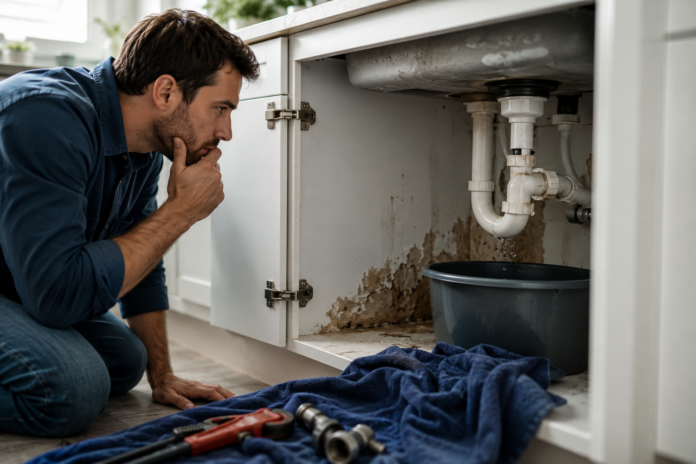

Most plumbing disasters do not start with a bang. They start with a slow drip under the sink you keep meaning to look at, or a water bill that crept up $30 and you blamed on a long vacation. By the time something dramatic happens — a soaked subfloor, a flooded utility room, a water heater that quit overnight — the damage was weeks or months in the making.
The good news is that your home almost always gives you signals first. You just need to know what you’re looking at. This guide walks through the most common warning signs, tells you which ones you can watch and which ones need a professional today, and gives you a simple framework to tell the difference.
The “Silent vs. Loud” Problem Framework
Before getting into specific symptoms, here’s a way to think about plumbing problems that actually holds up in real life. Every issue falls into one of two categories: Silent Problems and Loud Problems.
A Loud Problem announces itself. Water is on the floor. Nothing comes out of the faucet. The hot water is ice cold. These are urgent and obvious. A Silent Problem, by contrast, runs in the background. A pinhole leak behind drywall. A toilet that runs for 10 seconds after each flush. A water heater working twice as hard because of sediment buildup you cannot see.
Silent Problems cost more over time, almost without exception. They compound. The leak becomes mold. The sediment becomes a failed heating element. The slightly slow drain becomes a full blockage that backs up into the house. Loud Problems feel worse in the moment, but they are easier to catch. Your job as a homeowner is to go hunting for Silent Problems before they turn into Loud ones.
Your Water Bill Is Telling You Something
Pull up the last three months of water bills right now. Seriously. A sudden increase — or a slow upward drift with no change in household habits — is one of the most reliable early signals that something is leaking somewhere you cannot see.
According to the U.S. Environmental Protection Agency, the average household’s leaks can account for more than 9,300 gallons of water wasted every year, and nine percent of homes have leaks that waste 50 gallons or more per day. That volume adds up fast on a monthly bill, and a lot of it is happening through problems as simple as a worn toilet flapper or a slightly loose supply line connection.
If your bill jumped and there’s no obvious explanation, check every toilet first. Drop food coloring into the tank and do not flush. If color shows up in the bowl within 15 minutes without flushing, the flapper is leaking. That’s a $10 fix. If the toilet passes and the bill is still high, the leak is somewhere else — and that’s when you call someone in to do a proper inspection.
Slow Drains Are Rarely Just About Hair
A slow drain in one fixture? Probably a local clog. A slow drain in two or more fixtures at the same time? That’s a different conversation. Multiple slow drains usually point to a partial blockage further down the main line, or an early-stage issue with the drain-waste-vent system.
Here’s the scenario that trips people up most often: the kitchen sink starts draining slowly, so you pour drain cleaner down it and it temporarily improves. Six weeks later the same thing happens. You do it again. Three months later, the bathroom tub is now slow too. What started as a localized grease buildup is now a partial blockage migrating toward the main line, and the drain cleaner masked the symptom without addressing the cause.
Two slow drains at the same time is the threshold. Below that, try a drain snake first. At or above it, get a camera inspection done. A good plumber can scope the drain, show you exactly what’s happening, and tell you whether you need a cleaning or something more serious.
Water Heater Warning Signs You Shouldn’t Sit On
The water heater is where homeowners tend to procrastinate the hardest, and it’s one of the most expensive mistakes in residential plumbing. There’s a specific pattern that plays out constantly: the homeowner notices lukewarm water, hits the reset button on the water heater, and it fixes the problem for a few days. They do this four or five times over two months. Then the unit fails completely over a holiday weekend, and now it’s an emergency call, an emergency rate, and a scramble to install a new unit fast rather than at a planned time.
If you’re hitting that reset button more than once, the unit is telling you it’s in decline. Other signs to take seriously: a metallic or sulfur smell in the hot water, popping or rumbling sounds from the tank (that’s sediment hardening on the heating elements), visible rust on the tank or water connections, and water pooling near the base.
Water heating is not a minor energy category in a home. According to the U.S. Energy Information Administration’s Residential Energy Consumption Survey, space heating and water heating collectively accounted for 62 percent of household energy consumption, with water heating ranking as the second-largest energy-consuming end use in U.S. homes. An aging, sediment-heavy water heater is running harder than it should to hit the same temperature, and that inefficiency shows up on your utility bill every single month before the unit ever fails outright.
A tank unit older than ten years deserves a professional assessment, not another reset. That’s not a scare tactic — it’s just the math on lifecycle costs.
Low Water Pressure Across Multiple Fixtures
Pressure dropping at one showerhead? Probably a clogged aerator. Remove it, clean it, done. But when pressure drops across the whole house — multiple faucets, the shower, even outside hose bibs — you’re looking at something systemic. That means the main supply line, a pressure regulator that’s failing, or in older homes, galvanized steel pipes that have corroded from the inside out until the interior diameter is a fraction of what it was when installed.
Galvanized pipe is worth mentioning specifically because it doesn’t fail dramatically. It just slowly delivers less and less water, and the homeowner adjusts. Showers get a little weaker. The dishwasher takes longer. You stop running two things at once because the pressure just isn’t there. If your home was built before 1980 and you’ve never had the supply lines replaced, that’s the first thing a plumber will want to look at.
A Practical Checklist: What to Inspect Every Six Months
Most plumbing problems that become emergencies were visible months earlier to anyone who looked. Here’s what a six-month walkthrough should cover:
- Check under every sink cabinet for moisture, staining, or soft wood on the cabinet floor
- Look at the water heater for corrosion at the connections and any water marks on the floor beneath it
- Test every toilet with the food-coloring method described above
- Compare your current water bill to the same month from the prior year
- Run all faucets and check for pressure drops when two run at once
- Look at any visible pipe sections in the basement or utility room for corrosion, discoloration, or mineral deposits at joints
If your home is older or you’ve never had a plumbing inspection done, this walkthrough alone will not catch everything. Hidden slab leaks, corroded supply lines behind walls, and drain line deterioration require professional equipment. Working with qualified Plumbing Services Tulsa, OK, means getting a thorough inspection that starts at the root cause rather than just treating whatever symptom you called about — which is the only kind of inspection that actually saves you money long term.
When to Call Immediately vs. Watch for a Week
| Symptom | What It Likely Means | Call Now or Watch? |
| One slow drain | Local clog | Watch — try a snake first |
| Two or more slow drains | Main line partial blockage | Call within 48 hours |
| Water heater reset needed repeatedly | Failing element or thermostat | Call — unit is in decline |
| Whole-house low pressure | Main line, regulator, or pipe corrosion | Call — inspection needed |
| Unexplained bill increase | Hidden leak somewhere in system | Call if toilet test is clear |
| Visible pipe corrosion | Aging supply lines | Call — do not wait |
| Water pooling under water heater | Tank failure | Call immediately |
“Silent household water leaks are among the most underestimated drivers of both utility costs and structural damage in residential properties. Regular inspection is the single most effective prevention measure available to homeowners.” — Consensus position of the EPA WaterSense program, reflected in their annual Fix a Leak Week advisory guidance.
Your plumbing is one of those systems that rewards attention and punishes neglect with almost perfect consistency. The homeowners who never face a catastrophic water event are not lucky — they’re the ones who looked under the sink last March and made the call when something felt off. Start there.
Also Read: Signs Your Home’s Plumbing and HVAC Systems Are Overdue for a Checkup