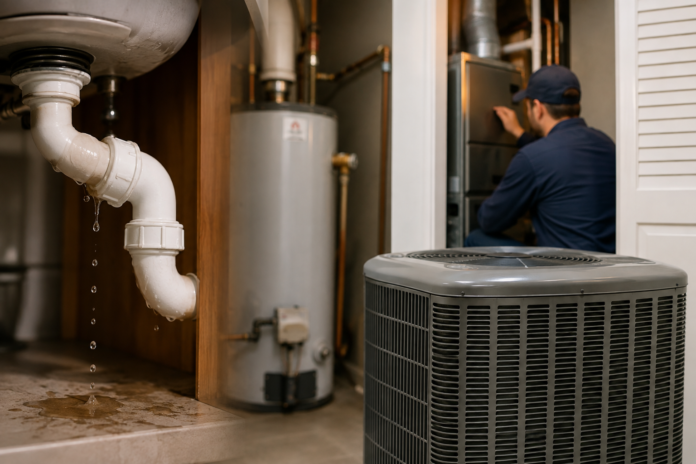

Forty-two years. That’s the median age of an owner-occupied home in the United States right now. Most of the mechanical systems inside those walls were never meant to run this long without a serious look. Yet most homeowners do exactly that until something soaks the ceiling or stops blowing cold air in August.
The good news: your plumbing and HVAC systems almost always telegraph trouble before they fail completely. You just have to know what to look for. This piece covers the honest warning signs worth taking seriously, the ones that are just background noise, and how to build a maintenance rhythm that keeps you ahead of the repair bill rather than reacting to it.
Why Aging Housing Stock Changes Your Risk Calculus
This is not an abstract concern. According to the National Association of Home Builders’ March 2026 analysis of 2024 American Community Survey data, the median age of owner-occupied homes has climbed to 42 years old, up from just 31 years in 2005. Nearly half of all owner-occupied homes are now at least 45 years old.
That matters because most mechanical systems have hard lifespans. A furnace installed in 1992 is operating well past its prime. A water heater from 2010 is living on borrowed time. Copper supply lines from a 1979 build have been flexing through temperature cycles for nearly five decades. None of those facts show up on your utility bill until something breaks.
The mental model most homeowners use, “if it’s working, it’s fine,” works great for furniture and badly for systems with failure modes that compound over time.
Plumbing: The Four Warning Signals Worth Acting On
Not every drip is a crisis. But these four signals are genuinely worth a phone call to a pro rather than a YouTube tutorial.
- Water pressure that changed on its own. If your shower felt strong two years ago and now it doesn’t, and you haven’t touched a fixture, you’ve got mineral buildup, a corroding supply line, or a pressure regulator going out. None of those fix themselves.
- Slow drains in more than one room simultaneously. One slow drain is a clog. Two or three slow drains at the same time usually point to a problem in the main stack or sewer line, which is a different job entirely.
- Water stains on ceilings or walls with no visible source. These almost always indicate a slow leak inside the structure. The longer you wait, the more drywall and potentially framing you’re paying to replace.
- A water heater that’s more than a decade old. ENERGY STAR’s guidance is direct on this: a water heater 10 years old or older is likely “heating water inconsistently, or worse, going to fail and flood your home,” according to the U.S. Department of Energy’s ENERGY STAR program. Visible corrosion around the water lines, rust-tinged hot water, or any moisture pooling near the base are each a reason to stop waiting.
The water heater one deserves extra attention. It sits in your basement or garage doing quiet, continuous work, and most people ignore it completely until the morning they step into a cold shower or find standing water. Proactive replacement on your schedule costs far less than an emergency call on the hottest Friday in July.
HVAC: What Normal Wear Looks Like vs. What Needs Attention
Your heating and cooling system will always make some noise and always lose a little efficiency over time. That’s expected. What you’re watching for are the signs that put it outside normal decay:
Uneven temperatures between rooms that weren’t there two years ago. A functioning system with clean ductwork and balanced airflow should heat and cool relatively evenly. When one bedroom is always cold and the living room is always hot, you’re looking at duct leakage, a failing zone damper, or a refrigerant issue, not just “old house quirks.”
Short cycling is the HVAC version of a car engine that keeps stalling. The system runs for a few minutes, shuts off, runs again. Every startup burns more energy and puts more wear on the compressor than a full cycle would. Left unchecked, it turns a tune-up situation into a compressor replacement.
Bills that jumped with no corresponding behavior change. If your household hasn’t added people or appliances, and your energy costs climbed 20% or more year-over-year, your system is working harder to do the same job. That’s a diagnostic conversation, not a “just how it is” situation.
The DASH Framework: A Simple Self-Assessment for Any Season
Here’s a framework I find genuinely useful, and one no homeowner should have to read a 40-page manual to apply. Run through it twice a year, once before heating season and once before cooling season. Call it the DASH check:
| Letter | Stands For | What to Actually Check | Action If Off |
| D | Drains | All drains draining freely, no odors from sewer gas | Snake or pro assessment |
| A | Air Filter | HVAC filter condition, date last replaced | Replace if over 90 days old |
| S | Supply Lines | Visible pipes, water heater connections, shut-off valves turning freely | Call a plumber for corrosion or stiffness |
| H | Hot Water | Water heater age, temperature consistency, any moisture near base | Schedule inspection if over 8 years old |
It takes about 15 minutes and catches 80% of developing problems before they become emergencies. No tools required.
A Concrete Scenario: The 1987 Colonial
Picture a home built in 1987 in central Pennsylvania. Original copper plumbing throughout, a gas furnace replaced in 2008, and a water heater nobody remembers installing. On a March morning, the homeowner notices the hot water takes three minutes longer than it used to. A month later, a ceiling stain appears in the first-floor bathroom, directly below the master bath above. Separately, the furnace has started short cycling three times before settling into a full run.
None of those events, taken alone, seems catastrophic. Together, they’re a home telling you it needs attention across multiple systems at once. Scheduling a single comprehensive visit from a qualified local contractor to address all three at once is almost always cheaper than three emergency calls spread across six months.
Homeowners in South Central Pennsylvania who want that kind of coordinated look at their systems often turn to Plumbing & Heating Services in Mechanicsburg, PA, for precisely this reason: one contractor who understands both the plumbing and the HVAC side means nothing falls through the diagnostic cracks.
When to Call vs. When to Watch
Not every symptom demands a same-day call. Here’s an honest breakdown:
- Call today: No hot water, active leak, water near the electrical panel, HVAC not responding at all in extreme temperatures, sewage odor inside the home.
- Schedule within the week: Inconsistent hot water, one slow drain, unusual HVAC noises that started recently, a water heater over 10 years old.
- Monitor and note: Slightly higher energy bills than last year, a drain that’s just a little slower than usual, a furnace that’s noisy on startup but quiets within 30 seconds.
The “monitor and note” category is where most homeowners get into trouble. Monitoring without follow-through just means you have better documentation of when things went wrong.
The Maintenance Rhythm That Actually Works
Annual HVAC tune-ups and a plumbing inspection every two to three years will catch the vast majority of developing issues before they become expensive ones. The homeowners who skip these visits aren’t saving money. They’re deferring costs into larger, less predictable ones.
Your home is probably older than you think its systems are. Check the DASH items this weekend. Find out how old your water heater actually is. And if the answer surprises you, that’s your sign.
Also Read: What Homeowners Should Check Each Season: HVAC, Plumbing, and Electrical Essentials