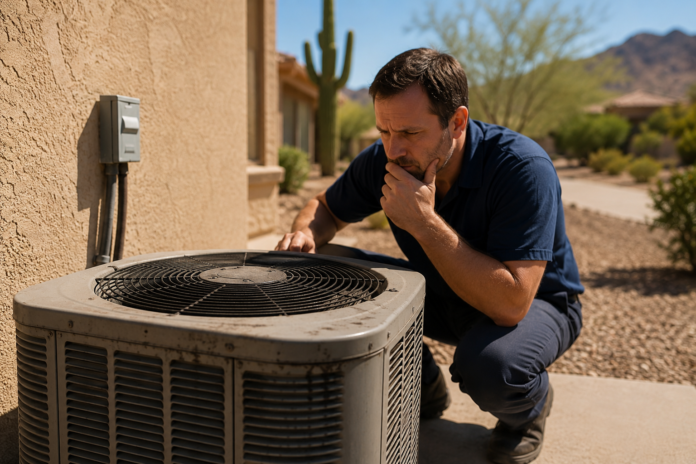

Your air conditioner will tell you it’s dying. Most homeowners just aren’t listening until it quits on a 112-degree July afternoon. In Arizona, that’s not an inconvenience; it’s genuinely dangerous, and the repair bill gets a lot steeper when you’re booking an emergency appointment during peak season. Catching these signals early is the difference between a quick fix and a full replacement you didn’t budget for.
Why Arizona ACs Wear Out Faster Than You’d Expect
An AC in Ohio runs maybe four months a year. In the Phoenix metro and communities like Carefree and Cave Creek, that same system runs nonstop from April through October — sometimes beyond. That’s a fundamentally different workload, and it shortens the realistic lifespan of your equipment considerably.
You should generally plan to replace your air conditioner every 15 to 20 years. But that estimate assumes moderate climate and consistent maintenance. Without maintenance, an AC unit’s lifespan may be reduced to 10 to 12 years; neglect leads to dirty coils and strained compressors, causing the system to fail years earlier than a well-maintained unit. In Arizona’s desert heat, that decay happens on an accelerated schedule.
According to data from the National Energy Assistance Directors Association, which uses electricity prices from the Energy Information Administration and temperature forecasts from NOAA, Arizonans are projected to pay an estimated $1,060 for electricity between June and September this year, as reported by the Phoenix New Times in July 2026. That figure makes Arizona the only state in the country projected to top four digits in summer cooling expenses. A failing AC that runs inefficiently pushes that number even higher.
The 7 Signs You Shouldn’t Ignore
These signals show up weeks or months before full failure. Pay attention to all of them, not just the dramatic ones.
- Warm air from the vents. If your system is running but the air coming out feels tepid, you’re likely looking at a refrigerant issue, a failing compressor, or a frozen evaporator coil. None of those get better on their own.
- Strange noises. Grinding, banging, or high-pitched squealing are all mechanical distress signals. A well-functioning system should be relatively quiet. Rattling can mean a loose component; grinding almost always points to bearing failure.
- Moisture or pooling water around the unit. Some condensation is normal. Actual puddles or ice forming on the unit are not. Refrigerant leaks and blocked drain lines both show up this way.
- Rooms that won’t cool evenly. If the living room hits your target temperature but the bedrooms stay five degrees warmer, your system is struggling to distribute air properly. This can indicate duct problems, a weak blower motor, or a unit that’s simply undersized for how you’re using the space.
- Short cycling. An AC that clicks on and off every few minutes without completing a full cooling cycle is overworking its compressor. Short cycling burns through components fast.
- Spike in your electric bill with no change in usage. If your bill climbed significantly but your habits haven’t changed, your AC is working harder than it should be to produce the same output. Efficiency loss is one of the earliest and most consistent failure predictors.
- The system is over ten years old and needs a major repair. Age alone isn’t disqualifying, but age combined with a costly repair quote changes the math entirely.
The 3-Strike Rule: A Framework for Deciding What to Do Next
Here’s a framework that cuts through the noise when you’re staring at a repair quote and not sure whether to fix the unit or replace it. Call it the 3-Strike Rule.
- Strike 1: The unit is more than 10 years old. That’s one strike against repair. It’s not a dealbreaker on its own, but it changes how much risk you’re accepting when you spend money to fix it.
- Strike 2: The repair costs more than half the price of a new system. If the cost of a repair approaches 50% of the value of a new system, it is usually time to upgrade. That’s not opinion; it’s the consistent guidance from the industry. At that price point, you’re essentially paying a large portion of a new unit’s cost just to extend the life of an old one with no warranty and no guarantee it won’t fail again next summer.
- Strike 3: You’ve already repaired it once in the last 12 months. Repeat failures signal a system that’s degrading systemically, not just suffering a one-off part failure.
Two strikes out of three? Lean toward replacement. All three? You’re throwing money at a losing hand.
Here’s what this looks like in practice. Say you’re a Carefree homeowner with a 13-year-old unit and a quote for $1,400 to replace the compressor. That’s Strike 1 (age over 10 years) and Strike 2 (repair cost likely exceeds 40–50% of a basic new system). If your system died once already last summer, Strike 3. At that point, the math strongly favors replacement, not repair. Calling a trusted local provider for air conditioning repair carefree az to get an honest second opinion on whether repair or replacement makes more sense is exactly the right move before committing to either.
| Warning Sign | Likely Cause | Severity | Recommended Action |
| Warm air from vents | Low refrigerant, compressor issue | High | Call a technician promptly |
| Grinding or banging noise | Bearing or motor failure | High | Stop running the unit, call immediately |
| Short cycling | Oversized unit, compressor stress | Medium-High | Diagnose before failure occurs |
| Uneven room temperatures | Duct leaks, weak blower | Medium | Schedule inspection |
| Rising energy bill | Efficiency degradation | Medium | Annual maintenance check |
| Moisture or pooling water | Blocked drain, refrigerant leak | High | Call a technician promptly |
What Regular Maintenance Actually Does for Your System
Most of the warning signs above are preventable, not inevitable. That’s the part homeowners consistently underestimate.
“Dirt and neglect are the top causes of heating and cooling system failure and inefficiency.” – ENERGY STAR, U.S. Environmental Protection Agency
That’s not marketing copy; it’s the consistent finding from years of residential energy research. In a typical house, about 20 to 30 percent of the air that moves through the duct system is lost due to leaks, holes, and poorly connected ducts, resulting in higher utility bills and difficulty keeping the house comfortable. ENERGY STAR recommends regular duct inspection and sealing as a core part of keeping any forced-air system running efficiently.
Annual servicing catches refrigerant issues, clears coils, checks electrical connections, and makes sure your blower is moving the right volume of air. The U.S. Department of Energy estimates that following operations and maintenance best practices can save 5 to 20 percent annually on energy bills, according to the DOE’s Better Buildings Solution Center. In a state where summer electricity costs run past a thousand dollars, that range is real money.
My honest take: most people skip the spring tune-up because nothing feels wrong yet. That’s exactly the wrong way to think about it in Arizona’s climate. Schedule the inspection before June. You’re far better off catching a refrigerant leak in April than discovering it when your system stops cooling at 10 p.m. on a Tuesday in August.
What to Do Right Now
Run through this checklist before the peak heat season arrives.
- Check your system’s age. If it’s past 12 years, apply the 3-Strike Rule to any repair decision going forward.
- Replace your air filter if you haven’t done it in the last 60 days. A clogged filter makes every other problem worse.
- Walk through your home room by room and note any uneven cooling. Write down which rooms feel different and when.
- Look at your last three electric bills and compare them to the same months last year. Any significant jump is worth investigating.
- Schedule a professional inspection before June if your system hasn’t had one in the past 12 months.
Your AC is the hardest-working appliance in your Arizona home. Treat it accordingly, and it’ll last. Ignore the signals it’s sending, and you’ll be making expensive decisions under pressure in the middle of summer, which is never the right time to make them calmly.
Also Read: 5 Warning Signs Your Home AC Needs Attention Before Summer Peaks