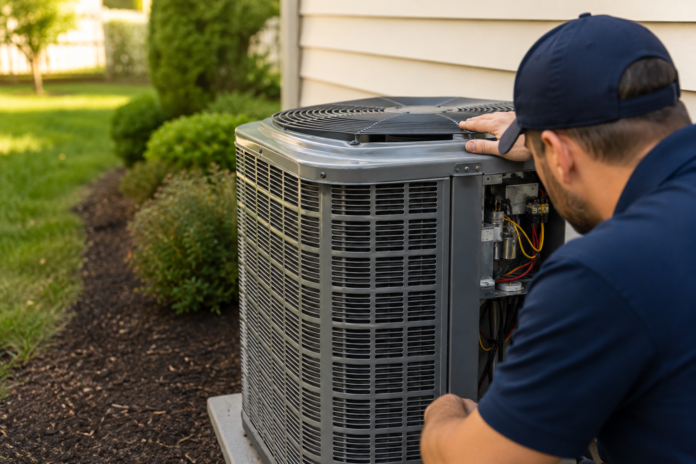

Your AC ran fine last September. You shut it off, forgot about it for eight months, and now it’s 91 degrees outside and the vents are blowing something that feels more like an apology than cold air. Sound familiar? You’re not alone, and you’re not out of options yet. Catching the right signals early is the difference between a quick service call and a full replacement bill landing on your kitchen table in July.
Here are five signs your air conditioner is telling you something, and what to actually do about each one.
1. Your Energy Bills Spike Without Any Change in Usage
This is the warning most homeowners miss because they blame the utility company first. But when your habits haven’t changed and the bill climbs, the AC is usually the culprit.
Think about what that looks like in practice. A homeowner in suburban Michigan keeps the thermostat at 72 degrees, same as every summer. July arrives, and the electric bill is $40 higher than it was at the same time last year. Nothing else changed. The refrigerator is the same age, the lighting is the same, and nobody bought a hot tub. The AC is working harder to produce the same result, which almost always means something is dirty, low on refrigerant, or mechanically worn.
According to the EPA’s 2024 residential energy technical documentation, air conditioning accounts for 19 percent of the average American household’s annual electricity use — and that share climbs fast when a system is underperforming. A sudden jump in your bill is a concrete, measurable signal worth taking seriously before the compressor gives out entirely.
What to do: Pull your bills from the same month last year and compare them side by side. A 15 percent or greater increase without a rate change warrants a professional inspection.
2. Weak or Uneven Airflow Across Rooms
Stand in front of every supply vent in your house and hold your hand close. Every room fed by the same system should feel roughly equivalent. If one bedroom is a freezer and the room next to it is a sauna, something is blocking or restricting airflow somewhere in the chain.
The usual suspects are a clogged filter, a partially closed damper, or a duct that has disconnected inside the wall or attic. A dirty filter is the easiest fix and the one most homeowners put off longest. A dirty air filter will cause your heating and cooling system to work harder to distribute air throughout your home, which can increase energy costs and damage your equipment, leading to early failure , according to ENERGY STAR. That’s a government-backed program run by the EPA, not a sales pitch from a contractor.
If replacing the filter doesn’t solve the airflow problem within a day of running the system, the issue is likely mechanical, and a technician needs to trace it.
The 3-2-1 AC Check: A Simple Diagnostic Before You Call Anyone
Before you pick up the phone, run through this quick framework. It takes about ten minutes and helps you rule out the easiest fixes, so you’re not paying a service fee for something you could have handled yourself.
- 3 things to look at: the air filter (is it gray and clogged?), the outdoor unit (is it buried in leaves, grass clippings, or debris?), and the thermostat (is it set correctly and are the batteries fresh?).
- 2 things to listen for: any banging, rattling, or grinding from the air handler or outdoor compressor, and whether the fan in the outdoor unit is spinning when the system is running.
- 1 thing to feel: the air coming from your supply vents. It should be noticeably cool, not just slightly less warm than the room.
If the 3-2-1 check turns up nothing obvious, you’re past DIY territory. That’s not a failure. It means the problem is internal, and internal problems get worse with every day you run the system in a degraded state.
3. The System Runs Constantly But Can’t Hit the Set Temperature
A healthy AC cycles on, cools the space to the target temperature, then shuts off. If yours runs for two or three hours straight and never shuts off, or if it shuts off but the house never actually reaches 72 degrees, that’s a red flag.
The most common causes are low refrigerant, a failing compressor, or a system that was never properly sized for the home in the first place. Each of these requires a licensed technician. Short cycling, where the system kicks on and off every few minutes, is equally bad. Both conditions cause accelerated wear on the compressor, which is the most expensive component in the unit.
If you’re in the Great Lakes region, this matters more than you might think. In 2020, the Midwest Census Region had one of the highest percentages of households using air conditioning in the country, at 92 percent , according to the U.S. Energy Information Administration’s Residential Energy Consumption Survey. That means regional HVAC contractors stay busy fast when summer hits, and wait times for repairs extend quickly. Calling early matters.
If you’re in the Grand Rapids area and seeing this symptom, working with a local specialist who knows the regional climate and load patterns makes a real difference. A team offering AC Repair Grand Rapids homeowners can call directly will be faster to diagnose the cause than a national chain dispatching from three counties over.
4. Unusual Sounds Coming From the Unit
AC systems are not silent, but they have a normal sound profile you learn to tune out. When that profile changes, pay attention.
A rattling noise usually means a loose panel or debris inside the outdoor unit. A grinding or metal-on-metal sound means bearings are failing, and running the system will accelerate the damage. A hissing sound after the system shuts off is sometimes normal refrigerant pressure equalization, but persistent hissing during operation can mean a refrigerant leak. A banging noise is almost always a mechanical failure that needs same-day attention.
The rule I’d apply here: if the noise started suddenly and wasn’t there before, shut the system off and call a technician. Continuing to run a system with a mechanical noise is how a $300 repair becomes a $3,000 replacement.
5. The Unit Is More Than 12 Years Old and Showing Any Other Sign on This List
Age alone isn’t a death sentence for an AC. But age combined with any of the other four symptoms is a serious conversation starter. The older a system gets, the less cost-effective individual repairs become relative to putting that money toward a newer, more efficient unit.
“Dirt and neglect are the top causes of heating and cooling system failure and inefficiency,” according to ENERGY STAR. Getting annual pre-season check-ups from a licensed contractor, ideally each spring before peak demand, is the single most reliable way to extend a system’s working life.
The Department of Energy and industry consensus both point to 15 to 20 years as a reasonable lifespan for a well-maintained central AC, but that ceiling drops fast when maintenance has been inconsistent. A 13-year-old unit that’s never been serviced is not a 13-year-old unit by wear standards. It’s older.
If your system is aging and you’re seeing short cycling, high bills, or weak airflow, get a professional assessment before you commit to another repair. The technician can tell you whether the remaining life justifies the cost, or whether you’re better off planning a replacement now on your timeline rather than during an emergency on a 95-degree afternoon.
Act Before the Rush, Not During It
The worst time to discover your AC is failing is the first truly hot week of summer, when every HVAC company in your area has a packed schedule. Running through the 3-2-1 check now, watching your energy bills monthly, and scheduling a professional inspection in late spring puts you ahead of 90 percent of homeowners who wait until there’s a problem they can’t ignore.
Which of these five signs has your system been showing? If the answer is more than one, that’s not a coincidence. That’s a pattern worth acting on today.