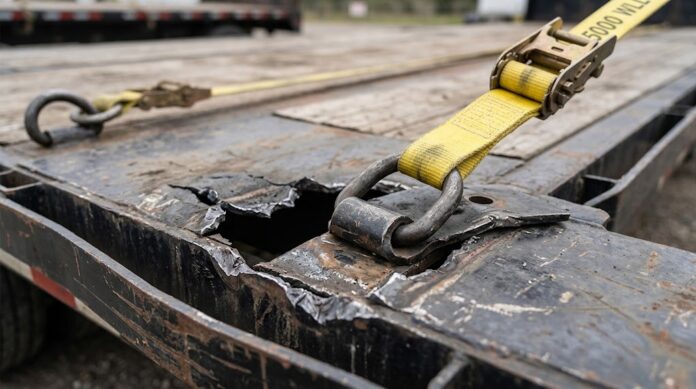

A load arrives with a strap intact and a D-ring torn out of the deck. The strap is fine. It held exactly as rated. What failed was the thing the strap was attached to, and in most post-incident reviews that anchor point was never rated for anything in the first place.
This is the recurring pattern in securement failures. Attention concentrates on webbing, chain, and binders, because those are the visible components with printed capacities on them. The attachment point is treated as part of the structure, and structure is assumed adequate.
The Rating Chain Is Only As Good As Its Anchor
Cargo securement regulations in the US set an aggregate working load limit requirement: the combined WLL of the securement system must equal at least half the weight of the cargo being secured. That calculation is straightforward when every component carries a marked rating.
The problem is that the chain includes the anchor. A 5,000 pound strap fixed to an unrated welded loop does not produce a 5,000 pound securement point. It produces an unknown one, and the regulation’s arithmetic no longer describes anything real.
Working load limit is not breaking strength. It is breaking strength divided by a design factor, and that factor exists to account for shock loading, wear, and off-axis pull. A fabricated attachment point with no documented test basis has neither a known breaking strength nor an applied factor, which means it has no defensible WLL even if it looks substantial.
Auditors and investigators ask for that documentation. Fabrication welded on by a maintenance crew three years ago does not produce it.
Direction Of Pull Changes The Number
Rated attachment points are typically tested for load applied in specific directions, and capacity drops when the pull goes off-axis.
A ring rated for in-line tension may carry substantially less when loaded at ninety degrees to its designed orientation. Pull across the mounting plate rather than through the ring introduces bending into a component designed for tension.
Rotating or swiveling designs address this by allowing the ring to align with the load path. Fixed designs require the installer to anticipate the direction of pull during the layout, which rarely survives contact with how loads actually get strapped in the field.
This is why placement matters as much as selection. An adequately rated anchor in the wrong position delivers less than a lower-rated one positioned correctly.
Where Stainless Earns Its Cost
Material selection is usually framed as a corrosion question, and that framing is incomplete.
Corrosion resistance matters in marine environments, chemical transport, food-grade washdown operations, and anywhere de-icing salt is present. Carbon steel with a plated or galvanized finish performs adequately until the coating is breached, and coatings get breached by exactly the mechanical wear that attachment points experience. Once corrosion starts at a strap contact point, section loss proceeds where nobody is looking.
Stainless steel D-ring tie-downs become the reasonable specification where that exposure is constant rather than occasional. The relevant distinction is usually between the common austenitic grades: the molybdenum-bearing grade handles chloride exposure considerably better than the standard one, which matters in salt environments and is the difference between a component that lasts and one that pits.
Stainless is not immune. Chloride stress corrosion cracking and crevice corrosion both affect austenitic grades, and crevices are exactly what a bolted or welded mounting plate creates. Specifying stainless without addressing detailing at the interface trades one failure mode for a less familiar one.
The Galvanic Problem Nobody Plans For
Mixing metals in a securement installation has consequences.
Stainless coupled to carbon steel in the presence of an electrolyte accelerates corrosion of the carbon steel. Fit stainless hardware to a carbon steel deck in a marine environment and the deck around the fitting corrodes faster than it otherwise would.
The anchor stays sound while the material it is mounted to deteriorates. That is a worse outcome than uniform corrosion, because inspection focuses on the fitting and the loss is happening in the substrate.
Isolation at the interface, correct fastener selection, and drainage that prevents standing moisture all address this. None of it is complicated, and all of it gets skipped when hardware is fitted by someone solving an immediate problem.
Welding Is Where Ratings Disappear
Weld-on attachment points are common and frequently the right choice. The weld is also where the engineering gets lost.
A manufacturer’s rating covers the component as supplied. It does not cover the installation. A properly rated ring attached with an inadequate weld, or welded to a structural member not designed to accept the load, has a capacity determined by the weakest of those three things.
Welding stainless introduces its own consideration. Heat input in the affected zone can reduce corrosion resistance through carbide precipitation, which is why low-carbon grades are specified for welded assemblies. Using standard grade filler and technique on a component intended for corrosive service undermines the reason stainless was chosen.
For shipping containers specifically, the structure is engineered to carry load through corner castings and rails. Attachment points welded to side panels are fixed to a skin that was never designed to accept concentrated tension, and the panel deforms before the fitting does.
Bolt-on installations avoid the weld quality question and bring their own: backing plates, correct torque, thread engagement, and prevention of loosening under vibration.
What To Inspect And How Often
Attachment points fail through accumulation rather than single events.
Elongation of the ring opening indicates the fitting has been overloaded, even if it still functions. Deformation of the mounting plate shows load was transferred at an angle the design did not anticipate. Cracking at weld toes is the standard fatigue location. Pitting or section loss at strap contact points is where corrosion concentrates.
Documented inspection intervals matter for the same reason documented ratings do. After an incident, the questions are what the capacity was, who established it, and when it was last verified.
An operation that can answer all three is in a fundamentally different position from one that can only produce a photograph of the failed component.