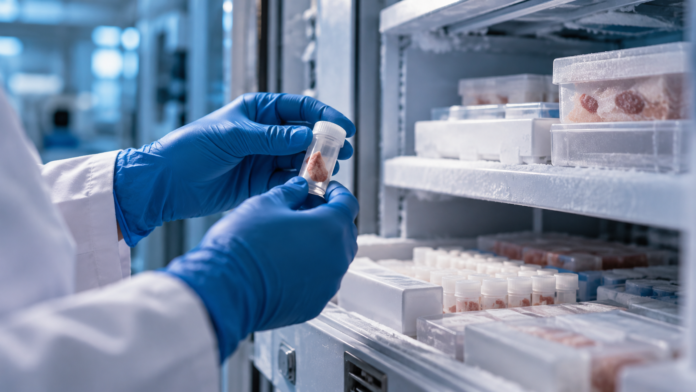

Every blockbuster drug you have ever taken started as a question that needed human tissue to answer it. Not a simulation. Not a cell line grown in a plastic flask since 1974. Actual tissue, from an actual person, with an actual diagnosis attached. That’s the unglamorous truth nobody puts on a conference slide.
And here’s what most people get wrong: they assume hospitals just hand over whatever researchers ask for. They don’t. Tissue has to be collected with consent, fixed, processed, catalogued, and stored under conditions strict enough that a sample pulled five years ago still yields usable data today. That whole chain is what people in the field call a biospecimen bank, and it’s one of the least visible pieces of the medical world, which is strange given how much depends on it working.
So let’s pull the curtain back. You don’t need a lab coat to understand this. You just need to know what happens between a tissue sample leaving a surgical suite and a researcher getting a labeled tube in the mail.
What actually gets stored, and why the format matters
Walk into a working biospecimen bank and you’ll see the same two words on almost every box: FFPE and fresh-frozen.
FFPE stands for formalin-fixed, paraffin-embedded. The tissue gets chemically preserved, then encased in a wax block you can slice into sheets thinner than a human hair. It’s the workhorse format. Blocks sit at room temperature for decades without degrading, and pathologists have been reading them under microscopes since the late 1800s, so the methods for handling them are thoroughly mapped out. If you’ve ever had a biopsy and heard the word “block,” that’s what came back from the lab.
Fresh-frozen is the other lane. The sample gets chilled fast, sometimes within minutes of removal, and stays frozen. You keep more of the fragile material intact that way, which matters if you’re hunting for RNA or doing work that formaldehyde would scramble. The tradeoff is logistics. A frozen sample can’t sit on a shelf. It needs a cold chain that holds from the collection site all the way to the researcher’s bench.
Neither format is better. They answer different questions. A good bank carries both and tells you exactly what you’re getting.
The part researchers actually care about: annotation
A tube of tissue with no history is close to worthless. You can run it through a sequencer, sure, but you won’t know what you’re looking at.
What makes a sample valuable is everything attached to it. Diagnosis. Tumor type, if there is one. Stage. Grade. Whether the tissue is malignant, normal, or something in between. Which anatomic site it came from. Results from prior immunohistochemistry and gene mutation testing, so a new team isn’t repeating work someone already did.
I’ve watched researchers describe sourcing samples the way you’d describe buying a used car. The specimen itself is the engine. The paperwork is the title, and without the title, the engine is scrap.
This is also where a real bank separates itself from a freezer with good intentions. Standardizing that metadata is tedious, unglamorous work, and it’s governed by outside bodies for a reason. The National Institute of Standards and Technology publishes reference materials and measurement guidance that labs lean on when they need results to mean the same thing across institutions, which is exactly the problem a shared repository has to solve.
Who’s ordering, and what they do with it
The customer list for a biobank is broader than most people picture.
- Academic researchers running oncology or immunology studies
- Commercial labs validating an assay before it goes to market
- Pharmaceutical developers screening candidates
- Antibody developers who need known-positive and known-negative controls
- Contract research organizations assembling a study cohort on a deadline
Spatial biology teams have become a big slice of that demand in recent years. They want to see where specific proteins and gene transcripts sit inside the tissue architecture, not just whether they’re present. That requires intact structure and clean annotation, which pushes banks toward higher standards rather than lower ones.
The common thread: someone needs a specific diagnosis, in a specific tissue type, in a quantity that’s actually usable, and they need it fast. Nobody builds a study around a six-month procurement delay.
A practical checklist before you place an order
If you’re sourcing samples for a project, these are the questions I’d ask any supplier before signing anything.
- Is the diagnosis confirmed by a pathologist, or is it self-reported? Ask for documentation. Not a summary.
- What’s the fixation protocol? Fixation time changes downstream results more than most people expect.
- Can they match your cohort criteria, or only sell what’s on the shelf? A bank that can’t match a request is a warehouse.
- What’s the shipping timeline? Ask for the actual number in writing.
- Are bulk orders discounted? If your study needs hundreds of samples, that conversation should happen up front.
- Which accreditation standards do they follow? Ask them to name the bodies and the specific protocols.
That last one matters more than it sounds. The National Science Foundation has funded the development of shared research infrastructure for years precisely because reproducibility collapses when samples from different sources can’t be compared to each other. If a supplier can’t tell you what standard they hold themselves to, you’re taking on risk you can’t measure.
Where the field is heading
Two shifts are underway, and both favor researchers.
The first is consolidation. Small hospital collections built up over decades are being folded into larger, better-catalogued repositories. That’s good news for anyone who has ever spent three weeks chasing a single rare tumor type across six institutions.
The second is data pairing. Increasingly, a tissue sample arrives with genomic results already attached, which cuts months off a study timeline. The bank stops being a supplier and starts being a research partner.
The National Archives is an odd comparison to reach for, but a fair one: institutions that take preservation and cataloguing seriously outlast the ones that don’t by a wide margin. Medical research runs on the same principle, just on a shorter clock.
One Last Thing About the Freezer Room
Nobody gets into research because they love inventory management. But the sample you can’t find is the sample that doesn’t exist, and the diagnosis you can’t trust is worse than no diagnosis at all.
So next time you read about a trial that produced a promising result, spare a thought for the wax blocks and the cold chain and the pathologist’s notes that made it possible. The science gets the credit. The infrastructure does the work.
If your team is planning a study and still figuring out where the tissue comes from, that’s not a detail to settle later. It’s the first decision, and it shapes every result that follows.