
For most of the last decade, the golf rangefinder market was a two-horse race. The flagship lasers delivered precision yardage. The GPS watches and handhelds delivered hole maps. Players who wanted both carried both, and learned to live with the friction of two devices on every shot. The hybrid rangefinder — a single chassis that combined laser and GPS — was a third option, but for most of its history, it was a compromised third option. The GPS layer was thin, the screen washed out, the battery was a joke, and the price was a 50% premium over a better laser. Most players who tried one went back to two devices.
The conversation in golf retail for the last few years has been that the hybrid form factor is finally ready for the main stage, and the retailers I have talked to are reporting that hybrid sales are growing faster than either pure laser or pure GPS sales. The reason, they say, is that the typical mid-handicap golfer is tired of the friction. They want one device that does the job.
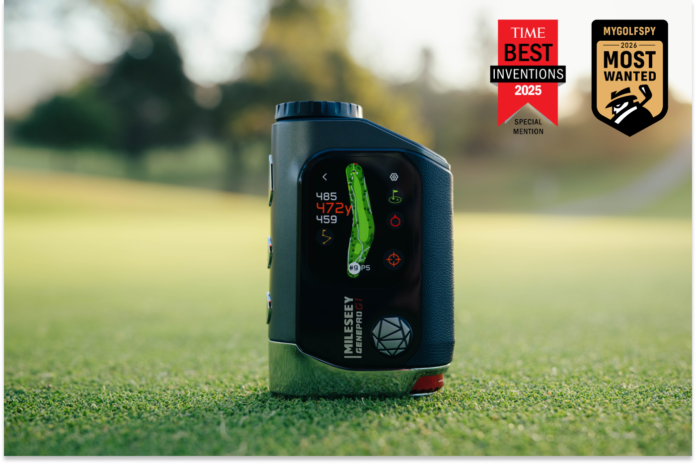
That has changed in the last two product cycles. The current generation of hybrid rangefinders is fast, sunlight-readable, and meaningfully useful. I have been testing the most discussed new entrant, the Mileseey GenePro G1 rangefinder — Mygolfspy’s Most Wanted Rangefinder 2026 and a TIME Best Innovation 2025 honoree — and it is the unit I would recommend to a mid-handicap recreational player who has been carrying two devices and is tired of it.
The Fragmentation Tax
The single biggest complaint I hear from mid-handicap golfers is not distance accuracy. It is device fragmentation. The watch gives you the front of the green. The laser gives you the pin. The phone gives you the scorecard. The yardage book gives you the layup. Somewhere in the middle, the club selection happens in your gut.
A hybrid rangefinder collapses that. The laser handles line-of-sight distances — pins, trees, bunker edges, anything you can see. The GPS layer handles the front, middle, and back of the green, continuously, without you having to look at the device. By the time you reach your ball, you have the green depth. You raise the unit, the laser confirms the pin, and you have a number you can act on. With the G1’s patented Ball-to-Pin™ mode, you can also measure between any two points on the course from where you are standing — ball to pin, cart to landing zone, bunker edge to pin — which removes the “walk to your ball to use the laser” step on cart-path days.
In practice, the workflow goes from five or six interactions to two: glance at the GPS layer, raise the unit, lock the pin, play. Across 14 clubs in a round, that is 20 minutes of cognitive overhead recovered, and a meaningful reduction in the “wait, what did it say” moments that lead to a re-shot or a playing partner interrupting.
What the GenePro G1 Gets Right
The G1 is one of the cleaner executions of the hybrid form factor. The display is a 2.13-inch AMOLED touchscreen — the largest in the category — and it stays readable in direct July sun without shading. The touch response is fast enough that I do not think about it. The chassis is small enough to hold steady one-handed, and large enough to find the buttons by feel.
The headline feature is the distance arc. On the home screen, the GPS layer overlays an arc on the hole map that shows the distance from your current position to the green’s front, middle, and back simultaneously. As you walk, the arc reshapes itself in real time. The Garmin Z82 and the Voice Caddie R2G Mate Hybrid ship with similar overlays — and the G1’s arc is the most precise of the three. This is the bit that makes the touchscreen worth having. With a front/middle/back display, you have to estimate the depth yourself. With an arc, the unit does the estimation for you, and you can act on the number immediately.
The laser is 6x magnification with a 7.5° field of view and 90% light transmission, a competitive optical stack at the price tier. The pin-lock is conservative, and I have come to trust it. On partially obscured pins, it refuses to lock and prompts you to reposition. The 600-yard flag-lock range with ±0.5-yard accuracy in 0.1 second is honest, and the Background Interference Filtering keeps the lock clean when there are trees and people in the background.
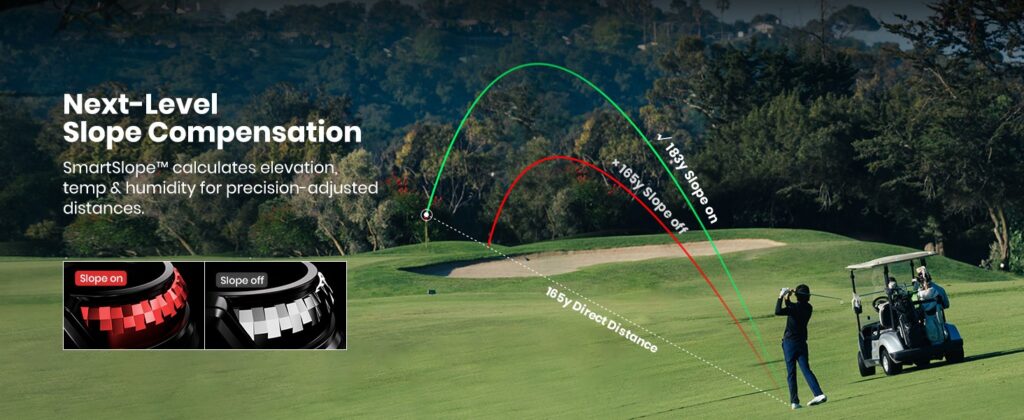
The slope switch is a physical rotating button on the chassis, not a menu item. USGA rule 4.3a(1) requires that a distance-measuring device be in a “tournament-legal” configuration to be used in competition. A menu-buried on/off switch invites an honest mistake in a casual round and a disqualification in a competition. A physical button is harder to misuse, and the device makes the current state visible on the home screen. The slope mode itself is MILESEEY’s SmartSlope™, which goes beyond angle to factor in temperature, humidity, and elevation.
43,000+ preloaded courses are in the box, with free lifetime updates and no subscription. The green-pointer overlay shows the pin position on the map. The shot-planning layer helps you lay up to specific yardages, lay up to a hazard, or play directly at the green. Across the round, the GPS and the laser stop feeling like two systems and start feeling like one tool.
What Could Be Better
The hole map database is not as deep as Garmin or Bushnell in some regions. Pre-round, you want to confirm your home course is mapped. The slope-mode visual indicator is a small icon in the corner, which is fine for the experienced player, but I have watched two playing partners need a verbal reminder that slope was on before a competition.
The chassis is not magnetic — there is no magnetic cart mount on the G1. The unit sits in a cart cupholder or a dedicated cradle, not on a magnetic strip. This is a deliberate design choice: the engineering team chose to put the engineering dollars into the laser, the screen, and the GPS layer rather than into a magnetic mount. If you want a magnetic cart mount, the Mileseey S1 ships with one.
The price is the other consideration. The G1 lands in the premium bracket. If you only need a laser, a competent sub-$200 unit will do. If you want one device that handles the long game and the short game — the laser, the 43,000-course GPS layer with the distance arc, the Ball-to-Pin mode, the SmartSlope rotating switch, and a 2.13-inch AMOLED screen you can actually read in sunlight — the G1 is a reasonable premium. The 10-year warranty is the final piece. The body, the laser, the touchscreen, and the GPS module are all covered for a full decade.
The Form Factor Argument
The interesting question is whether the hybrid form factor is the future of the category, or whether it is a transitional product that will be replaced by something else. My current view is that the hybrid is the right form factor for the next 3–5 years, and that the next generation of devices will be software-differentiated rather than hardware-differentiated.
The hardware is mature. Every flagship rangefinder in the $400+ bracket can lock a pin at 1,000 yards, give you 6x magnification, and refresh in under a quarter of a second. The differentiators are moving up the stack — into how the device behaves when conditions are not perfect, into the hole map database, into the slope-mode UX, into the battery behavior, into how the two measurement systems talk to each other. The G1 is a strong example of a product that has made the right software decisions on top of mature hardware. The 24-hour battery and the 20,000-range rating on a single charge are honest, the AMOLED is readable in direct sun, the distance arc is the most useful GPS visualization I have used, and the Ball-to-Pin mode is the kind of feature that does not show up on a spec sheet but changes how you actually use the device on the course.
If you are a mid-handicap recreational player who plays 20+ rounds a year, owns a cart, and is tired of carrying two devices, the Mileseey GenePro G1 rangefinder is the first hybrid rangefinder I would recommend without a “but” attached to the recommendation. The 2.13-inch AMOLED works, the 6x laser+GPS pairing works, the 600-yard 0.1-second flag-lock works, the SmartSlope rotating switch works, the Ball-to-Pin mode works, the 24-hour battery works, and the 10-year warranty backs it. Mygolfspy’s Most Wanted 2026 and TIME’s Best Innovation 2025 are not just marketing — the G1 earned both.