

GPS robot lawn mowers can be highly accurate when they combine strong satellite positioning, careful mapping, and reliable onboard sensors. Their accuracy comes from more than GPS alone. RTK correction, virtual boundaries, visual navigation, obstacle detection, and stable ground contact all influence how closely the mower follows its planned route. In open yards with good signal conditions, these machines can cut in orderly paths and stay within mapped areas without buried wires. Accuracy becomes harder near trees, walls, slopes, wet grass, and tight edges, so buyers should judge both the mower’s technology and the yard’s real conditions before choosing.
How GPS Robot Mower Accuracy Works
GPS vs. RTK Positioning Accuracy
Standard GPS helps a robot mower understand its general location, but RTK improves accuracy by correcting satellite data in real time. This makes the mower better at following planned routes, respecting boundaries, and returning to specific areas after charging. A GPS mower with RTK is the stronger choice for yards that need cleaner lines, wire-free navigation, and more dependable positioning around defined lawn zones.
Why Virtual Boundaries Need Precise Mapping
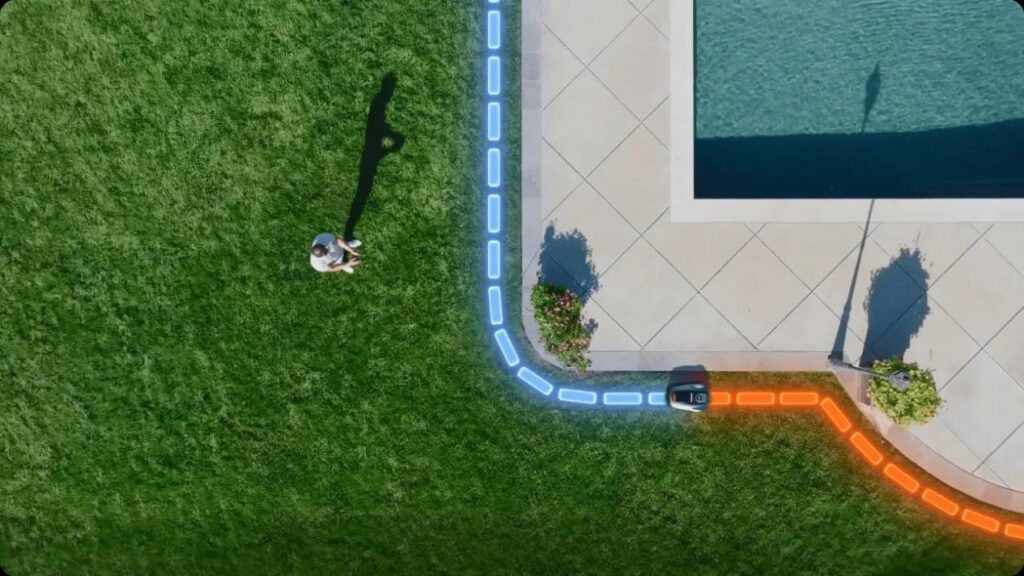
Virtual boundaries replace buried perimeter wires with digital edges, so mapping accuracy matters from the first setup. When the boundary line follows the real lawn edge closely, the mower can cut near borders without entering flower beds, paths, patios, or pools. Poorly mapped edges create missed strips or unsafe overreach. Careful boundary creation gives the mower a clear working area and reduces later manual trimming.
How Sensors Support GPS Navigation
Sensors help GPS navigation by giving the mower more information than satellite signals alone can provide. Cameras, vision AI, binocular sensing, iToF, and similar technologies can detect obstacles, estimate distance, and support movement around trees, furniture, and garden objects. Sunseeker Elite GPS robot mower, for example, combines RTK, VSLAM, virtual boundaries, AI vision, and all-terrain performance to improve control in complex outdoor spaces.
Why Straight Cutting Lines Depend on Stable Signals
Straight cutting lines depend on the mower knowing where it is from one moment to the next. When signals remain stable, the mower can follow parallel routes and overlap passes evenly. When signals weaken or bounce near buildings, trees, or narrow corridors, the mower may adjust its path. Good signal quality helps reduce wavering lines, missed bands, and uneven coverage across larger lawns.
Yard Conditions That Affect Accuracy Most
Trees, Rooflines, and Signal Blockers
Trees, rooflines, walls, sheds, and covered passages can reduce GPS mower accuracy by blocking or reflecting satellite signals. Dense canopies are especially challenging because leaves change through the season and may create inconsistent reception. Tall structures along one side of the lawn can also narrow the mower’s usable sky view. Yards with these features need stronger positioning support, careful base placement, and sensor-assisted navigation to keep routes steady around shaded or enclosed areas.
Slopes, Bumps, and Soft Ground
Slopes and uneven ground affect accuracy because the mower must maintain traction while maintaining its route. On steep areas, weak grip can cause sliding, drifting, or uneven turns. Bumps may shift the mower’s body angle, while soft soil can slow wheels or create small path deviations. A model rated for hillside work, with stable drive control and strong wheel grip, will hold its line better on challenging terrain than a flat-yard mower.
Narrow Passages and Tight Lawn Edges
Narrow passages test both positioning and movement control. The mower must stay centered enough to pass safely while avoiding walls, beds, fences, and paving. Tight lawn edges create another challenge because the machine needs accurate boundaries and controlled turning space. If the mapped line sits too far inward, the mower leaves uncut strips. If it sits too far outward, it may cross into protected areas. Careful setup improves accuracy in these pressure points.
Weather, Wet Grass, and Seasonal Changes
Weather can change how accurately a robot mower performs. Wet grass may reduce traction, increase clumping, and make slopes harder to climb cleanly. Heavy cloud cover usually matters less than physical signal blockers, but storms and poor ground conditions can still affect mowing quality. Seasonal growth also changes the yard: thicker grass, fallen leaves, new furniture, and expanding shrubs can alter how the mower moves. Regular map checks keep accuracy consistent over time.
How to Improve GPS Mower Accuracy
Place the Charging Station and RTK Base Correctly
Place the charging station on firm, level ground with clear access to the mowing area. The mower should enter and leave the dock without sharp turns, obstacles, or soft soil. If the system uses an RTK base, give it the clearest possible sky view and keep it away from tall walls, dense trees, and metal structures. Correct placement improves positioning stability, docking reliability, and the mower’s ability to resume routes accurately after charging.
Map Boundaries Slowly and Carefully
Accurate mowing starts with slow, careful boundary mapping. Follow the real lawn edge closely, keep the mapping path smooth, and avoid sudden movements near beds, fences, and corners. Mark separate zones, paths, and excluded areas during setup rather than correcting everything later. A clean first map gives the mower better route data, improves edge control, and reduces the need for repeated manual adjustments.
Adjust No-Go Zones After the First Runs
The first few mowing sessions reveal where the map needs refinement. Watch how the mower handles trees, furniture, roots, drains, play equipment, and tight corners. If it turns too close to an object or leaves awkward patches, adjust the no-go zone or boundary line in the app. Small changes after real-world runs often produce better accuracy than relying only on the initial map.
Conclusion
GPS robot lawn mowers are accurate enough for many modern yards when they use RTK positioning, precise virtual boundaries, smart sensors, and careful mapping. The best performance comes from open sky, stable ground, correct station placement, and boundaries created with patience. Trees, walls, slopes, wet grass, and tight edges can reduce accuracy, but good setup solves many problems. Choose a mower that matches your yard’s challenges, and GPS mowing becomes reliable, orderly, and practical.