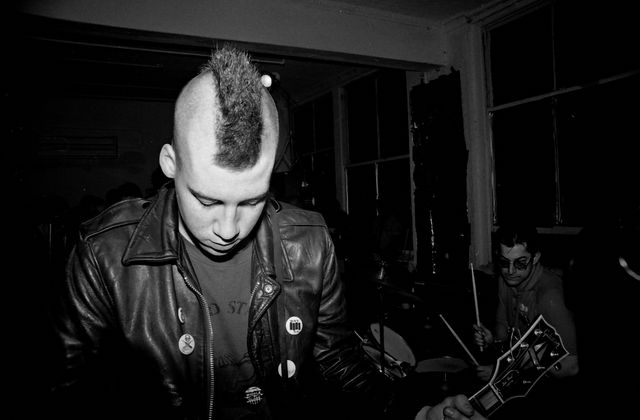

Punk has never depended on polish to make its point. Its force came from ordinary people turning irritation, isolation, humor, and political unease into something loud enough to share with a roomful of strangers. This history of punk rock bands follows that transformation from the first New York clubs to international scenes, while considering why the music still speaks to anyone trying to recover a sense of agency and purpose.
How punk rock bands turned frustration into a new musical language
Punk emerged as both a sound and a refusal of rock music’s growing distance from everyday life. The musicians did not need virtuoso technique, expensive production, or permission from established institutions to make a lasting impression. They needed urgency, a few strong ideas, and somewhere to play.
The stripped-down sound of speed, volume, and economy
Punk music reduced rock to its most immediate elements: rhythm, distortion, repetition, and a voice that sounded close enough to touch. Short songs could carry a complete argument before the listener had time to settle into passive attention. The economy was not a limitation so much as a decision to remove anything that softened the impact.
That directness also changed the relationship between band and audience. A song could feel unfinished, rough, or even reckless and still feel honest. Urgency became an aesthetic, not a flaw to be corrected.
DIY recording and independent venues as creative tools
Small clubs, rehearsal rooms, independent labels, and homemade publicity gave punk musicians ways to work outside the established music business. A flyer, a borrowed amplifier, or a four-track recording could become part of the creative process rather than an embarrassing substitute for professional infrastructure.
The practical lessons were simple and durable. A scene could grow when people shared responsibilities instead of waiting for a gatekeeper to approve the work:
- Book a room and make the event welcoming to newcomers.
- Record a song with the equipment that is actually available.
- Trade flyers, tapes, ideas, and support across local communities.
- Build trust through participation rather than status.
These habits made punk feel less like a product delivered to fans and more like a culture people could enter. That spirit still resonates with men’s wellness programs that use practical guidance and accountability to help participants build healthier habits, although the goals and settings are entirely different.
Lyrics that replaced rock-star mythology with lived experience
Punk lyrics often traded fantasy for rent, boredom, work, fear, desire, and resentment. The narrator was not always a heroic rebel; sometimes he or she was confused, petty, lonely, or simply tired of being ignored. That imperfection gave the songs their unusual intimacy.
Instead of presenting rebellion as a glamorous identity, many punk writers treated it as a daily practice of noticing what was wrong and refusing to pretend otherwise. The result was music that could validate frustration without requiring the listener to turn frustration into a permanent personality.
The New York bands that defined punk’s first wave
New York’s first punk wave formed around clubs, artists, poets, and musicians who were reimagining what a rock performance could be. CBGB became an important meeting point, but the movement was larger than one room. It drew power from the friction between minimal pop, experimental guitar music, performance art, and downtown life.
The Ramones and the power of minimalist songwriting
The Ramones made speed and repetition feel thrilling rather than crude. Their songs used compact structures, memorable hooks, and a comic bluntness that turned teenage restlessness into something communal. The band’s influence came partly from showing how little a song needed in order to become unforgettable.
Their template made room for musicians who might have been intimidated by progressive arrangements or virtuosic expectations. Three chords, a sharp tempo, and a clear emotional premise could be enough to start a band.
Patti Smith Group and the connection between poetry and punk
Patti Smith brought the elasticity of poetry into a rock setting, allowing images, fragments, and spoken intensity to sit beside driving guitars. Her performances suggested that punk could be intellectual without becoming detached, and emotional without becoming sentimental.
The Patti Smith Group also widened the idea of who could command a stage. Smith’s work treated language as physical force, turning a concert into a place where thought and noise could collide.
Television, Richard Hell, and the move toward sharper guitar interplay
Television approached punk through intricate, searching guitar lines rather than sheer speed. The interplay between instruments created tension without relying on conventional virtuoso display. Richard Hell, meanwhile, helped articulate the movement’s sense of alienation and self-invention.
Together, these artists showed that punk could be spare yet musically alert. The genre’s boundaries were never as narrow as its reputation suggested.
Blondie and the expansion of punk’s musical boundaries
Blondie moved easily between punk attitude, pop melody, reggae, disco, and other forms. That flexibility challenged the idea that authenticity required one fixed sound or uniform appearance. Debbie Harry’s cool, direct presence also made room for glamour within a scene often associated with deliberate ugliness.
Blondie’s success demonstrated that experimentation did not have to weaken punk’s edge. Sometimes the most rebellious choice was to refuse the scene’s expected limits.
The British punk explosion and its political edge
British punk arrived amid economic strain, class tension, youth unemployment, and distrust of political authority. Its clothes, slogans, and confrontational performances made social anger visible, even when individual songs were more theatrical than programmatic. The movement’s politics were often contradictory, but that contradiction was part of its charge.
The Sex Pistols and the shock of confrontation
The Sex Pistols made provocation central to their public identity. Their performances and songs treated politeness as a kind of surrender, challenging institutions and the cultural rituals that protected them from scrutiny.
The band’s importance lies less in offering a coherent political program than in demonstrating how spectacle could expose public unease. Their antagonism forced audiences to decide whether outrage was a threat, a performance, or both.
The Clash and the blend of punk with reggae, rockabilly, and protest music
The Clash treated punk as an open vocabulary. They drew on reggae, rockabilly, rhythm and blues, and protest traditions, using those influences to explore race, war, policing, migration, and working-class life. Their broad musical palette made political curiosity audible.
This was not rebellion as a single pose. It was an argument for listening beyond one’s immediate surroundings and recognizing that social problems rarely fit inside one genre.
Buzzcocks and the emotional directness of punk songwriting
Buzzcocks brought romantic confusion and vulnerability into a fast, compact format. Their songs could be catchy without losing their nervous energy, and personal feeling did not need to be treated as a retreat from punk’s public concerns.
That balance helped establish a lasting idea: a song about desire, rejection, or uncertainty can still be rebellious when it refuses emotional dishonesty.
Siouxsie and the Banshees and the darker side of rebellion
Siouxsie and the Banshees explored atmosphere, unease, and theatrical darkness. Their music stretched punk toward post-punk and gothic expression without abandoning its sense of danger. The band made alienation sound textured rather than merely loud.
Their work also reminded listeners that rebellion can be inward. It may involve questioning one’s own fears, roles, and assumptions as much as confronting an outside authority.
Hardcore punk bands that made the sound faster and more confrontational
Hardcore intensified punk’s speed, volume, and physical presence. Scenes in the United States developed their own networks of shows, labels, zines, and local identities, often with little support from mainstream institutions. The music could be abrasive, but the surrounding communities also created spaces for participation and mutual recognition.
Black Flag and the rise of relentless, abrasive hardcore
Black Flag made instability part of the sound. Their shifting lineups and raw recordings matched music that felt constantly close to breaking apart. The band’s relentless attack helped define hardcore as a form built for pressure rather than comfort.
Their example also emphasized endurance. Touring, organizing shows, and sustaining a scene required commitment beyond the performance itself.
Minor Threat and the discipline of the straight-edge movement
Minor Threat connected hardcore’s intensity with a rejection of intoxication and self-destructive habits. The straight-edge movement that grew around this idea took different forms among different people, but its central appeal was the possibility of choosing clarity in a culture that often celebrated excess.
That choice could be empowering when it remained voluntary rather than judgmental. Discipline, in this context, was not about perfection; it was about making behavior serve a personally held purpose.
Bad Brains and the fusion of hardcore speed with reggae rhythms
Bad Brains combined astonishing hardcore velocity with reggae’s spacious rhythms and spiritual dimensions. That contrast revealed how much range could exist inside a supposedly narrow genre. Their musicianship was intense, but the larger lesson was equally significant: punk could absorb difference without losing force.
The band’s presence also challenged assumptions about who belonged at the center of hardcore. Their contribution remains essential to any account of the form’s development.
Dead Kennedys and the use of satire as political resistance
Dead Kennedys used grotesque humor and sharp satire to attack political hypocrisy, consumer culture, and authoritarian habits. Their songs made laughter uncomfortable, exposing how absurd public language can become when it hides cruelty or corruption.
Satire does not solve a political problem by itself. It can, however, make familiar rhetoric sound strange enough for people to question it.
How punk scenes challenged ideas about identity and belonging
Punk scenes offered belonging to people who felt excluded from conventional ideas of respectability. Yet scenes could reproduce their own hierarchies and exclusions, so the story is not simply one of liberation. The most compelling artists pushed the culture to examine who was being heard, who was being represented, and who was being asked to stay at the margins.
X-Ray Spex and Poly Styrene’s critique of consumer culture
X-Ray Spex turned consumer goods, advertising, and manufactured identity into subjects for scrutiny. Poly Styrene’s vocal performance sounded gleefully resistant to the smoothness expected from commercial pop, while the band’s songs questioned the promise that buying the right objects could create a satisfying self.
That critique still feels recognizable. A person can be surrounded by choices and remain uncertain about what actually matters.
The Slits and the rethinking of gender and musical expectations
The Slits challenged expectations about how women in rock should look, sound, and behave. Their music was exploratory and sometimes deliberately unruly, rejecting the demand that female performers be either polished entertainers or symbols of decorum.
Their importance extends beyond any single recording. They made experimentation, awkwardness, and self-definition visible as legitimate forms of musical authority.
The Avengers and the visibility of women in American punk
The Avengers brought urgency and political intelligence to San Francisco punk. Penelope Houston’s role as a front person helped contest the assumption that aggression and leadership were naturally masculine traits.
Visibility alone does not erase barriers, but it can alter what a younger musician imagines to be possible. Punk’s small stages often became testing grounds for that change.
The Exploited and the relationship between punk, class, and anger
The Exploited represented a strain of punk that foregrounded class anger, confrontation, and street-level resentment. Their music was less interested in refinement than in expressing the heat of alienation. That directness could be galvanizing, though it could also become trapped in provocation for its own sake.
The tension matters because anger is both information and risk. It can identify injustice, but it needs reflection and responsibility if it is to lead anywhere useful.
The punk rock bands that reshaped alternative and mainstream music
Punk’s influence did not stop when major labels began paying attention. Later bands carried its speed and independence into melodic songwriting, noisy guitar rock, pop, and ska. Some reached large audiences without abandoning every principle of the earlier scenes, while others sparked arguments about what authenticity meant once punk entered the mainstream.
Hüsker Dü and the bridge from hardcore to melodic rock
Hüsker Dü joined hardcore’s velocity to expansive melodies and emotionally complicated songwriting. Their work showed that a band could preserve urgency while allowing songs to develop beyond the briefest structures.
That bridge helped shape alternative rock. Volume could carry tenderness, and melodic writing did not have to mean surrendering intensity.
The Replacements and the appeal of vulnerability beneath the noise
The Replacements made sloppiness, humor, and vulnerability part of their appeal. Their songs could sound reckless on the surface while revealing fear, disappointment, affection, or the desire to be taken seriously underneath.
This mixture gave punk a more forgiving emotional vocabulary. Failure was not always proof of worthlessness; sometimes it was the material from which a more truthful song could be made.
Green Day and the mainstream breakthrough of pop-punk
Green Day helped bring pop-punk’s concise hooks and energetic performances to a broad audience. Their breakthrough showed that punk-derived music could be commercially visible while retaining a sense of youthfulness and impatience.
The mainstream connection also created a familiar debate. Wider reach can spread a sound and its ideas, but it can also smooth away the local conditions that gave those ideas their urgency.
Rancid and the revival of punk’s ska and street-rock influences
Rancid connected punk to ska, reggae, and street-rock traditions, helping renew interest in sounds that had long circulated through underground scenes. Their music emphasized movement, ensemble energy, and the social world around the songs.
That approach treated punk history as a resource rather than a museum piece. The past could be revisited, rearranged, and made useful for a new audience.
Punk’s global legacy and its continuing influence
Punk traveled because its basic tools were portable: loud instruments, direct language, shared spaces, and the confidence to begin without institutional approval. In each place, musicians adapted those tools to local languages, political realities, and musical traditions. The result was never one global punk sound, but a continuing argument about freedom, community, and responsibility.
Japanese punk scenes and the adaptation of punk’s DIY ethos
Japanese punk scenes developed their own approaches to speed, performance, design, and experimentation. Rather than simply copying British or American models, musicians adapted punk’s independence to local venues, audiences, and cultural expectations.
That pattern is central to punk’s international life. The ethos travels most successfully when people translate it instead of treating it as a fixed uniform.
Latin American punk and music as a response to political repression
Across Latin America, punk has often provided a language for confronting repression, inequality, police violence, and restricted public speech. The music’s urgency can make private fear social and audible, especially when official accounts leave little room for dissent.
These scenes also show why context matters. The same chord pattern can carry very different consequences when it is played under different political pressures.
Riot grrrl and the revival of activist, feminist punk
Riot grrrl renewed punk’s connections to feminist organizing, personal testimony, zines, and direct action. It made sexual harassment, body politics, friendship, and power central subjects rather than side conversations.
Its legacy lies in the insistence that a scene should be judged by how it treats people, not only by how exciting its music sounds. That principle continues to challenge communities that confuse rebellion with permission to harm.
Contemporary punk bands carrying rebellion into new social and musical contexts
Contemporary punk bands continue to mix the old ingredients with electronic textures, hip-hop, metal, folk, and regionally specific traditions. Some organize around mutual aid or political education; others focus on personal survival, grief, identity, or the ordinary work of staying connected.
A useful way to trace this history is to compare what changes and what remains stable across generations:
| Punk element | Early expression | Continuing form |
| Independence | Small labels and informal venues | Community-run events and self-released work |
| Direct language | Songs about boredom and social anger | Testimony about identity, injustice, and mental health |
| Musical economy | Short, forceful arrangements | Concise songs alongside deliberate experimentation |
| Belonging | Local scenes and shared spaces | International networks shaped by local needs |
The table makes punk’s continuity easier to see without pretending that every scene shares the same politics or sound. The enduring idea is not a particular tempo. It is the belief that people can create culture together, question inherited rules, and make room for lives that dominant institutions overlook. For men’s wellness programs, that same emphasis on accountability and purposeful community can support personal growth, though recovery is an individual process rather than a musical movement. The Punk Rock Museum reflects the value of preserving this history through artifacts, stories, and context, while the living scenes keep changing it.
Conclusion
The most influential punk rock bands changed rebellion by making it participatory. They proved that a song could be rough and still precise, political and still personal, local and still capable of traveling across borders. Punk’s lasting lesson is not that anger should run everything; it is that frustration can become art, community, and more honest action when people give it form and direction.
Frequently Asked Questions
What defines punk music?
Punk music is generally associated with direct songwriting, energetic performances, distorted guitars, strong rhythmic drive, and an independent or anti-establishment attitude. Its sound varies widely, so no single production style defines every punk scene.
Which bands started the first major punk wave?
The first major wave is commonly associated with artists from New York and London, including the Ramones, Patti Smith Group, Television, Blondie, the Sex Pistols, and the Clash. Their approaches differed considerably even when they shared venues, audiences, or a rejection of rock convention.
How did punk differ from mainstream rock?
Punk often favored shorter songs, simpler structures, accessible performance techniques, and direct criticism of social or cultural norms. It also encouraged listeners to form bands, publish writing, organize shows, and participate in a scene rather than remain passive consumers.
What is hardcore punk?
Hardcore punk is a faster, more abrasive development of punk that became prominent in the United States during the early 1980s. It is associated with intense live shows, compact songs, forceful vocals, and tightly connected local communities.
Why is DIY important to punk?
DIY practices allowed musicians and fans to record, distribute, promote, and perform music without waiting for established companies or venues. The approach also made creative control and community participation part of the music’s meaning.
Did punk influence music outside rock?
Yes. Punk’s attitude and techniques influenced alternative rock, pop-punk, post-punk, ska, reggae, hardcore, metal, electronic music, and many regional scenes. Its influence often appears in independent production and direct songwriting as much as in guitar sound.
Is punk still relevant?
Punk remains relevant wherever people use music and community organizing to question authority, express marginalization, or create alternatives to established systems. Its meaning changes with each generation, which is one reason it has continued to survive.