
Most travel videos are assembled after the trip from whatever happened to be captured: a wide view from the hotel, three seconds of food, a shaky street clip, and dozens of nearly identical photos. The result may document the destination, but it rarely communicates what the journey felt like.
AI image-to-video tools offer a different way to use those still images. They can add camera movement, environmental motion, and transitions where no video was recorded. The challenge is restraint. If every photograph spins, zooms, or transforms, the finished piece becomes a demonstration of effects rather than a memory with shape.
The strongest approach begins with a simple story and treats each animated photo as a shot with a purpose.
Find the Change Hidden in the Album
A story does not require drama. It requires a difference between the beginning and the end.
Perhaps the trip moves from a crowded city to a quiet coast. Maybe the weather changes from rain to clear evening light. A food journey can begin with a market and end at a shared table. A family video might follow one child becoming more curious and independent over several days.
Write that change in one sentence before selecting images. For example: “We arrived overwhelmed by the city and left feeling at home in its small morning routines.” This sentence becomes an editing filter. A beautiful photograph that does not support the change can stay in the album.
Choose Roles, Not Just Favorites
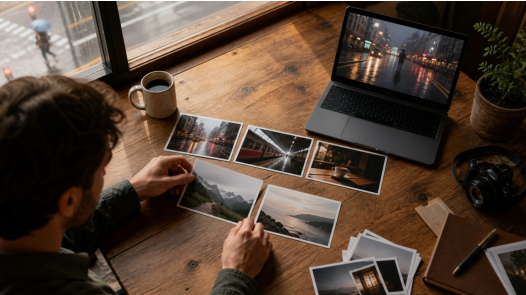
Select six to ten images and assign each one a role:
- Opening: establishes place, weather, or point of view.
- Orientation: introduces the traveler or a recognizable landmark.
- Detail: shows food, texture, signage, hands, or a small ritual.
- Movement: implies a journey through a road, train, path, or crowd.
- Turn: marks a change in mood, location, or understanding.
- Resolution: ends on a calm image that can hold for a moment.
Visual variety matters. If every source image is a centered portrait, the video will feel repetitive even with animated motion. Mix wide environments, medium human moments, and close details.
Match Motion to the Photograph
The source image already contains clues about how it wants to move.
A road disappearing into the distance supports a gentle forward camera move. A person looking outside the frame may support a small pan toward what they see. Steam can rise from food; fabric can respond to wind; water can ripple; market lights can flicker subtly. A still architectural façade may need only shifting sunlight and distant pedestrians.
Avoid forcing action that the image cannot plausibly support. A tightly cropped face is a poor source for a full-body walking sequence. A blurred nighttime snapshot will not become a clean aerial view simply because the prompt requests one. Choose motion that extends the evidence already present.
An AI image-to-video generator can help test these movements from individual photographs. The platform offers free access, which is useful for comparing a restrained camera move with a more ambitious animation before deciding which direction belongs in the final edit.
Protect Identity and Place
Travel photographs often contain people whose appearance matters more than cinematic spectacle. Keep instructions simple when animating a recognizable face: natural breathing, a small turn, a change of expression, or a glance toward the environment. Dramatic rotations and fast body movement create more opportunities for identity to drift.
The location also has an identity. Preserve distinctive rooflines, mountain silhouettes, street geometry, and cultural details. Do not ask a model to “improve” a real place by adding monuments, crowds, or decorations that were never there. The goal is to animate a memory, not replace it with a generic fantasy destination.
If people in the background did not consent to become prominent subjects, select another frame, crop thoughtfully, or keep them indistinct. The same care applies to children and private locations.
Write Shot-Level Prompts
Each image needs a prompt that describes one short action, one camera behavior, and one continuity constraint.
For a rainy café photograph:
Slow push toward the window as raindrops travel down the glass and warm interior reflections shift gently. The seated traveler remains still and recognizable. Natural documentary motion, no camera cut.
For a mountain path:
The camera glides forward a short distance along the path while grass moves in a light wind and clouds drift slowly over the ridge. Preserve the exact mountain silhouette and late-afternoon lighting.
These prompts do not overload the shot with new events. They create a believable extension of the photograph.
Build Rhythm Before Adding Transitions
Place the images in story order and decide how long each should remain on screen. Openings and endings often need more time. Detail shots can be shorter. A turn in the story may benefit from a pause or a change in music.
Use simple cuts first. If the sequence already feels coherent, transitions are optional. When a transition is helpful, find a visual relationship: a circular plate cutting to the sun, a train window cutting to a hotel window, or a hand closing a map before a wide landscape appears.
AI transformations can connect images, but they should express the journey rather than announce themselves. One memorable transition has more value than a different effect between every shot.
Let Real Sound Carry Memory
Travel footage feels specific when it includes sound captured on location: station announcements, waves, bicycle bells, café noise, insects at dusk, or footsteps on stone. Even a few seconds recorded on a phone can give generated motion a documentary anchor.
Layer these sounds quietly under music instead of replacing them. Match them to the correct place and moment. Do not put tropical birds over a winter city simply because the ambience sounds pleasant.
If no original audio exists, choose a restrained music track and allow occasional silence. Constant sound can flatten the emotional rhythm just as constant visual motion does.
Use Examples as a Motion Library
When it is difficult to describe a camera move or environmental behavior, browse Seedance video examples and study one variable at a time. Notice whether the camera moves toward, around, or with the subject. Observe how cloth, water, crowds, or light behave. Then write that behavior in language appropriate to your own photograph.
Do not copy an example’s characters or story. The value is learning a vocabulary for motion.
Finish with What the Trip Meant
A travel video does not need a narrated lesson, but the last image should feel chosen. Return to a motif from the opening, show the traveler differently, or hold on the quiet detail that now carries meaning. A crowded station at arrival might be echoed by the same platform at dawn. A closed restaurant door might be answered by hands sharing food.
AI can supply motion that was never recorded. It cannot decide which memory matters. That editorial choice—what to include, what to leave still, and where to end—is what turns an animated album into a story.