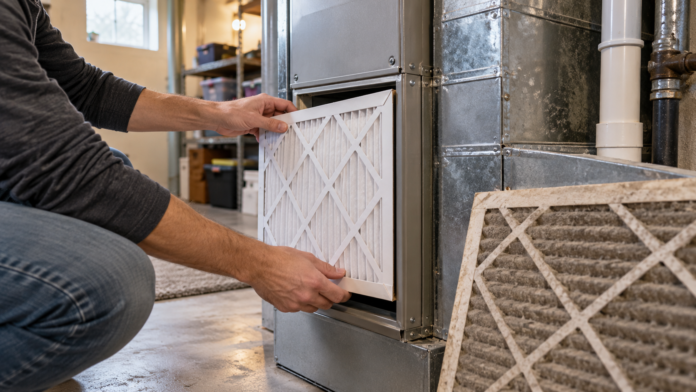

Here is the answer nobody gives you: it depends. And that is not a dodge, it is the truth. The standard one-size-fits-all advice, “change it every 90 days,” works fine for an empty apartment with a basic fiberglass filter. But it falls apart the moment you have a dog, a dusty workshop, or a house where someone actually cooks three meals a day. You likely need to change your furnace filter somewhere between every 30 and every 90 days. This guide walks you through exactly how to find your number without overthinking it. You will also learn why a clean filter matters more than you think, and how skipping changes quietly wrecks your furnace, your air, and your energy bill.
What Actually Happens When You Skip a Filter Change?
Let’s talk about the stakes first, because most homeowners treat the filter like a suggestion. It is not. A clogged filter forces your blower motor to work harder to pull air through the system. That extra effort pushes your furnace closer to an overheating shutdown, and it does not stop there. The heat exchanger, the component that actually warms your air, can run hotter than designed when airflow drops. That is the failure mode that cracks heat exchangers. A cracked heat exchanger is a carbon monoxide risk nobody should ignore.
The Environmental Protection Agency publishes straightforward guidance on indoor air quality and HVAC maintenance, and their core point is this: the filter is your first defense against recirculating dust, pollen, pet dander, and the general crud that lives in your ductwork. When you skip changes, that crud builds up on the blower wheel and the evaporator coil. Cleaning those components later costs far more than a box of filters ever did.
Here is another angle most guides skip. Your furnace filter also protects the equipment itself, not just your lungs. A blower caked in dust runs out of balance, which shortens its lifespan and raises your monthly power draw. So the real question is not “how often should I change it,” but “how fast does my filter actually load up?”
What Is the 30-60-90 Rule, Really?
You have probably heard some version of the 30-60-90 rule. It goes like this: basic 1-inch fiberglass filters get changed monthly, standard pleated filters every 60 days, and thicker media filters can stretch to 90 days. Here is the catch. That rule assumes a normal household with average dust. Most households are not average.
Consider the ENERGY STAR program’s guidance on home efficiency. They emphasize that any restriction on airflow makes your whole system run less efficiently. A dirty filter is the most common airflow restriction in residential HVAC. Their recommendation boils down to checking your filter monthly and replacing it whenever it looks dirty, regardless of the calendar.
That is the honest answer. Pull the filter out once a month. Hold it up to a light. If you cannot see light through the pleats, or if a visible layer of gray fuzz covers the surface, it is time. Some months your filter will be fine at day 30. During heavy pollen season, or when you run the fan constantly, it will look like a used shop rag by week three.
Match the Filter to Your Household, Not the Package
Your household profile changes the math more than anything else. Let’s break it down by the situations that actually alter your timeline.
You have pets. One medium dog adds a surprising amount of dander and hair to your air. Plan on monthly changes during shedding season, especially with a 1-inch pleated filter. Some pet owners switch to a washable electrostatic filter, but those have a trade-off: they stop working well once the charge dissipates, usually after a few weeks of airflow.
Someone in the house has allergies or asthma. You probably already run a higher MERV filter, in the 11 to 13 range. That higher efficiency catches more particles, but it also loads up faster and restricts airflow more when dirty. Change it on the shorter end of the range, every 30 to 45 days, and never push it past 60.
You live in a dusty area or a newer construction zone. New homes generate drywall dust and sawdust for the first year or two. If you are near an active construction site, a field, or a busy road, your filter is eating more than a suburban house would. Monthly changes are not overkill here.
You run your fan continuously. Many modern thermostats have a fan setting that circulates air 24/7 for even temperatures. That is great for comfort, but it means your filter works around the clock. Slice your normal interval in half.
Why Thicker Filters Change the Conversation
Not all filter slots are created equal. Some systems use a 1-inch filter at the return grille. Others use a 4-inch or 5-inch media cabinet installed right at the furnace. That difference matters a lot.
A 1-inch filter has less surface area, so it loads up faster. A 4-inch media filter has roughly four times the surface area and can often last six months or more. If you have the deeper cabinet, you can afford to extend your intervals, but you still need to check monthly until you learn your home’s dust load.
If you are shopping for filters, look at the MERV rating. Ratings between 8 and 11 handle the vast majority of homes well without choking your blower. Above 13, you start to trade airflow for filtration, and a furnace not designed for that static pressure will struggle. When in doubt, a MERV 8 or MERV 11 pleated filter is the safest call for most systems.
How a Dirty Filter Sneaks Into Your Energy Bill
Here is a phase most homeowners never connect. A dirty filter raises your monthly heating cost before you ever notice anything wrong. The blower works harder, runs longer, and your furnace cycles more often because the heat exchanger trips its limit switch earlier than it should.
And here is the part that sounds backwards at first. A system with a dirty filter often short-cycles, meaning it turns on, heats for a short burst, then shuts off when the safety limit trips. That makes the house feel unevenly warm and drives your bill up, all while the furnace never quite delivers what you paid for.
Getting your system cleaned and checked once a year is the complement to regular filter changes. When you bring in an expert HVAC tune-up service, the technician checks blower wheel balance, measures temperature rise across the heat exchanger, and catches the signs of a neglected filter before they become a breakdown. A full hvac tune up also includes inspecting the burners, verifying gas pressure, and testing the safety switches. Think of it this way: the filter is your daily brushing, the yearly tune-up is the dentist visit. You need both.
Signs You Waited Too Long
Sometimes you just forget. It happens. Here are the telltale signs your filter has been in service too long, so you can fix it before real damage sets in.
- The register feels weak. Hold your hand over a supply vent. If the airflow feels noticeably weaker than it did last season, your filter is likely the culprit.
- Dust returns within hours. If you dust a shelf and it looks dusty again the same day, your system is recirculating the junk it should be trapping.
- The furnace cycles on and off frequently. Short cycling is the safety limit responding to high heat exchanger temperatures caused by low airflow.
- The filter is visibly gray or brown. If you can see a matted layer of dust, the filter has already passed its useful window.
- The house smells dusty when the heat kicks on. That is the smell of the blower heater burning off accumulated debris, and it means the coil likely needs professional cleaning.
A Simple Routine That Sticks
Everyone knows they should change the filter. Nobody actually does it on schedule. Instead of relying on memory, build a habit around something that already happens.
Set a recurring reminder on your phone for the first Saturday of every month. Buy your filters in a six-pack so you never have a trip to the store as an excuse. Write the date on the new filter’s cardboard edge with a marker the moment you install it. That marker trick sounds small, but it tells you exactly how long that filter has served, and it shows the technician what they are dealing with.
When you pull the filter out, take a second to look at the furnace’s blower compartment. If you see dust built up on the blower wheel, that is the sign you waited too long this cycle. Vacuum what you can reach, and mention it at your next scheduled maintenance visit so the tech can give it a proper cleaning.
One more thing worth saying. If your filter keeps loading up way faster than the 90-day mark suggests it should, do not just shrug and buy cheaper filters. That fast loading is information. It means your house is dustier than average, your ductwork might have leaks pulling in attic or crawlspace air, or your return grille is undersized. All of those are fixable, and a good technician can trace the source during the yearly check. That is exactly why the annual hvac tune up matters. The filter is the symptom, and the system tells the full story.
So, how often should you replace your furnace filter? Start at 30 days for a 1-inch filter in an active household, 60 days for a quiet home with a standard pleated filter, and 90 days only if you have a deep media cabinet and light dust. Then watch what your filter tells you and adjust from there.
Also Read: SIGNS YOUR HOME’S PLUMBING AND HVAC SYSTEMS ARE OVERDUE FOR A CHECKUP