

Forty-six percent of fashion executives expect industry conditions to worsen this year. That’s not a reason to panic. It is a reason to move faster and smarter than the brands still emailing spreadsheets between teams. The labels winning right now aren’t necessarily the ones with bigger budgets or better designers. They’re the ones who figured out that speed-to-market is a systems problem, not a creativity problem.
This piece walks through the real levers behind faster collection development: where time actually bleeds out in a typical product cycle, what the highest-performing brands do differently at each stage, and the specific tools and workflows you can start putting in place right now. If you’ve ever watched a trend peak on TikTok while your sample is still in its third revision round, keep reading.
The Speed Problem Is Bigger Than You Think
The traditional definition of fast fashion, roughly a six-week lead time from design to retail, is now effectively obsolete. Ultra-fast players have compressed the production cycle to as little as three days. Your brand almost certainly doesn’t need to operate at that extreme, but the gap between where most mid-size labels sit and where the market expects them to be is wider than it was even three years ago.
The fashion industry runs on seasonal cycles that demand timely production and delivery, and shortening time-to-market is crucial to capitalize on emerging trends, which puts real strain on every link in the supply chain. The pressure is structural, not temporary.
Here’s what makes this genuinely hard: speed and quality aren’t naturally aligned. Rush a garment through development without the right systems, and you end up with costly sample revisions, production delays, and garments that don’t match the original vision. The brands that crack the speed-quality equation aren’t cutting corners. They’re removing the invisible inefficiencies that nobody measures because nobody owns them.
Where Time Actually Goes (The Leak Map Framework)
Most people assume development delays happen at the factory. In reality, the biggest time losses almost always happen before a single sample is cut. I call these the four invisible leaks, and if you can identify which ones are hitting your brand hardest, you’ll know exactly where to focus first.
Leak 1: Uncontrolled revision loops. A single measurement change to a tech pack can ripple into fabric procurement, costing sheets, and vendor timelines simultaneously. When that change lives in an email thread instead of a shared system, different stakeholders act on different versions of the truth. You burn a week just reconciling what the current spec actually is.
Leak 2: Approval paralysis. Design sign-off, material approval, fit approval. Each one has a stakeholder who’s balancing your product against twelve other priorities. Without a defined approval workflow with timestamps and accountability, “I’m reviewing it” lives comfortably in someone’s inbox for nine days.
Leak 3: Vendor communication gaps. Many fashion brands source materials and manufacture globally to manage costs, but managing a global supply chain introduces real complexity around lead times, logistics, and supplier communication. When vendors are working from PDF attachments sent via WhatsApp, you’ve already lost control of the revision trail.
Leak 4: Documentation poverty. The hidden costs of manual tech packs extend far beyond the time spent creating them. Supply chain inefficiencies, many of which stem from poor technical documentation, cost the global fashion industry an estimated $500 billion annually, according to McKinsey’s State of Fashion research. That’s not an abstract number. Every hour your technical designer spends rebuilding a spec sheet from scratch is an hour you can’t get back before the delivery window closes.
What the Fastest Brands Actually Do Differently
Speed comes from discipline applied in the right places, not pressure applied everywhere. Here’s what separates the brands hitting aggressive delivery timelines from the ones still firefighting in Week 9 of a 10-week development cycle.
They treat product data as a single source of truth
The fastest development teams don’t manage products through a collection of files. Every spec, BOM update, sample comment, and vendor response lives in one connected system that all stakeholders access in real time. When a fabric gets swapped, the cost sheet updates. When a measurement changes, every downstream document reflects it. There’s no “latest version” confusion because there’s only one version.
This is exactly the infrastructure that purpose-built product lifecycle management software provides. For brands evaluating options, resources like a dedicated guide to the best PLM software for fashion can help teams understand what a genuinely apparel-specific system looks like versus a generic project tool adapted for garment development.
They build supplier transparency into the process, not onto it
Global fashion brands now audit their suppliers not only for production capacity, but for how information flows. That shift matters. Risk in the supply chain isn’t only about product quality. It’s about compliance exposure, audit readiness, and the day-to-day cost of managing the relationship. A manufacturer with a transparent, digital supply chain process reduces the brand’s administrative burden and signals the kind of operational discipline that justifies longer contract terms.
Brands that bring vendors into shared digital workflows, rather than managing them through back-and-forth emails, shave real days off every development round. Fewer follow-up messages. Fewer “did you get my last email” delays. Fewer samples built on outdated specs.
They compress the approval cycle, not the creative cycle
This is the nuance most brands miss. The goal is never to give your design team less time. The goal is to give your approval process fewer places to stall. Setting defined SLAs for each approval gate, whether it’s 24 hours for a material confirmation or 48 hours for a fit sign-off, turns an indefinite waiting period into a scheduled step. You can plan around a scheduled step. You cannot plan around “sometime this week.”
The 2026 Market Reality Behind the Urgency
According to McKinsey’s State of Fashion 2026 report, 46 percent of fashion leaders said they expect conditions to worsen this year, up from 39 percent in last year’s survey. That pessimism isn’t irrational. But among those polled, 25 percent believe industry conditions will improve, up from 20 percent in 2025, suggesting some players genuinely see pockets of opportunity.
The brands finding those pockets are almost universally the ones that invested in operational tightness during the slow years. Faster development doesn’t just get product to market sooner. It gives you the flexibility to react when a trend breaks unexpectedly, cut a collection that isn’t performing, or double down on one that is. That kind of agility is worth more in a volatile market than any single season’s margin improvement.
The Interline and MMGNET’s Fashion and Technology in 2025 report revealed that brands have four top priorities heading into this period: profitability and margin, demand forecasting, sustainability compliance, and competitive differentiation. Companies are investing heavily in technology to achieve these goals, and 85.71 percent believe technology will play a role in helping businesses overcome the current challenges.
Speed-to-market touches all four of those priorities directly. Move faster, and you carry less dead inventory. React to demand signals more quickly, and your forecasting problem shrinks. A tighter, more transparent development process is also easier to audit for sustainability compliance. Hard to argue with that math.
“Building supply chain transparency requires more than intention. It requires the right tools integrated into the right workflow.”- Audaces, writing on apparel supply chain management in their analysis of how tech packs improve transparency, June 2026
Time-to-Market by Development Stage: A Reference Benchmark
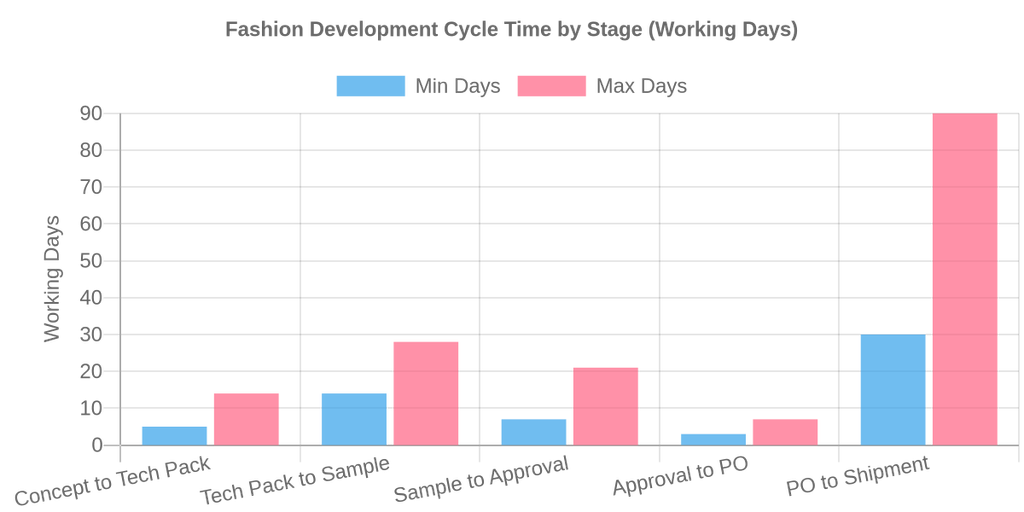
Most development teams have no idea how their cycle time compares to industry norms because nobody publishes this data cleanly. The table below draws on practitioner benchmarks across mid-market fashion brands to give you a working reference. Your numbers will vary by category and production region, but if you’re consistently sitting at the high end of every range, that’s where the investigation starts.
| Development Stage | Typical Range (Working Days) | Primary Time Risk |
|---|---|---|
| Concept to approved tech pack | 5 to 14 days | Revision loops, unclear approval ownership |
| Tech pack to first sample | 14 to 28 days | Vendor communication lag, spec errors |
| First sample to approval | 7 to 21 days | Multiple fit review rounds, stakeholder availability |
| Approved sample to production order | 3 to 7 days | Costing finalization, PO sign-off delays |
| Production order to shipment | 30 to 90 days | Factory lead times, material availability |
Notice that the first three rows, the stages your team controls most directly, can swing by 35 to 50 working days depending on how organized your process is. That swing is entirely recoverable with the right systems in place.
A Practical Checklist for Compressing Your Next Development Cycle
This isn’t theory. These are the specific things your team can act on before your next collection kicks off.
- Audit your revision trail. Pull the last three tech packs your team completed and count the number of email threads touching each one. More than five separate threads per style is a warning sign that your revision process is uncontrolled.
- Assign approval owners, not approval groups. Every sign-off gate needs exactly one person accountable. Groups diffuse responsibility. One name means one deadline.
- Set a vendor access standard. Decide whether your suppliers will work inside a shared digital system or whether they’ll continue receiving PDFs. If it’s PDFs, budget for the revision lag that comes with it.
- Build your material library before the season starts. Approved fabrics and trims that live in a searchable library take 30 seconds to add to a BOM. Fabrics that live in a folder on someone’s desktop require a conversation that takes two days.
- Track sample round counts, not just delivery dates. Delivery date slippage is a symptom. High sample round counts are the cause. Target no more than three rounds per style on average.
- Map your calendar backward from ship date. Start with the date your product needs to be at the distribution center and work backward through every stage. This makes the non-negotiable constraints visible before the season starts, not three weeks in.
The Technology Layer: What Actually Moves the Needle
Every team wants better results. Not every team wants to change how they work to get them. So here’s a clear-eyed read on where technology investment actually pays off in speed-to-market, and where it doesn’t.
- High impact: Centralized product data management. When your tech packs, BOMs, costing, and sample comments all live in one connected system, you eliminate the version control chaos that silently eats weeks. This is the single highest-leverage technology investment for development speed.
- High impact: Vendor-facing collaboration tools. Anything that puts your supplier inside the same system your team is working in, rather than outside it sending emails, compresses the communication lag that lives between every development step.
- Moderate impact: AI-assisted design tools. Useful for generating concepts quickly and exploring variations before committing to sampling. The total integration of AI across the supply chain is transforming parts of the industry from a supply-driven model to a demand-driven read-and-react approach. For most brands, this is a genuine advantage at the earliest stages of development, before the operational process takes over.
- Lower impact than advertised: General project management tools adapted for fashion. Trello, Asana, and Monday.com can track tasks. They weren’t built for apparel workflows, and the workarounds required to make them function like a proper development system usually cost more in maintenance than the tools cost in licensing fees. Fashion-specific infrastructure beats general infrastructure here, full stop.
For a deeper look at what purpose-built apparel systems look like in practice, Techpacker’s supply chain guide offers a clear breakdown of how centralized platforms address the communication and documentation gaps that most brands underestimate.
And for context on just how severe the market pressure has become, McKinsey’s State of Fashion 2026 report lays out the broader competitive environment clearly, including the regional variation in where opportunity is actually emerging.
The Honest Trade-Off Nobody Talks About
Compressing your development cycle does require a real upfront investment: in systems, in process redesign, and in getting your team to actually change how they work day to day. The last one is the hardest. A new PLM system doesn’t help if your technical designers are still maintaining their own private spreadsheets “just in case.”
The brands that fail at this aren’t failing because the technology doesn’t work. They’re failing because they treated the technology purchase as the finish line instead of the starting point. Implementation is a people project as much as a software project. The brands that succeed treat adoption as a deliverable, not an assumption.
You already know where your process breaks down. You’ve felt it every season when the same problems reappear in slightly different form. The question isn’t whether your current workflow has inefficiencies. It does. The question is whether the cost of fixing them this year is higher than the cost of carrying them into next year. Given where the market is headed, most brands will find the math tilts firmly toward fixing them now. What’s the single biggest time sink in your last development cycle, and do you know which stage it belongs to?
Also Read: REFRESHING YOUR WARDROBE AND SPACE WITH ONLINE FASHION AND HOME ACCESSORIES