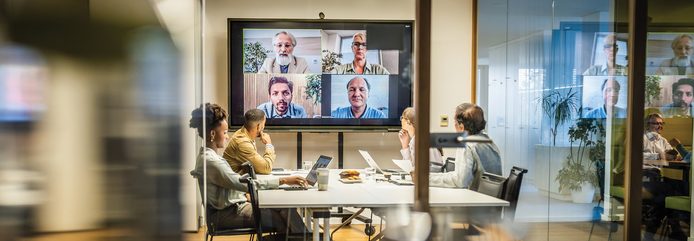

Hybrid work has changed the way businesses approach meeting spaces. A modern meeting is no longer limited to employees sitting around the same table. Participants may join from home, another office, a different city, or even another country.
This creates new requirements for workplace meeting rooms. A space that works well for an entirely in-person meeting may not provide the same experience for remote participants.
This is where video conferencing companies can help businesses plan and implement meeting environments that support both in-person and remote collaboration.
What Makes a Hybrid Meeting Space Different?
A traditional meeting room mainly needs to accommodate people physically present in the room. A hybrid meeting space has another audience to consider: people participating remotely.
Remote participants need to see the people in the room, hear conversations clearly, view presentations, and participate without constantly asking others to repeat themselves.
This means the room’s cameras, microphones, speakers, displays, lighting, furniture, and network connectivity all need to work together.
Simply placing a webcam on a conference table is rarely enough for larger or more complex meeting environments.
How Can Video Conferencing Companies Help With Room Design?
Professional providers can assess how a business uses its meeting spaces before recommending technology.
Factors such as room size, seating arrangement, number of participants, acoustic conditions, display requirements, and preferred conferencing platforms can all influence the final design.
For example, a small room used primarily for two or three people may require a very different camera and microphone arrangement from a large boardroom used for presentations and team meetings.
Designing around the room’s actual purpose can help prevent businesses from purchasing equipment that is unsuitable for the environment.
Why Are Cameras Important in Hybrid Meetings?
Remote participants need a clear view of the people taking part in a meeting. A poorly positioned camera can create awkward viewing angles, exclude participants from the frame, or make it difficult to identify who is speaking.
Modern conferencing systems can include wide-angle cameras, automatic framing, speaker tracking, and other intelligent features.
The right camera configuration depends on the room. A small huddle space may need only a single compact camera, while a larger meeting room may benefit from multiple cameras or more advanced tracking capabilities.
Professional planning helps ensure camera coverage matches the physical layout.
How Does Audio Affect the Hybrid Meeting Experience?
Audio is just as important as video.
Remote participants cannot follow a meeting effectively if voices are unclear, microphones fail to capture people sitting further away, or background noise and echo interfere with conversations.
The number and placement of microphones should therefore be considered during the design process. Speakers should also provide clear audio throughout the room without creating unnecessary volume differences.
Acoustic treatment can further improve the experience by reducing unwanted reflections and background noise.
How Do Office Pods Fit Into Hybrid Workplace Design?
Not every virtual meeting needs a large conference room.
Office pods can provide smaller, dedicated environments for individual video calls, interviews, focused collaboration, and small virtual meetings.
For example, an employee may need to attend a confidential client call while the rest of the office remains active. A private pod can provide acoustic separation without requiring the employee to occupy a large meeting room.
Small meeting pods can also support two or three employees joining a virtual meeting together.
When equipped with suitable displays, cameras, microphones, and connectivity, these spaces can become useful extensions of the wider hybrid meeting strategy.
Why Does Technology Integration Matter?
One of the biggest challenges with workplace AV technology is complexity.
If employees need to connect multiple cables, change several settings, switch between devices, and troubleshoot equipment before every meeting, the technology can become a barrier rather than a benefit.
Professional video conferencing companies can help integrate conferencing equipment into a simpler user experience.
Depending on the environment, this could include touch controls, wireless presentation, integrated displays, automated camera functions, and centralised control.
The objective is straightforward: employees should be able to enter a room and start a meeting with minimal technical intervention.
How Can Businesses Plan for Future Requirements?
Hybrid workplace technology continues to evolve, so businesses should consider flexibility when designing meeting spaces.
Infrastructure such as power, data connectivity, cable pathways, display mounting, and equipment access can influence how easily technology can be upgraded later.
This is particularly important for office pods and smaller meeting spaces, where adding equipment after installation may be more difficult.
A flexible design allows businesses to replace cameras, displays, microphones, and conferencing hardware as requirements change without completely redesigning the space.
Choosing the Right Approach for Hybrid Meetings
There is no universal technology package for every business.
A workplace may require a combination of large boardrooms, small collaboration rooms, individual video-call pods, and informal meeting spaces.
The right mix depends on how employees work, how frequently remote participants join meetings, the size of teams, and the types of conversations taking place.
Working with experienced video conferencing companies can help businesses consider these factors before investing in equipment and room infrastructure.
Conclusion
Hybrid meetings require more than a camera and a screen. They depend on the interaction between room design, acoustics, connectivity, audiovisual technology, and the way employees actually use the space.
Office pods can provide private and flexible environments for individual and small-group virtual meetings, while professionally designed conference rooms can support larger hybrid discussions.
By planning the technology and physical environment together, businesses can create meeting spaces that are easier to use, more inclusive for remote participants, and flexible enough to adapt as workplace requirements continue to change.