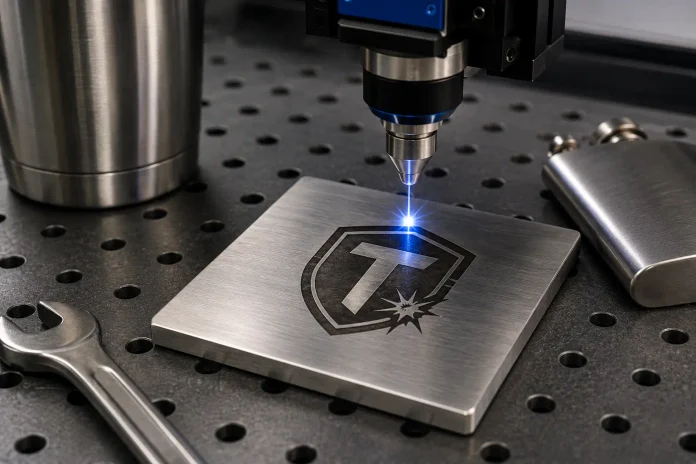

Stainless steel is commonly used for industrial components, machinery, tools, equipment and identification plates because of its strength and resistance to corrosion. When permanent identification is required, laser processing can create precise markings and engravings without relying on printed labels.
However, achieving a clean and readable result depends heavily on selecting appropriate laser settings. Power, speed, frequency, focus and other processing variables can all influence the appearance and consistency of laser engraving stainless steel.
Why Do Laser Settings Matter?
A laser engraving system uses concentrated energy to interact with the surface of the material. The amount of energy delivered to a particular area depends on several parameters, including laser power and processing speed.
If too little energy reaches the surface, the resulting mark may have insufficient contrast or definition. Excessive energy can produce unwanted surface changes or affect the surrounding area.
The goal is to match the laser parameters to the specific stainless steel material, surface finish and desired result.
How Does Laser Power Affect Stainless Steel?
Laser power determines how much energy is available to process the surface. Increasing power can produce a stronger interaction with the material, while lower power can create a more subtle effect.
The appropriate power level depends on the laser system, stainless steel grade, surface condition and type of marking required. A surface identification mark may require different settings from an application where material removal or deeper engraving is needed.
Using excessive power does not necessarily produce a better result. Controlled testing is important for identifying a suitable range.
What Effect Does Processing Speed Have?
Laser speed determines how quickly the beam moves across the material. A slower speed generally allows more energy to be delivered to a particular area, while a faster speed reduces the interaction time.
This means speed and power need to be considered together. Changing one setting without accounting for the other can alter the appearance of the engraving.
For production applications, finding a balanced combination can help achieve consistent results across multiple components.
How Does Frequency Influence the Mark?
Frequency controls the rate at which laser pulses are delivered in systems where pulse frequency is adjustable. Changes in frequency can affect the way energy is distributed across the stainless steel surface.
Depending on the laser system and application, different frequency settings may influence the contrast, texture and overall appearance of the mark.
Because laser technology varies between machines, the appropriate frequency range should be established through controlled testing rather than applying a universal setting.
Why Is Focus Important?
The laser beam needs to be properly focused on the work surface to achieve a controlled and consistent result. Incorrect focus can spread the energy over a larger area, potentially reducing detail and clarity.
This becomes particularly important when engraving small text, fine symbols or machine-readable codes. Accurate positioning and focus can help maintain the definition of these details.
The workpiece should also be positioned consistently so that the focal distance remains appropriate throughout the engraving process.
How Does Surface Finish Affect the Result?
Stainless steel can have polished, brushed, satin or other surface finishes. These finishes can affect how the laser interacts with and how the resulting mark appears on the material.
A mark that looks highly visible on one surface may have a different level of contrast on another. Surface condition should therefore be considered when selecting processing parameters.
Testing on the actual surface finish can help determine whether adjustments are needed to achieve the required appearance.
Can a Metal Engraving Machine Produce Consistent Results?
A Metal Engraving machine can be used for various metal identification applications, but consistency depends on the relationship between the equipment, material and processing settings.
Digital designs can help maintain consistent positioning and dimensions, while repeatable machine parameters can help produce similar results across multiple components.
For stainless steel applications, the machine should be compatible with the required processing method and the specific material being engraved.
Why Is Sample Testing Recommended?
Before beginning a large production run, sample testing allows operators to compare different combinations of power, speed, frequency and focus.
The test can evaluate factors such as contrast, detail, surface appearance and consistency. This is particularly useful when working with a new stainless steel grade, surface finish or engraving design.
Once suitable settings have been identified, they can be documented and reproduced for subsequent production.
Selecting the Right Settings for Stainless Steel
There is no single combination of laser settings that works for every stainless steel application. The correct parameters depend on the material, surface finish, laser system and intended result.
For businesses using laser engraving stainless steel, controlled testing and consistent machine setup can help achieve clear and repeatable identification. A suitable Metal Engraving machine, combined with properly matched processing parameters, can support accurate engraving across a range of industrial metal applications.