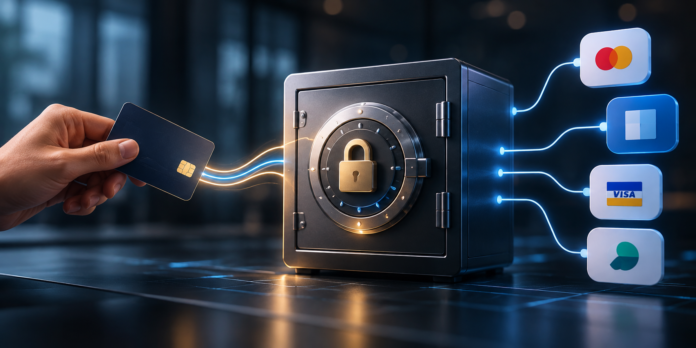

Switch payment processors today and you’re not really switching anything. You’re starting over. Every stored card, every saved payment method, every token your customers never think about, it’s all sitting in a vault your old processor owns, not you. A payment vault changes that equation entirely, and understanding how is worth more than another vendor pitch deck promising flexibility it can’t actually deliver.
Why Processor Lock-In Happens in the First Place
Tokenization is supposed to be the security win everyone talks about. Replace raw card data with a token, keep sensitive information out of your systems, reduce PCI scope. All true. What gets left out of the pitch: when the processor generates and owns that token, switching providers means the token goes nowhere with you. Vendor lock-in shows up when a merchant becomes highly dependent on a particular payments provider, since certain capabilities like card-on-file payments end up tied to that vendor because the tokenized payment instruments live in its proprietary payment vault.
Here’s the part that actually costs money. A failed transaction can’t cascade to a different provider when the payment method is tied to one vendor’s token, which means soft declines that a second processor might have approved just get lost. That’s not a security gap. It’s a revenue leak, quietly built into the architecture.
What a Payment Vault Actually Changes
A payment vault, run independently of any single processor, holds the tokenization layer itself. When merchants own these tokens rather than the processor, they can port or reuse customer payment data across processors, and that one architectural shift is the entire difference between orchestration that works and orchestration that just adds a routing layer on top of the same lock-in.
The distinction matters more than it sounds like it should. Plenty of “orchestration” platforms route traffic across processors while still leaving the tokens themselves sitting in processor-owned vaults underneath. That’s orchestration in name only. Building multiprocessor routing on top of vendor-owned token vaults can actually worsen lock-in rather than solve it, since now you’ve added a dependency layer without removing the original one.
Processor-Owned vs. Vault-Owned Tokenization
| Factor | Processor-Owned Tokens | Independent Payment Vault |
| Token portability | Tied to one processor | Portable across processors |
| Switching cost | High, requires re-tokenization | Low, tokens already yours |
| Failover on decline | Not possible | Cascades to next processor |
| PCI scope | Reduced, but vendor-dependent | Reduced, vendor-independent |
| Negotiating leverage | Weak | Strong |
The Business Case Beyond Security
Security gets the headline, but the real driver here is commercial. Multiprocessor adoption is rising fast, with a majority of merchants preferring to work with multiple payment providers to improve flexibility, reach, and cost optimization, and that preference doesn’t mean much without the token portability to actually act on it.
Data ownership tends to matter more the bigger the business gets. Merchants above roughly $100 million in revenue overwhelmingly say controlling their own payment data is key to business success, which tracks with what you’d expect: the cost of staying locked in scales with transaction volume, and at enough scale, even a small improvement in approval rates through smart routing outweighs whatever switching friction a vault-first architecture takes to set up.
None of this requires abandoning existing processor relationships. A payment vault sits underneath them, not instead of them. You keep the integrations you already have and gain the ability to add, remove, or rebalance traffic across providers without re-tokenizing your entire customer base each time.
The customer experience angle gets overlooked in most of these conversations, and it shouldn’t. A failed recurring charge on a subscription doesn’t just cost that month’s revenue; it risks the customer noticing, updating a card elsewhere, or churning outright before anyone on the merchant side even sees the decline. Cascading a soft decline to a second processor, invisibly, before the customer ever encounters friction, turns a routing decision into a retention outcome. That’s a harder number to put on a slide than PCI scope reduction, but it tends to matter more to the finance team once someone actually calculates it.
How the Migration Actually Works
Moving to a vault-first architecture isn’t a weekend project, and treating it as one is how these rollouts stall. The realistic path starts with auditing which tokens currently exist across which processors, then running the vault alongside existing integrations rather than cutting over all at once. New transactions get tokenized at the vault layer immediately; existing stored payment methods get migrated in batches, processor by processor, as contracts and re-authentication windows allow.
Expect a period, often a full billing cycle or two for subscription-heavy businesses, where both the old and new tokenization paths run in parallel. Rushing that overlap to save a few weeks tends to be where migrations actually break, usually in the form of a subscription renewal that silently fails because a token didn’t finish migrating in time.
Conclusion
PCI validation is table stakes, not a differentiator; assume any credible vault meets it and dig into what happens beyond that baseline. Network token support matters more than it gets credit for, since network tokens (as opposed to processor-specific tokens) tend to carry their own portability advantages on top of whatever the vault provides.
Ask specifically how token migration works if you ever need to move away from the vault provider itself, not just away from a processor. A vault that solves processor lock-in while quietly introducing vault lock-in hasn’t actually fixed the underlying problem, just relocated it one layer up. One detailed breakdown of how this architecture works in practice is worth reading if you want the deeper technical mechanics beyond what fits here.
A payment vault built the right way turns processor relationships into something you can actually renegotiate, reroute, and replace without disrupting the customer experience underneath it. That’s the entire point. Anything marketed as orchestration that doesn’t deliver token portability at the vault layer is solving a smaller problem than the one that’s actually costing you money.