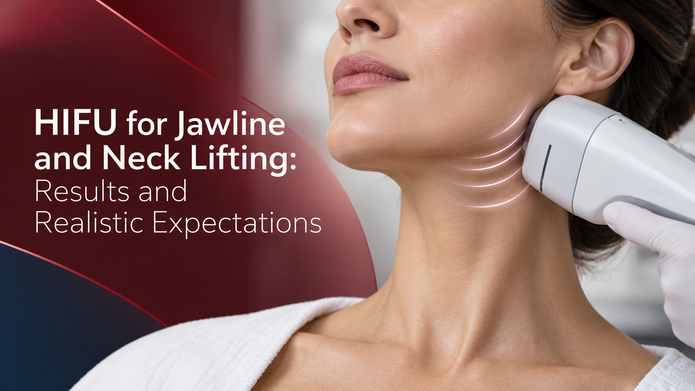

Sagging along the jawline and under the chin is usually one of the first signs that the deeper support layer of the face has loosened, not just the surface skin. HIFU, short for high-intensity focused ultrasound, works on that deeper layer without cutting or needles, which is why it has become a common choice for people who want a firmer lower face and neckline but are not ready for surgery.
Among the face lifting devices sold for clinic and at-home use, HIFU systems stand apart because they aim energy below the skin surface rather than only warming the top layers. The device focuses ultrasound on a precise point deep in the tissue, and the body responds by rebuilding collagen over the following weeks. That is the whole idea behind using it for a slack jawline: tighten the structure that holds the lower face up, then let new collagen hold the improvement.
How HIFU reaches the jawline and neck
Focused ultrasound concentrates energy at fixed focal depths, commonly around 1.5, 3.0 and 4.5 mm below the surface. Those depths reach the dermis and, at the deepest setting, the superficial musculoaponeurotic system, or SMAS. The SMAS is the fibrous muscle-and-connective-tissue layer that a surgeon actually pulls and tightens during a facelift, so reaching it non-surgically is what makes the technique interesting for the lower face and neck.
At each focal point the tissue is heated past roughly 65 degrees Celsius. This creates tiny, controlled zones of thermal coagulation while leaving the skin surface intact. Two things follow: existing collagen fibers contract straight away, giving a small immediate tightening, and the heated points trigger neocollagenesis, the slower formation of fresh collagen and elastin. The deeper 4.5 mm setting is the one that engages the SMAS under the jaw and neck, which is why the depth chosen for the area genuinely changes the result.
What results to expect on a sagging jawline and neck
Published reviews of face and neck treatment report skin laxity improvements in the range of roughly 18 to 30 percent, with the lower face and neck among the areas that respond best. That is a real, visible refinement of the jawline and a softening of early jowls, not the dramatic redraping a surgical lift produces. Framing the goal as tightening and better definition, rather than removal of loose skin, keeps expectations honest.
The timeline matters as much as the amount. Any tightening felt right after a session is modest. The main effect builds gradually over about two to three months as the new collagen matures, so the jawline usually looks its best well after the appointment rather than the same week. Improvements commonly hold for around 12 to 18 months, after which natural aging continues and many people schedule a maintenance session to keep the effect topped up.
Who gets the most from it, and who does not
The strongest candidates have mild to moderate laxity: an early softening of the jawline, light jowling, or a neckline that has just started to lose its edge, usually paired with skin that still has reasonable elasticity. For this group HIFU can meaningfully sharpen the lower face with no downtime.
- A good fit tends to be someone with early to moderate sagging who wants firming without surgery or recovery time.
- Heavy, deeply drooping tissue or a large amount of excess neck skin is beyond what focused ultrasound can lift, and a surgical neck lift will do far more there.
- Prominent vertical neck bands come from the platysma muscle and are a different problem, often handled with other treatments rather than tightening alone.
- At-home HIFU-style devices run at much lower energy than clinical systems, so any effect is subtler and slower, and they do not substitute for an in-clinic treatment.
HIFU compared with a surgical neck lift
Choosing between them is mostly about how much laxity there is and how much downtime a person will accept. The comparison below sets out the practical trade-offs.
| Factor | HIFU | Surgical neck or lower facelift |
| Invasiveness | Non-invasive, no incisions | Surgery under anesthesia, incisions |
| Downtime | Little to none, back to routine same day | Days to weeks of recovery |
| Best for | Mild to moderate laxity | Significant sagging and excess skin |
| Onset | Builds over about 2 to 3 months | Visible once healing settles |
| Duration | Roughly 12 to 18 months | Long lasting, though aging continues |
What the session feels like and how safe it is
A treatment is done in a single visit and feels like warmth with brief prickling or a deep tingling as energy is delivered, stronger at the deeper settings that reach the SMAS. There is no wound to care for afterward and most people return to normal activity immediately.
The safety record for face and neck treatment is favorable. Reported side effects are usually transient: some redness, mild swelling, tenderness, the occasional small bruise, and short-lived numbness or tingling in the treated area. In reviewed patients fewer than about 5 percent noted these effects, and they typically settle on their own. More serious problems, such as nerve irritation, are uncommon and are far less likely when the treatment is carried out by a trained practitioner who maps the depths correctly. Because the lower face and neck sit close to nerves, having the procedure done by a qualified professional after an in-person assessment is the single most important safety step.
It is worth knowing that regulatory clearance is device-specific rather than blanket. Microfocused ultrasound with visualization, marketed as Ultherapy, is cleared by the US FDA for non-invasive lifting of the brow, the submental area under the chin and the neck, and for improving lines on the chest. Not every device on the market carries the same clearance or the same clinical evidence, so the specific system used is a fair question to ask.
Common follow-up questions
How many sessions are needed? Many people see the intended lift from a single well-planned treatment, though some benefit from a touch-up, and a maintenance session roughly once a year helps hold the result.
Is the effect permanent? No. HIFU renews collagen and buys time, but it does not stop aging, so the jawline will gradually soften again and can be re-treated.
Is it a facelift replacement? For genuine, heavy sagging, no. It is best understood as a tightening step for people whose looseness is still mild to moderate, or as a way to delay considering surgery.