
You’ve saved the photos. You’ve bought the pieces someone else wore well. And somehow the outfit that looked effortless on them feels like a costume on you. That’s not a failure of taste, it’s what happens when you copy results instead of understanding what you actually like. Personal style isn’t something you find fully formed, it’s something you assemble by paying attention. A hellstar graphic hoodie suits one person completely and reads as borrowed on another, and knowing which you are takes a bit of honest work. Let’s get into how that works.
Why Copying Outfits Doesn’t Transfer
There’s a specific reason a look that works on someone else falls flat on you, and it isn’t confidence. Every outfit depends on a set of conditions that don’t travel with the photo. Their proportions differ from yours, so the same silhouette sits differently on a different frame. Their colouring interacts with the shades they chose, which is why a colour that makes them glow can leave you looking washed out. Their life shapes the outfit too, since clothes that suit someone walking a city all day feel wrong on someone who drives to an office. Then there’s the setting, because a look that reads as normal in one place reads as costume in another. So you’re copying an outcome that was produced by inputs you don’t share. That’s the core problem. My honest opinion? Copying isn’t useless, it’s just the wrong stage of the process. Photos are excellent for gathering information about what appeals to you and terrible as shopping lists. The useful move is to look at what you’re drawn to and ask why, since the answer is usually more specific than “that outfit.” Maybe it’s the relaxed shoulder line, or the muted palette, or the contrast between something soft and something structured. Those underlying elements do transfer. The exact pieces mostly don’t.
Gathering Evidence About Your Own Taste
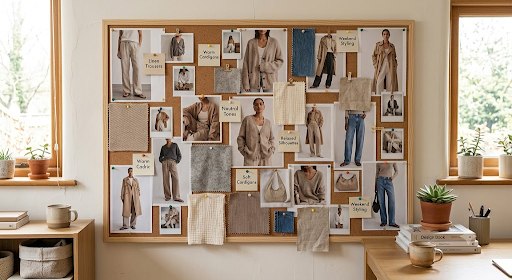
Before deciding anything, collect data on what you actually respond to. Save images over a few weeks without filtering or judging, pulling anything that catches your eye regardless of whether you think it suits you. Volume matters here since patterns only emerge across enough examples. Then look at the whole collection together and hunt for repetition. Most people find their taste is far narrower than they assumed, with the same palette, the same level of volume, and the same handful of silhouettes appearing again and again. That repetition is your actual preference showing itself. Look at your existing wardrobe with the same eye too, and specifically at the pieces you reach for constantly. Those are the strongest evidence you have, since you chose them repeatedly under real conditions rather than aspirationally. Note what they share, whether that’s weight, colour, cut, or how they feel to wear. Also, note what you own and never touch, because the reasons those fail tell you your limits. Someone who never reaches for anything bright has learned something about themselves worth respecting rather than fighting. This whole exercise takes a few weeks of passive collecting and about an hour of looking, and it’s more useful than any amount of shopping.
Turning Observations Into Rules
Once you’ve spotted your patterns, convert them into decisions you can actually use:
- Name your palette, listing the three or four colours that appear most in what you like and already wear
- Define your volume, deciding whether you prefer relaxed, fitted, or a specific mix of the two
- Identify your non-negotiables, meaning the details you consistently need, like fabric weight or sleeve length
- List your actual settings, since style has to work for the places you genuinely spend time
- Write down what you’ve ruled out, because knowing your limits speeds up every future decision
Step five is underrated and does a surprising amount of work. Knowing you don’t wear bright colours, or don’t like anything cropped, eliminates enormous swathes of the market instantly and makes shopping fast rather than overwhelming. Step four keeps the whole thing honest too, since a style built for a life you don’t live produces a wardrobe you don’t wear. Be realistic about where you actually go. Once you’ve written these five things down, you’ve got a filter you can apply to any piece you encounter, and most decisions become quick. That’s the point. Style isn’t about having more options, it’s about having fewer and better ones.
Testing Before Committing
Rules on paper still need checking against reality, and testing cheaply prevents expensive mistakes. Start by experimenting with what you already own, rearranging combinations you haven’t tried rather than buying anything. Most people have more workable outfits in their wardrobe than they’ve discovered, and finding them costs nothing. Then, when you do buy, buy one piece at a time and live with it for a few weeks before adding anything else. That pace lets you notice whether you actually reach for it, which is the only test that matters. Buying five pieces at once means you never learn which one was the good decision. Photograph yourself in new combinations too, since a mirror and a photo tell you different things, and the camera catches proportions your eye smooths over. Here’s the hands-on detail worth knowing: the pieces you keep reaching for are almost always the ones that need no adjustment during the day, and if you find yourself tugging a hem or pulling at a shoulder, that piece will quietly fall out of rotation within a month regardless of how good it looks. Comfort predicts frequency better than appearance does. One honest limitation: taste genuinely shifts over time, so anything you settle on now is a working answer rather than a permanent one, and expecting otherwise leads to frustration.
The Building Blocks Most Styles Need
Whatever direction you land on, certain foundations make everything else easier:
- A small palette of two or three neutrals that combine freely, reducing daily decisions to almost nothing
- One quality outer layer that works over most of what you own, anchoring cold-weather outfits
- Bottoms in a cut you genuinely like, since these determine the silhouette more than tops do
- Footwear in a neutral tone that matches the formality of most of your week
- One or two pieces with real personality, kept few enough that they stay special rather than competing
That last balance matters more than people expect. A wardrobe of all statement pieces has no quiet ground for anything to stand out against, so everything cancels out. Neutrals aren’t boring, they’re the surface that lets the interesting pieces work. Quality matters throughout too, since heavyweight fabric holds its shape and reads as considered while thin pieces undermine even a well-planned outfit. A dense cole buxton piece behaves differently from a lightweight equivalent, and that difference shows in how the whole outfit sits. My preference is spending most on the foundations and least on the statement items, since foundations get worn constantly while personality pieces come out occasionally.
Letting Style Develop Rather Than Fixing It
There’s a trap on the other side of this, which is deciding on a style and then defending it rigidly. Taste evolves, and it should. What suited you at twenty-two may not at thirty-five, and clinging to an old answer produces a wardrobe that feels like a costume of your past self. So revisit your patterns once or twice a year rather than treating them as settled. Notice when you stop reaching for something you used to love, because that drift is information rather than a betrayal. Let new influences in without abandoning what works either, since the useful approach is adding one new element at a time and seeing whether it sticks. Wholesale reinvention rarely holds, while gradual drift usually does. Also, resist the urge to have a fully articulated identity, honestly. Plenty of well-dressed people couldn’t describe their style in words and simply know what they like when they see it. The written rules are a tool for making decisions faster, not a personality statement. If they start feeling restrictive, loosen them. The whole point is a wardrobe that makes getting dressed easy and makes you feel like yourself, which is a moving target rather than a destination you arrive at.
Final Words
Personal style comes from paying attention, not from copying. Collect images without filtering for a few weeks, then look for what repeats, since your taste is narrower and more specific than you assume. Convert those patterns into a palette, a preferred volume, a few non-negotiables, and a clear list of what you’ve ruled out. Test with what you own before buying, add one piece at a time, and trust comfort as a predictor of what you’ll actually wear. Build on neutral foundations and keep statement pieces few. Then let it drift over time, because a style that can’t change stops being yours.
FAQ BLOCK
Q: Why doesn’t an outfit look the same on me?
A: Because proportions, colouring, setting, and daily life all differ, and none of those travel with the photo. Copy the underlying elements you’re drawn to, like the palette or silhouette, rather than exact pieces.
Q: How do I work out what my style actually is?
A: Save images for a few weeks without filtering, then look for what repeats. Also examine the pieces you already reach for constantly, since those are real evidence of preference rather than aspiration.
Q: How many statement pieces should I own?
A: Few. A wardrobe of all statement pieces has no quiet ground for anything to stand out against. Build on two or three neutrals and let one or two personality items do the work.
Q: How do I know if a new piece will stick?
A: Comfort predicts it better than appearance. If you’re tugging at a hem or adjusting a shoulder during the day, it’ll fall out of rotation within a month regardless of how good it looks.
Q: Should my style stay the same over time?
A: No. Taste shifts, and clinging to an old answer produces a wardrobe that feels like a costume. Revisit your patterns once or twice a year and let new elements in gradually rather than all at once.