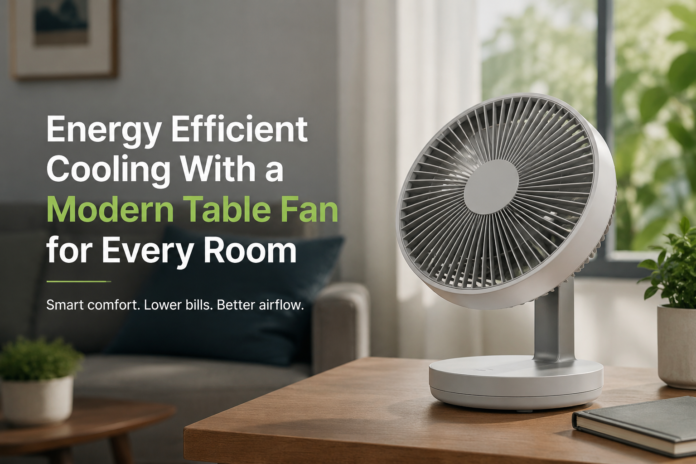

A table fan is one of the simplest and most cost-effective tools for staying comfortable at home without watching your electricity bill climb. Running on as little as 10–25 watts, these compact fans consume a fraction of what an air conditioner uses – making them a smart pick for targeted, room-by-room cooling.
That’s the short answer. But there’s more going on here than just pointing a fan at yourself on a hot afternoon.
Modern desktop fans have moved well beyond single-speed, plastic-housing basics. Today’s options feature adjustable oscillation, multiple speed settings, quiet DC motors, and slim profiles that fit on a nightstand or office desk without crowding the space. For anyone who wants steady airflow without the noise or energy drain of central air, a portable cooling fan offers something genuinely valuable – the flexibility to cool the room you’re in, not every room in the house.
Why Table Fans Actually Work for Home Cooling
Fans don’t lower a room’s temperature. What they do is create a wind-chill effect that makes your body feel several degrees cooler than the air actually is. According to the U.S. Department of Energy, using a fan allows you to raise your thermostat setting by about 4°F without any noticeable drop in comfort – a meaningful difference that adds up across a warm season.
Most people treat fans and air conditioning as an either/or situation. Used together, though, they’re more effective than either alone. Raise your thermostat by 3–4 degrees while running a fan in occupied rooms, and most people won’t notice the difference in comfort – but the energy savings show up on the next bill.
The Energy Numbers Are Hard to Ignore
The watt-for-watt comparison between fans and air conditioners is striking. A central AC unit draws between 2,000 and 5,000 watts per hour. A standard small table fan draws roughly 10 to 25 watts. According to Power Wizard’s 2026 energy usage analysis, fans consume 97–99% less electricity than air conditioners running over the same period.
Here’s a simple breakdown:
| Cooling Device | Typical Wattage | Avg. Cost per Hour (at $0.16/kWh) |
| Central AC | 2,000–5,000W | $0.32–$0.80 |
| Window AC Unit | 500–1,500W | $0.08–$0.24 |
| Standard Table Fan | 40–75W | $0.006–$0.012 |
| Small Table Fan | 10–25W | $0.001–$0.004 |
The savings accumulate quickly over the summer. And unlike AC equipment, a fan table setup requires no installation, no refrigerant, and no service technician – just an outlet and a flat surface.
Choosing the Right Fan for Different Rooms
Not every room has the same cooling needs. A bedroom calls for quiet, steady airflow. A home office needs consistent, directional circulation. A kitchen or laundry room just wants some basic air movement. Getting the right match for each space matters more than most people assume.
Bedrooms: Prioritize Quiet Operation
Sleep quality drops quickly with background noise. In bedrooms, the priority is a fan that moves enough air at low or medium speed so the motor doesn’t strain – and the blades don’t create turbulence that keeps you awake. Models with DC motors run noticeably quieter than older AC motor designs and pull significantly less power.
Features worth looking for in a bedroom fan:
- Multiple low-speed settings with genuine airflow at each
- Oscillation (90° or wider) for even air distribution
- A timer function so the fan shuts off after you fall asleep
- A compact footprint that doesn’t take over the nightstand
Home Offices: Consistency Over Raw Airflow
An office fan needs to be consistent rather than aggressive. Most people working at a desk don’t want a wind tunnel – they want enough air movement to stay comfortable during long hours without papers blowing around. An adjustable-tilt model works particularly well here, since you can angle it slightly upward to keep direct airflow off your face while still benefiting from the circulation.
Placement matters as much as the fan itself. Setting a fan table near a window during cooler morning hours pulls fresh outdoor air in before afternoon heat builds — and that alone can keep a room 3–5 degrees more comfortable by midday without any mechanical cooling at all.
The right table fan keeps any workspace cool, quiet, and energy efficient all day long.
Tips for Getting More Out of Your Cooling Fan
Research from the California Air Resources Board, cited in a 2024 energy efficiency analysis by Brody Pennell, found that using fans alongside AC and raising the thermostat accordingly can reduce HVAC energy consumption by roughly 5% per degree Fahrenheit. Raising a setpoint from 72°F to 77°F while running fans could therefore cut cooling-related energy use by around 25% over the course of a day – a real, measurable number, not a marketing estimate.
The catch is that fans only benefit people who are in the room. A fan running in a space does nothing for comfort and just wastes electricity. The savings come from using fans intentionally, in occupied spaces, during the hours when people are actually present.
A few simple adjustments can meaningfully increase how much comfort you get from the same appliance:
- Match speed to activity level. Sitting still at a desk calls for lower, steadier airflow than cooking in a hot kitchen. Adjust as conditions change rather than leaving it at one setting all day.
- Create cross-breezes in larger rooms. Place one fan near a window or doorway facing inward and another pointing toward an exit. Moving air replaces stagnant warm air far faster than recirculating the same air.
- Pair with humidity management. Fans work best in lower humidity because the cooling effect is evaporation-based. In high-humidity months, combining a fan with a dehumidifier noticeably improves the result.
- Keep blades clean. Dust buildup on blades cuts airflow efficiency and forces the motor to work harder. A quick wipe-down every few weeks keeps a fan table performing the way it should.
Explore JPRO Supplies’ climate control collection for fans suited to homes, offices, warehouses, and commercial facilities – including compact models for desktops and more robust units for larger open spaces.
Frequently Asked Questions
What is a table fan, and how does it work?
It’s a compact, portable electric fan designed to sit on a flat surface and circulate air nearby. It creates a wind-chill effect that makes the body feel cooler through sweat evaporation – without changing the room’s actual temperature.
Why choose a table fan over a ceiling or floor model?
Portability. A fan you can move from room to room provides targeted cooling exactly where it’s needed, while ceiling fans are fixed to one space.
How energy efficient are table fans versus pedestal or wall fans?
Very similar – efficiency depends more on motor type (DC vs. AC) and blade design than form factor. A small table fan with a DC motor often uses less power than a larger pedestal model with an older motor.
Is it worth buying a table fan for home use?
Yes, especially for focused, room-by-room cooling. These fans are affordable, require no installation, and run at a fraction of the cost of air conditioning – most effective in bedrooms, offices, and smaller rooms.
What features matter most when buying a portable fan?
Look for multiple speed settings, oscillation range, noise level at low speeds, and motor type (DC/BLDC motors are quieter and more efficient). A timer function is a solid bonus for overnight use.