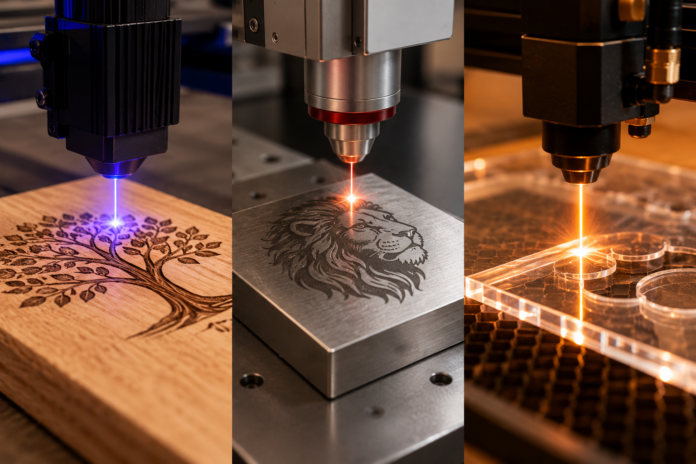

Anyone shopping for a marking or personalization tool runs into three main technologies almost immediately: diode, fiber, and CO2. The forum debates get heated, the spec sheets look interchangeable, and the price differences are large enough to matter. Small business owners printing on tumblers, hobbyists cutting plywood signs, jewelers marking rings, and industrial shops adding traceability codes to metal parts all end up asking a version of the same question. Which one is actually right for the work I do most?
The honest answer is that no single class wins on every dimension. Each technology has a material sweet spot, a price band, and a learning curve. This comparison sorts through the real strengths and limits of each type without leaning on marketing shorthand. By the end you should be able to look at your typical projects and match them to the option that fits, rather than buying based on brand loyalty or a viral video.
How the Three Technologies Actually Differ
The three types of laser engraving hardware differ mostly in the wavelength they emit and how they generate the beam. That single difference cascades into everything else: which materials absorb the energy, how fine the detail can get, and how expensive the machine is to buy and run. Understanding the wavelength story removes most of the confusion.
Diode units emit visible or near-infrared light and absorb well into organic and dark materials. Fiber units emit at around 1.06 microns and are optimized for metals and some plastics. CO2 tubes emit at 10.6 microns, a wavelength that plywood, acrylic, glass, and leather absorb readily. A serious buyer picking a laser engraving machine starts by listing the materials on the workbench and working backward to the wavelength that suits them.
Diode Systems
Diode machines are the entry point for many hobbyists and small side businesses. They cost less than the other two classes, run on standard household power, and produce clean marks on wood, cardboard, leather, and dark anodized aluminum. Their limits show up on clear acrylic, glass, and bare metal, where absorption is poor or nonexistent. A modern high-power diode can engrave stainless indirectly with a marking paste, but that is a workaround rather than a native strength.
Fiber Systems
Fiber is the specialist for metals. Stainless steel, brass, gold, silver, aluminum, and titanium all absorb well at the fiber wavelength, and modern galvo scanners move the beam fast enough to mark small parts in a fraction of a second. Serial numbers, QR codes, medical instrument traceability, and jewelry engraving all lean on fiber technology. The trade-off is that fiber does not cut wood or acrylic well, so a shop that needs both metals and organics usually pairs a fiber galvo with another platform.
CO2 Systems
CO2 tubes dominate the sign-making, gift, and craft world. Plywood, MDF, acrylic sheet, leather, and coated glass respond beautifully. The machines can be scaled up to large bed sizes for panel cutting or kept compact for benchtop personalization. On raw metal, CO2 struggles because the wavelength reflects rather than absorbs, but marking sprays and coated stock work fine as a workaround.
Matching the Machine to the Job
The clearest way to decide is to think about the specific outputs you plan to sell or produce.
Personalized Gifts and Small Signs
Wood coasters, leather wallets, acrylic keychains, and slate ornaments are the sweet spot for CO2 or high-power diode systems. CO2 is faster and cleaner on thicker materials; diode is cheaper to buy and easier to fit in a spare room. If your product mix is 80 percent wood and leather, either works. If you plan to add acrylic sheet cutting, CO2 pulls ahead.
Industrial Traceability and Metal Marking
Serial numbers on tools, part IDs on stainless fittings, medical device markings, and firearm engravings all require a fiber system. A fiber galvo produces deep, permanent, high-contrast marks on metal in seconds, and the marks survive machining, cleaning, and years of handling. No amount of tweaking makes a diode or CO2 system a real substitute for this work at production speed.
Jewelry, Watches, and Fine Detail
Fiber wins here too, but the setup differs from industrial marking. Rotary fixtures for rings and cylindrical items, precise focal control for concave watch cases, and a small spot size for millimeter-tall lettering all matter. Some jewelers keep a fiber galvo for inside-ring engravings and a small CO2 for wax models used in casting.
Hobby and Learning
A diode setup remains the easiest way to learn. The upfront cost is low, the software is friendly, and the projects are forgiving. Many operators start with a diode, discover the boundaries after a year, and then add a second machine that fits the direction their work has taken.
Speed, Detail, and Operating Cost
Beyond the material story, the three classes differ on daily operating characteristics.
Fiber galvos are the fastest for small marks because the mirrors move the beam rather than the workpiece. A serial number that takes twenty seconds on a diode can be done in one second on a fiber galvo. CO2 gantry systems are moderately fast for large runs, and diode units are the slowest for the same job, though the price difference often justifies the wait for a hobby workflow.
Consumables and Maintenance
Diode units have the fewest consumables. The diode module itself is the main wear part, and replacement costs are modest. CO2 tubes have a defined lifetime measured in operating hours and eventually need to be replaced, which is a meaningful line item. Fiber sources are the most durable of the three, often rated for tens of thousands of hours, but the initial investment is higher. Xlaserlab and similar reputable brands publish source lifetime numbers that you can factor into a five-year cost projection.
Software and Learning Curve
All three classes now have solid software options, from LightBurn on the CO2 and diode side to specialized fiber software for galvo systems. The bigger learning curve is not the software; it is understanding how each material behaves. Test grids on scrap material remain the fastest way to build intuition regardless of which class you buy.
Finding the Fit for Your Bench
The right choice comes down to the materials you handle most and the volume you plan to produce. Diode is the friendliest entry for hobby work and small wood or leather projects. CO2 owns the sign, gift, and acrylic cutting space. Fiber is the specialist for metals, traceability, and jewelry. Rather than searching for one machine that does everything, most working shops end up pairing two technologies to cover their real workload. Start with the class that matches the majority of your projects, learn its limits deeply, and expand only when the second machine has a clear job waiting for it.