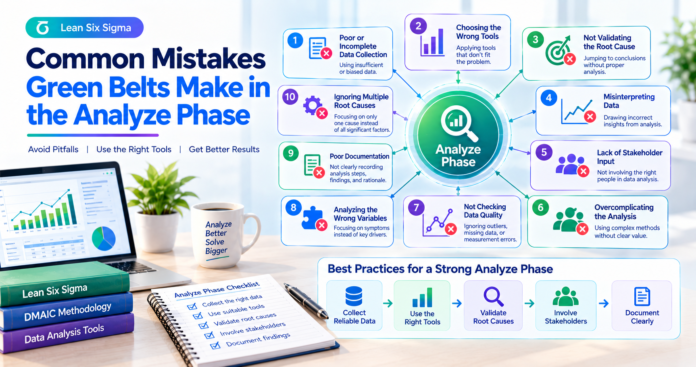

The Lean Six Sigma methodology and its projects revolve around following a structured pattern to identify problems, understanding their causes, and subsequently developing improvement processes. The DMAIC framework is important to this methodology’s execution.
Among the five phases, the ‘Analyze’ phase plays a vital role since it enables teams to look at data and uncover the root causes of process problems. However, Green Belt professionals can make errors during this stage, especially when they depend excessively on assumptions and inadequate data.
What Is the Analyze Phase in Lean Six Sigma?
The ‘Analyze’ phase is the third phase of the DMAIC framework: Define, Measure, Analyze, Improve, and Control. Its main purpose is to help understand why a process produces results that are undesirable or harmful to the business’ interests. To understand this framework in depth, professionals can register for the Lean Six Sigma Green Belt Training. This training will also help them learn about the best practices and tools to adopt during process improvement.
During the ‘Analyze’ phase, Green Belt professionals analyze the data collected during the ‘Measure’ phase and attempt to identify patterns, test causes, and understand which business factors make the most impact on the process performance. The aim of this phase is not to only highlight possible reasons for poor performance but also to verify and back it with data-driven evidence; this also helps establish the foundation for the next step, which is solving the problem.
What are the Common Mistakes Green Belts Make in the Analyze Phase?
Quick Conclusions
One of the most common errors made by Green Belt professionals is establishing the root cause of a problem before analyzing all the data thoroughly. Teams may justify that problems arise from ‘logical’ issues like employee performance and outdated data when, in reality, that may not be the case.
The Lean Six Sigma methodology relies on evidence and not assumptions. Factors that are suspected to cause a problem should be treated as theories to be verified using data before being accepted.
Confusing Symptoms with Root Causes
Another error that is often made by Green Belt professionals is assessing the symptoms of a problem rather than understanding what may be causing them.
For instance, if there are customer complaints about delayed ordered deliveries, reprimanding the delivery team may only address the symptom of the problem. The real, underlying issues, such as inaccurate inventory records and supplier delays, may go undetected.
Effective analysis happens when Green Belt professionals keep asking why a certain problem occurs until they reach its root cause. This root cause must be backed by evidence.
Excessive Brainstorming
Brainstorming helps Green Belt professionals identify potential causes for a problem; however, they do not stand as legitimate proof. Problem-solving tools like the Fishbone Diagram and process maps are useful in the identification of causes, but these causes must be verified using data and analytical methods. The lack of validation may put the team at risk of spending time on factors that have little impact on the problem.
Ignoring Data Quality
An accurate analysis depends on how reliable the data is. If the data collected during the ‘Measure’ phase is incomplete, biased, inconsistent, or inaccurate, the inferences made during the ‘Analyze’ process may also be unreliable.
Green Belt professionals, therefore, need to check the accuracy of data provided, the sampling methods, missing values, and potential sources of bias before making a deep analysis.
Incorrect Use of Statistical Tools
Although statistical tools can provide significant insights, they can lead to inaccurate inferences, especially if the results are interpreted incorrectly, the wrong statistical method is used, or if the tools are used in the wrong way. Green Belt professionals should understand why a particular tool is being used, what the assumptions are based on, and what the results imply.
Often, in complex process-improvement initiatives, professionals may find it difficult to derive insights through regular statistical analysis. Joining the Lean Six Sigma Black Belt Course can help professionals learn about how to use advanced statistical analysis to infer complex pieces of data and use AI to enhance findings further.
Focusing on Too Many Potential Causes
Attempting to assess and investigate every possible cause can make the improvement process unnecessarily complicated. Not every factor contributes to the problem equally. Green Belts need to, therefore, prioritise the causes that most strongly contribute to the problem. When a few core causes are focused on, it makes the improvement process more efficient.
Inability to Connect Analysis to Business Impact
Process improvement practices should support business goals. A finding, although statistically sound, may not produce meaningful benefits financially, operationally, or for the customer. Therefore, Green Belt Professionals must consider how identified root causes affect business metrics like cost, customer satisfaction, or revenue.
How Can Green Belts Improve Their ‘Analyze’ Phase?
Green Belt professionals should first begin with a clearly defined problem and defined project objectives. They should also verify their data quality, generate potential causes in a systematic manner, and use the correct statistical tools to test the causes generated.
Another important way to improve the ‘Analyze’ phase is by basing conclusions on evidence rather than assumptions. Teams should also communicate the findings with the stakeholders clearly so that they do not just understand the analytical findings but also why they matter for the business.
Conclusion
The ‘Analyze’ phase in Lean Six Sigma projects is where data is transformed into meaningful insights. However, when Green Belt professionals rush to make conclusions, confuse symptoms with root causes, disregard data quality, and misuse statistical tools, it can render a well-planned project weak.
When analysis is done with discipline and evidence-based thinking, teams can find causes that influence the process performances. A strong ‘Analyze’ phase creates the basis for improvements, meaningful results, and sustainable business value.