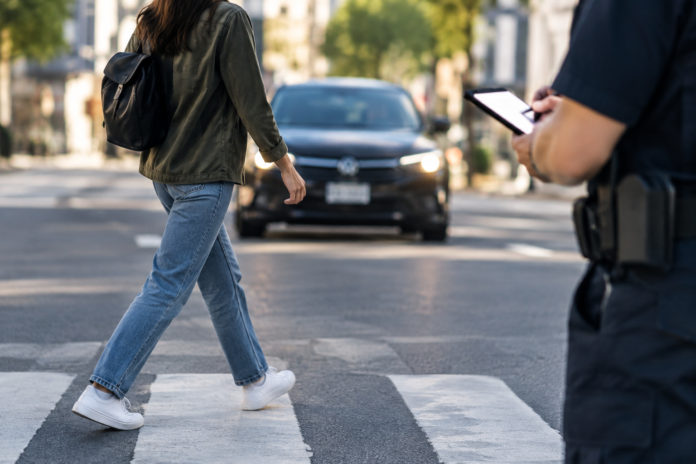

Safety issues related to pedestrians persisted in the United States. Based on the report by the National Highway Traffic Safety Administration (NHTSA), a total of 7,314 pedestrians died in traffic accidents in 2023, while 68,244 others suffered injuries. Pedestrian fatalities represented 18% of all traffic fatalities that occurred in that year.
Felony jaywalking is not a standard, standalone offense across the United States. In some U.S. states, crossing outside a designated crosswalk or ignoring pedestrian signals can result in a citation or fine.
There are several factors where jaywalking could lead to criminal charges. It depends on state and local laws, the circumstances of the incident, and whether the pedestrian’s actions contributed to an accident.
Let’s closely look at what penalties pedestrians may face after violating the laws.
What Jaywalking Actually Is, Legally Speaking
Most state laws do not include the word jaywalking. Traffic codes of states, however, include certain acts that pertain to pedestrians, such as crossing the road at a place other than a crosswalk.
As far as jaywalking goes, this is usually treated as an infraction by the states. In other words, it is not classified as a crime but as something close to parking tickets.
What lies beneath the pedestrian violation can actually be termed as a misdemeanor offense in certain states rather than an infraction offense.
However, even in such states, a normal jaywalking ticket is the least serious offense on the criminal scale, far from being a felony.
Where Things Actually Escalate
The real danger of escalation does not lie in the jaywalking offense being escalated. Instead, the danger is that the jaywalking offense can become the basis of a completely different offense in conjunction with other facts.
Reckless endangerment is one possible escalation. In a case where the manner of crossing by a pedestrian posed actual danger to others, forcing the driver to take evasive action putting others at risk, some prosecutors may opt to file the charge of reckless endangerment in addition to, or instead of, jaywalking. This is normally a misdemeanor charge, although depending on which state one is in, the exact definition and penalties will differ.
When a driver turns to avoid a pedestrian jaywalking and ends up causing injury or fatalities to another motorist or person, or when the pedestrian himself dies from an incident whereby the prosecutor thinks there is enough ground to prosecute another individual for the act, then the charges filed are attached to the new incident and not jaywalking.
These cases are rare, which is why jaywalking shows up only occasionally in the background of a more serious prosecution.
Civil Liability Runs on a Completely Separate Track
Jaywalking and its criminal implications and jaywalking’s influence on a civil case are two completely different issues. This is one of the most frequent errors made by individuals after being involved in a pedestrian collision.
Most jurisdictions have comparative negligence in regard to vehicle-pedestrian accidents, which means that a pedestrian who jaywalks but gets into an accident can still be compensated for his losses, only that the compensation will be reduced by the percentage of negligence he is determined to have committed.
In most states, a pedestrian found mostly at fault recovers nothing, though pure comparative fault states still allow a reduced recovery. A few contributory negligence states bar recovery for any share of fault.
Why the Location of the Violation Matters So Much
Because almost no state’s jaywalking rule looks identical to another’s, the specific facts of where and how someone crossed the street carry so much weight in both the criminal and civil analysis.
According to the Morgantown, West Virginia, criminal defense firm website https://www.dcmvlaw.com/, traffic matters handled in the city’s municipal court and the county justice center include speeding tickets, reckless driving charges, and hit-and-run charges.
The Practical Reality
Jaywalking alone is one of the least consequential traffic violations and will result in just a citation and a small fine. The part that will put someone at serious legal risk will have to do with what occurred with respect to the act of jaywalking, including whether it caused any danger to anyone, whether it was a factor in any accident, and if so, whether there were any significant injuries or fatalities.