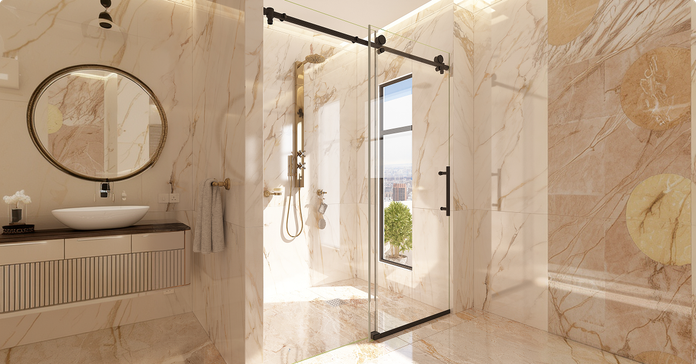

A frameless shower door can make a bathroom feel more open without requiring a major change to the shower footprint. But choosing the right configuration involves more than picking clear glass and a finish. Door width, opening size, glass thickness, hardware, track design, water containment, and the surrounding bathroom layout all affect how well a sliding system performs. The best frameless single sliding shower door for small baths is generally associated with a sliding or bypass configuration in which one glass panel moves horizontally while another panel remains fixed. Current U.S. listings commonly describe these systems with tempered safety glass, stainless steel hardware, rollers, guides, and adjustable opening ranges.
The important point is that “frameless” does not mean completely hardware-free. Sliding glass doors need a mechanism to carry and guide the moving panel. Understanding that distinction makes it easier to compare designs based on function rather than appearance alone.
How a Frameless Sliding Shower Door Works
Sliding shower doors operate differently from hinged or pivot doors. Instead of requiring floor space for a door to swing outward, the moving glass panel travels horizontally along a track or header system.
Many frameless sliding systems are technically bypass doors. The glass panels overlap and move past one another, allowing the user to enter through the resulting opening. Some systems use a top-mounted roller mechanism, while others incorporate guides or additional hardware near the bottom.
This arrangement makes sliding doors particularly useful when a bathroom contains a vanity, toilet, wall, or other fixture close to the shower entrance. There is no large outward swing arc competing for floor space.
However, there is a tradeoff: because the panels overlap, the usable entry opening is generally narrower than the overall enclosure width. A hinged door can potentially provide an opening close to the full door width, while a sliding configuration uses part of its total width for the fixed or overlapping panel. That difference matters when accessibility or ease of entry is a priority.
What Makes a Good Sliding Frameless Shower Door?
There is no universal “best” configuration. The correct choice depends on the dimensions and geometry of the bathroom.
1. Shower Opening Width
The first consideration should be the finished opening, not the size of the old door. Manufacturers sell sliding systems across a range of widths. Current U.S. product listings include configurations around 44–48 inches, 48–60 inches, 56–60 inches, and wider systems extending toward 72 inches.
That doesn’t mean every size is appropriate for every shower. A door system must be compatible with the actual finished opening and the manufacturer’s adjustment range. For remodeling projects, measure the opening after tile, stone, waterproofing, and other finish materials are complete whenever possible. Walls that are slightly out of square can affect installation and may require a system with appropriate adjustment capability.
2. Tempered Safety Glass
Tempered glass is a fundamental safety consideration for shower enclosures. It is heat-treated to increase its strength compared with ordinary annealed glass and is designed to break into smaller granular pieces rather than large sharp shards when it fails.
U.S. products in this category commonly use tempered glass in thicknesses such as 1/4-inch, 5/16-inch, 3/8-inch, or other specifications depending on the system. Current retail listings show both 1/4-inch and 5/16-inch configurations, while some specialty systems use 3/8-inch glass.
Glass thickness should not be selected solely because thicker sounds better. The appropriate thickness depends on the door dimensions, hardware system, engineering requirements, and applicable safety standards.
3. Roller and Track Quality
The sliding mechanism deserves as much attention as the glass. A heavy glass panel repeatedly moving along a track places considerable demands on rollers, bearings, guides, and mounting points. A poorly aligned system can become difficult to operate, while debris or mineral deposits can interfere with smooth movement.
Some frameless systems use top-mounted rollers and a header that supports the moving glass. Others use different hardware arrangements. The design should provide stable movement without excessive lateral play.
When comparing systems, look beyond the appearance of the rollers. Consider how the moving panel is supported, how the rollers are adjusted, and whether replacement hardware is available if components eventually wear.
Sliding vs. Hinged Shower Doors
The decision often comes down to the bathroom layout. A sliding door generally makes more sense when space outside the shower is restricted. Because the panel moves sideways, a nearby vanity or toilet does not necessarily create the same conflict that it would with an outward-swinging door.
A hinged or pivot shower door, however, can provide a wider entrance and eliminates much of the track hardware associated with sliding systems. It can also create a particularly minimal appearance because there is no horizontal sliding mechanism spanning the enclosure. Neither option is inherently superior. If the bathroom has ample clearance and maximizing the entry opening is important, a hinged configuration may be more practical. If the bathroom is tight and a swinging door would interfere with fixtures, sliding glass may be the better spatial solution. The mistake is choosing the door style before analyzing the room.
Water Control: What You Should Expect
A common misconception is that frameless glass shower doors are completely watertight. They are not. Shower doors are designed to control water, not create an impermeable barrier. Sliding configurations can use seals, guides, thresholds, and other components to limit water escaping through panel gaps.
Current products commonly incorporate bottom guides, sealing strips, or threshold barriers as part of their water-management design. The showerhead location also matters. Directing high-pressure spray toward the center seam or opening can increase the likelihood of water escaping. Good bathroom planning considers the relationship between the showerhead, door opening, fixed panels, and floor drainage.
For a curbless shower, drainage and slope become even more important because there is less physical separation between the wet area and bathroom floor.
Hardware Finishes and Bathroom Design
Once functional requirements are established, hardware finish becomes a design decision. Popular bathroom finishes include chrome, brushed nickel, matte black, and various warm metallic finishes. The finish can influence how prominent the shower hardware appears against the glass and tile.
Clear glass generally provides the most open visual effect because it preserves sightlines through the enclosure. Patterned, frosted, or textured glass can increase privacy but changes the visual character of the shower.
The smartest approach is to coordinate the shower hardware with existing bathroom fixtures rather than choosing the finish in isolation. Faucets, cabinet hardware, towel bars, lighting, and shower hardware do not necessarily have to match perfectly, but they should look intentional together.
Cleaning and Maintenance Considerations
One of the biggest practical differences between sliding and hinged doors is maintenance. A sliding system contains moving components and typically has areas where soap residue, hair, hard-water deposits, and dust can accumulate. The track, guides, rollers, and lower portions of the enclosure deserve regular attention.
Hard-water regions can be especially demanding because mineral deposits become visible on both glass and metal surfaces. Regularly removing water from the glass after showering can reduce buildup.
Cleaning products should be compatible with the glass and hardware. Abrasive pads and harsh chemicals can damage certain finishes even when they appear effective at removing buildup.
A frameless enclosure does not eliminate maintenance. It simply reduces the amount of visual framing compared with a traditional framed system.
Installation Is More Important Than Most Buyers Realize
Glass shower doors are not forgiving of inaccurate measurements. The installer needs to account for the finished opening, wall plumb, level, tile thickness, glass dimensions, hardware clearances, and the manufacturer’s installation requirements. A small measurement error can become a major problem when working with heavy glass.
For this reason, shower door measurements should not be treated like measuring a curtain rod. The exact process varies by system, and some manufacturers specify particular measurement points or require professional field measurements.
Installation also involves handling heavy glass safely. Tempered glass cannot simply be drilled or cut after tempering, so hardware locations and dimensions must be established before fabrication.
Common Mistakes to Avoid
The most common mistake is choosing a door based only on appearance. A sleek black-hardware sliding door may look excellent online but still be unsuitable for a particular opening.
Another mistake is assuming that every sliding door provides the same entry width. Two systems with identical overall dimensions can provide different usable openings depending on the fixed-panel arrangement and hardware design.
Ignoring wall conditions is another problem. An opening that looks rectangular may not be perfectly square or plumb after construction. This can affect whether a particular system can be installed correctly.
Finally, don’t overlook water management. Door orientation, showerhead placement, seals, threshold design, and floor slope all influence how effectively water stays inside the shower.
Is a Frameless Single Sliding Door Right for Your Bathroom?
For many bathrooms, a frameless single sliding shower door offers a useful balance between modern appearance and efficient use of space. It can be especially practical where a swinging door would collide with nearby fixtures or consume valuable floor area. But it isn’t automatically the best choice.
Before deciding, evaluate the finished shower opening, available entry width, surrounding fixtures, glass specification, hardware design, water-management features, cleaning requirements, and installation conditions. A larger opening may justify a sliding configuration, while a compact shower with limited width may be better suited to a hinged or pivot design.
The best shower door is ultimately the one that works with the geometry of the bathroom rather than forcing the bathroom to work around the door.
Final Takeaway
Choosing a sliding frameless shower enclosure should begin with measurements and bathroom layout, not aesthetics. Tempered safety glass, reliable roller hardware, suitable seals, correct clearances, and professional installation all contribute to long-term performance.
For homeowners comparing shower door styles, the most useful question isn’t simply, “Which door looks best?” It is, “Which door gives me the right combination of entry space, clearance, water control, maintenance, and visual openness for this specific shower?”
That approach leads to a better decision and avoids paying for a design that looks good but doesn’t work well in the room.