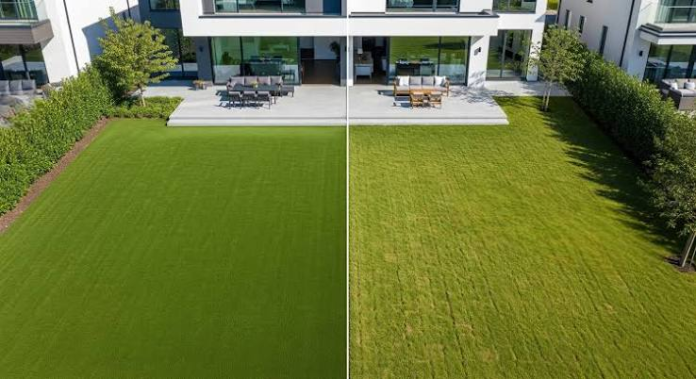

Picture your Saturday morning without dragging out the lawnmower, without adjusting sprinklers, and without patching dead spots after a dry summer. For a growing number of homeowners, that picture is already a reality, thanks to artificial grass. But swapping out a natural lawn is not a small decision, and the choice deserves a clear-eyed look at the real trade-offs involved.
This article walks through the key differences between artificial turf and natural grass across five areas that matter most to homeowners: upfront cost, long-term maintenance, water consumption, environmental impact, and performance in different climates. By the end, you will have a solid factual foundation to weigh what actually makes sense for your property and lifestyle.
Upfront Cost vs. Long-Term Cost
Cost is usually the first question people ask, and it is also one of the most misunderstood. Artificial turf carries a higher initial price tag. Professional installation of synthetic grass typically runs between $8 and $20 per square foot, depending on the product quality, infill material, and site preparation required. Natural lawn installation, whether seeded or sodded, is considerably cheaper upfront, often ranging from $0.25 per square foot for seed to around $2 per square foot for sod.
Where the math starts to shift is over time. Natural lawns require ongoing spending on water, fertilizer, weed control, pest treatments, aeration, and equipment maintenance or lawn care services. The cumulative cost of maintaining a natural lawn over a decade can easily exceed the initial installation price several times over. Artificial turf, by contrast, has relatively low annual maintenance costs once installed. Most quality synthetic turf carries manufacturer warranties of 8 to 15 years, and well-installed products often last 20 years or more with proper care.
| Cost Factor | Natural Grass | Artificial Turf |
| Installation (per sq ft) | $0.25 to $2.00 (seed/sod) | $8 to $20 |
| Annual watering cost | Moderate to high | Negligible |
| Fertilizer and chemicals | Recurring annually | Not required |
| Mowing and upkeep | Weekly during growing season | Occasional brushing |
| Lifespan | Indefinite with care | 15 to 20+ years |
| Replacement or renovation | Periodic reseeding or resodding | Full replacement at end of life |
Maintenance Requirements in Practice
Natural lawns demand consistent, seasonal attention. Mowing alone accounts for significant time investment, typically once a week during the growing season. Add in edging, dethatching, overseeding, aerating, and applying pre-emergent weed treatments, and a healthy natural lawn is essentially a part-time commitment. For people who enjoy gardening, that may feel rewarding. For those who simply want a functional outdoor space, it can become a burden.
Artificial turf is not completely maintenance-free, though it comes close. Leaves, pet waste, and debris need to be removed regularly. Infill material, usually crumb rubber or sand-based compounds, occasionally needs to be redistributed or topped off. High-traffic areas may require periodic brushing to keep the fibers standing upright. Compared to natural grass, however, the time commitment is substantially lower. Most homeowners report spending a few hours per year on turf upkeep rather than a few hours per week.
Water Use and Drought Considerations
Water consumption is where artificial turf has its most clear-cut advantage, particularly in arid and semi-arid climates. According to the Environmental Protection Agency, landscape irrigation accounts for nearly one-third of all residential water use in the United States, totaling approximately 9 billion gallons per day. A significant share of that is lawn irrigation.
A typical natural lawn requires about one inch of water per week during the growing season. For a 1,000-square-foot lawn, that translates to roughly 600 gallons of water per week. Artificial turf requires no irrigation whatsoever for maintenance, though some homeowners choose to rinse it down occasionally to manage heat or remove light debris. In states like California, Arizona, Nevada, and Texas, where water restrictions and drought conditions are increasingly common, the shift to synthetic grass has been substantial for this reason alone.
Environmental Considerations on Both Sides
The environmental picture is more nuanced than it might appear at first glance, and neither option is straightforwardly “green” in every respect.
Natural grass supports soil ecosystems, provides habitat for insects and small animals, absorbs carbon dioxide, and contributes to local cooling through evapotranspiration. However, conventionally maintained lawns rely on synthetic fertilizers and pesticides that can leach into waterways. Gas-powered mowers emit air pollutants, and over-irrigation contributes to runoff and water waste. The environmental cost of a well-maintained natural lawn is real, even if it is less visible.
Artificial turf, on the other hand, eliminates chemical applications and dramatically reduces water use. However, it is made from petroleum-based synthetic fibers, primarily polyethylene or polypropylene, which are not biodegradable. Disposal at the end of a turf product’s life cycle presents a recycling challenge, though manufacturers are increasingly developing take-back programs and recyclable products. Artificial turf also absorbs and retains heat; surface temperatures on synthetic grass can run significantly higher than on natural lawns on hot sunny days, which is worth accounting for in warm climates.
- Natural grass supports biodiversity and soil health but requires ongoing chemical inputs in conventional care
- Artificial turf eliminates pesticide and fertilizer runoff but is made from non-biodegradable synthetic materials
- Synthetic turf saves significant water, particularly valuable in drought-prone regions
- Heat retention is a real concern with artificial turf in hot climates; shade and adequate infill selection help manage this
- End-of-life disposal of synthetic turf is an evolving challenge, with some manufacturers now offering recycling options
Performance Across Different Climates and Uses
Climate plays a major role in how both options perform over time. Natural grass thrives in moderate, well-watered environments. Cool-season grasses like Kentucky bluegrass and fescue perform well in northern climates but go dormant and brown in hot, dry summers. Warm-season grasses like Bermuda and Zoysia handle heat better but go dormant in winter. For homeowners in climates with extreme seasonal swings, keeping a natural lawn looking healthy year-round requires significant effort and resources.
Artificial turf maintains the same appearance regardless of season. It does not go dormant, brown, or develop bare spots from drought. For households with active children and pets, synthetic turf also holds up well under heavy use that would tear up natural grass in high-traffic zones. Specific product lines are engineered for different applications, from residential landscaping and pet runs to sports fields and rooftop terraces. Companies that specialize in both turf and complementary hardscaping, such as Go Turf Artificial Grass & Pavers, offer product selections designed to match different installation environments and performance needs.
Pet-Friendly Landscaping
Pet owners represent one of the largest groups switching to artificial turf. Dogs in particular are hard on natural grass, creating dead patches from urine, digging up root systems, and tracking mud indoors. Synthetic turf designed for pet use typically features permeable backing that allows liquids to drain through, and the surface can be cleaned with water and enzyme-based solutions to manage odor. It is worth noting that not all artificial turf products are created equal for pet applications; buyers should specifically look for products with adequate drainage rates and antimicrobial infill options.
Sports and Recreation Surfaces
Artificial turf has long been used on professional sports fields, and residential and community sports applications have followed. Putting greens, bocce courts, backyard soccer areas, and multipurpose recreation spaces benefit from turf’s durability and consistent surface quality. The key consideration for these uses is pile height and infill density, which affect how the surface plays and how well it absorbs impact. Natural grass simply cannot sustain the same volume of use without significant recovery time and care.
What to Ask Before Making a Decision
Before committing to either option, it helps to think through a few practical questions specific to your situation. The answers will vary significantly depending on where you live, how you use your outdoor space, and what your priorities are.
- How much time are you realistically willing to spend on lawn care each week during the growing season?
- What are your local water costs, and are drought restrictions likely in your area now or in the future?
- Do you have children or pets who will put heavy use on the lawn surface?
- What is the climate like where you live, and does your lawn face extreme heat, cold, or both?
- How long do you plan to stay in the property? The break-even point on turf installation typically arrives between years five and eight.
- Are there local HOA rules or municipal regulations governing the use of artificial turf in your area?
These questions do not have universal right answers, but working through them honestly will help clarify whether the investment in artificial turf makes practical sense for your circumstances, or whether improving the management of a natural lawn is the better path.
The Bigger Picture on Lawn Choices
Natural grass and artificial turf each have genuine strengths and real limitations. The right choice depends on an honest assessment of your local climate, water situation, budget horizon, how the space gets used, and what kind of maintenance commitment you are comfortable with. Neither option is universally superior. What matters is matching the surface to the reality of your life and landscape.
As more homeowners weigh these trade-offs, the quality of both natural lawn care products and synthetic turf technology continues to improve. Artificial turf is becoming more realistic in appearance, more heat-resistant, and more recyclable. Natural lawn care practices are shifting toward lower-water, lower-chemical approaches. Understanding the full picture across cost, maintenance, water use, environmental impact, and performance gives you the foundation to make a decision that actually holds up over time.