

A campaign rarely starts from nothing.
By the time a marketing team begins thinking about video, there is usually already a folder of approved material: product photography, packaging artwork, product-only campaign images, brand colors, backgrounds, and perhaps footage from an earlier launch.
The challenge isn’t inventing another visual identity.
It’s creating new variations without drifting too far from the campaign that has already been approved.
That becomes harder when the same launch needs a product video, several social clips, a vertical cut, a feature-focused version, and different creative angles for different audiences.
AI video is more useful here when it starts with the campaign rather than replacing it.
Start With an Asset Audit, Not a Prompt
Before generating anything, divide the existing material into three groups.
Must stay accurate
These are elements that should be checked against approved source material throughout production:
- product appearance and proportions
- packaging
- logos
- prices and promotional claims
- legal copy
- interface details
Generated material should not become the source of truth for these elements.
Can guide
These materials can help establish creative direction:
- approved environments
- compositions
- color direction
- textures
- illustrations
- lighting references
- previous campaign material cleared for the intended AI workflow
They provide context without guaranteeing exact reproduction.
Can change
This is where the team has room to experiment:
- camera movement
- scene order
- pacing
- transitions
- background activity
- opening hooks
- some contextual elements
This small audit changes the brief.
Instead of asking, “What should the AI create?” the team asks:
“What must remain accurate, what can guide us, and where are we actually free to experiment?”
That is a stronger starting point for campaign variations.
Give Every Reference a Job
A useful reference folder shouldn’t simply contain twenty files with no explanation.
Each asset should have a purpose.
One product image might establish shape and materials. Packaging artwork can show the approved design. A campaign still might guide lighting and composition. An environment reference can suggest mood without dictating the exact scene.
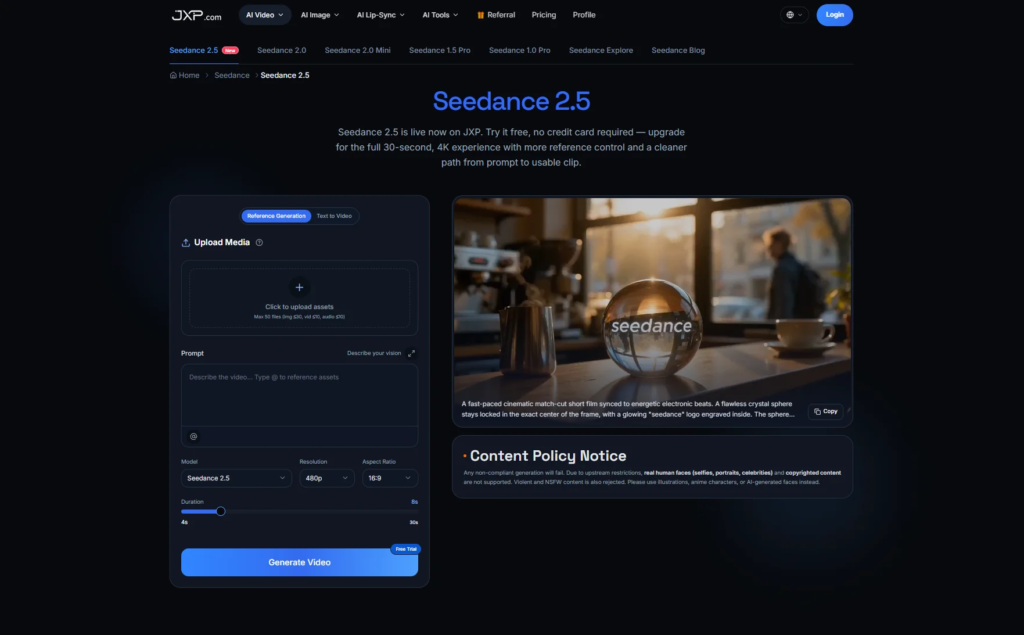
This is where Seedance 2.5 becomes relevant.
Its multimodal reference approach makes it useful for planning around images, video, and audio that already belong to the creative brief.
That doesn’t mean every supplied detail will be reproduced exactly. References guide the exploration; final commercial details still need to be checked against approved originals.
There is also an important platform restriction to account for before building the reference folder.
JXP’s current Seedance workflow does not support real human faces, including selfies, portrait photographs, or celebrity likenesses.
A campaign that depends on a real model, employee, founder, spokesperson, or celebrity therefore should not assume that person’s photograph can simply become a Seedance reference. Teams need to work within the platform’s supported alternatives and use separately produced, properly authorized real-person material where the final campaign requires it.
This limitation belongs in the planning stage, not at the end of production.
Build Variations Around a Shared Foundation
A reference-led campaign workflow becomes useful when the team plans a family of assets instead of generating unrelated clips.
Imagine a company launching a portable speaker.
The approved campaign already establishes the product, packaging, a dark studio environment, and a simple lighting direction.
The team could then plan several variations:
Product launch: Keep attention on the speaker and its physical design.
Lifestyle version: Place the product in an appropriate use context.
Feature version: Build the sequence around one product benefit.
Vertical version: Change the opening and pacing for a short-form placement.
The campaign foundation remains recognizable while the purpose of each variation changes.
A useful rule is to change one strategic dimension at a time whenever possible.
Change the audience.
Or the message.
Or the pacing.
Or the placement.
Or the scene order.
If every dimension changes at once, it becomes difficult to tell whether the team is creating a campaign variation or starting a new campaign.
Separate the Creative Layer From the Exact Layer
Reference-led generation should not be confused with exact brand reproduction.
If a logo needs to appear perfectly, use the approved logo during final editing.
If packaging contains readable text, compare it with the original artwork or composite the verified asset during post-production.
Prices, product specifications, promotional claims, and legal language should come from approved sources.
The same applies to real software. If a campaign demonstrates an actual interface, use verified screenshots or screen recordings rather than generated UI.
Seedance can help explore motion, staging, atmosphere, pacing, and scene structure around the campaign.
The exact commercial layer still belongs to the normal production and approval process.
Plan Distribution Before Generation
Campaign variations are often created for different placements, not just different creative ideas.
A horizontal website video has different requirements from a vertical social clip.
The first two seconds may need to change. Text may need to move. The product may need to appear earlier. A six-second placement cannot always be treated as a trimmed version of a longer concept.
That means distribution belongs in the brief.
Before generating a variation, define three things:
Audience: Who should this version reach?
Message: What is the one thing they should remember?
Placement: Where will they see it?
These decisions make it easier to determine what actually needs to change from the campaign foundation.
Teams should also check duration, aspect ratio, resolution, cost, and availability in the exact workflow they intend to use rather than assuming every product surface offers identical delivery options.
Review the Variations Together
A campaign variation can look good on its own and still feel wrong beside everything else.
Review the outputs as a group.
Does the product remain recognizable?
Has one variation drifted into a different visual language?
Does the pacing still feel related?
Has a social version introduced colors, environments, or graphic treatments that don’t appear anywhere else?
The goal isn’t to make every video identical.
It’s to create recognizable variation.
Reference-led generation can help teams explore a shared direction, but dependable consistency still comes from approved templates, typography, colors, graphic elements, source assets, and human editing.
Rights and Platform Eligibility Belong in the Same Audit
An asset being approved for an existing campaign does not automatically mean it can be uploaded to an external AI system.
There are two separate checks.
Do we have the necessary rights?
Photographs, footage, illustrations, music, sound recordings, and other material should be company-owned or properly licensed for the intended use. An older campaign clip may have been cleared for one advertisement without granting AI-processing, derivative-use, synchronization, or future paid-media rights.
Does the platform allow the material?
Rights clearance doesn’t override platform restrictions.
A company may have permission to use a spokesperson’s portrait, for example, while JXP’s current Seedance workflow still does not support real human faces as reference material.
The same principle applies to copyrighted or otherwise restricted material.
A useful asset audit therefore records both rights status and platform eligibility before anything is uploaded.
That is much easier than discovering the problem after a campaign variation has already been planned around an unusable reference.
The Goal Is Controlled Variation
AI video makes it tempting to generate more.
More concepts. More styles. More versions.
But twenty variations aren’t automatically more useful than five.
The better test is whether every version still has a clear relationship to the approved campaign.
That is the point of a reference-led planning method.
Start by deciding what must remain accurate.
Identify which materials can guide the creative direction.
Then decide what is genuinely allowed to change.
Seedance 2.5 can help teams explore movement and campaign variations around that foundation, but the important decisions still belong to the team.
The best campaign variations don’t begin by asking AI for something completely new.
They begin by deciding what from the approved campaign should never have changed in the first place.