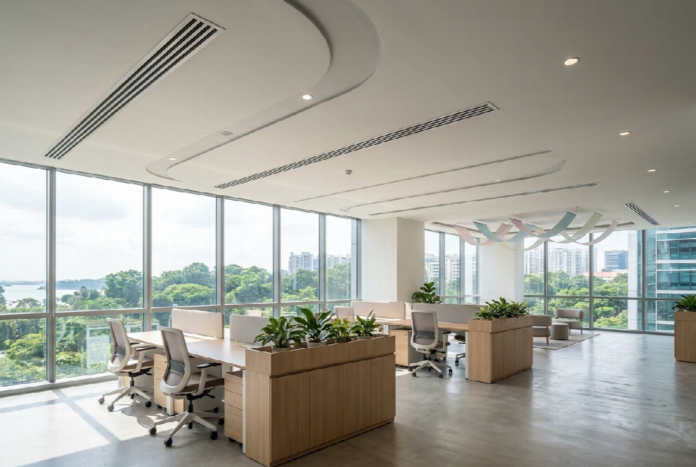

Nobody signs a lease because of the ductwork. Ask a tenant why they picked one office over another and you will hear about location, rent, maybe the view from the pantry. The mechanical floor never comes up. But walk that same tenant through the space six months later, and a surprising number will mention, unprompted, that the air just feels different in a way they cannot quite explain.
That feeling has a cause. Post-pandemic, people pay attention to air in a way they simply did not before. Combine that with a broader shift toward workplace wellness and you get occupants who notice stuffiness, odd smells, and inconsistent temperatures far more readily than they used to. In Singapore, where the tropical climate already pushes ACMV systems to their limits, this changes the equation for anyone managing a building.
Cool used to be enough. It is not anymore.
Why Buildings That Look Fine on Paper Still Get Complaints
Facility managers tend to check temperature and assume the rest follows. It doesn’t, not really. Temperature is one input among several, and it is far from the only thing occupants react to.
Humidity is arguably the bigger culprit in this climate, given outdoor levels that regularly sit above 80%. Get it wrong and a room either feels clammy despite being cool, or uncomfortably dry, neither of which reads as “good air” to the person sitting in it. Then there is air exchange. Buildings that don’t bring in enough fresh air trap CO2 and volatile compounds indoors, and that shows up as the vague afternoon headache or drowsiness everyone blames on lunch but is actually the room itself.
There’s also the equipment angle, which gets overlooked more than it should. Fan coil units and air handling units that haven’t been serviced properly stop being neutral and start actively contributing to the problem, dust and microbial buildup in the coils being the usual culprits. Extend the maintenance interval to save a few dollars and this is often the trade-off nobody notices until the complaints start rolling in.
A building can hit every number on the compliance sheet and still feel, to the people inside it, faintly off. That gap is where most of the dissatisfaction actually lives.
Air Quality Is Starting to Show Up in Lease Negotiations
For a long time, property owners marketed buildings on finishes, location, amenities. Air quality never made the cut, mostly because nobody had a good way to measure or prove it. That’s shifting.
Larger corporate tenants, particularly ones with formal wellness policies, are starting to ask pointed questions before signing. Some now want documentation on ventilation rates and filtration standards as part of due diligence, not as a courtesy but as a requirement. A building that can answer those questions clearly, with a maintenance record to back it up, has a real edge over one that just shrugs.
The World Health Organization has published guidance on indoor air quality and health that spells out why this has stopped being a soft amenity issue and become something closer to a baseline expectation.
Hospitality venues, healthcare facilities, and high-hygiene environments like food manufacturing or cleanrooms feel this even more acutely. Here, air quality isn’t a nice-to-have. It’s tied directly to guest experience, patient safety, or product integrity, and regulators treat it that way.
Good Air Doesn’t Happen by Accident
Getting indoor air right isn’t a matter of cranking the AC lower and hoping for the best. It takes a system that was designed properly in the first place, balanced correctly, and then maintained with something resembling discipline rather than an afterthought.
Design has to account for how a space actually gets used, not generic assumptions. A meeting room used twice a day needs a different ventilation approach than an open floor packed with people from nine to six. Skip that nuance during design and the mismatch shows up later, exactly in the spaces occupants complain about most.
Maintenance, meanwhile, never really stops mattering. Coils and filters collect contaminants no matter how well the system was specified originally. Cooling towers need NEA-compliant water treatment to keep bacterial growth in check, which is as much a public health issue as an air quality one. Buildings running structured preventive maintenance, instead of waiting for something to break, tend to report noticeably fewer complaints and steadier performance, even through Singapore’s relentless humidity.
BMS integration helps here too, giving facility teams a live view of ventilation performance instead of relying on someone walking the floor with a checklist. More of the sharper operators are treating this as standard now rather than a nice extra.
Finding a Contractor Who Actually Gets It
Fixing indoor air quality is rarely a one-step job. It’s usually some mix of better maintenance habits, targeted equipment upgrades, and occasionally a retrofit of components that were never built for today’s occupancy levels or today’s expectations.
This is exactly where the choice of contractor starts to matter a great deal. A professional ACMV company in Singapore that has worked across offices, hospitals, hotels, and high-hygiene facilities brings a different kind of judgement than a general servicing outfit that mostly changes filters and moves on. These are the people who understand how ventilation choices actually affect the humans breathing that air, not just how to keep a chiller humming along.
Credentials are a decent starting filter, if not the whole picture. BCA licensing at the right grade, ISO 9001:2015 for quality management, ISO 45001:2018 for workplace safety, these all point to a contractor working from documented processes rather than winging it. Experience with EC fan retrofits is also worth asking about specifically. It’s a technology that can meaningfully cut energy use while improving airflow control, useful for buildings trying to modernise older air handling systems without tearing everything out and starting over.
Owners who’ve brought in a professional ACMV company in Singapore to properly assess their air quality often find the fix is smaller than they feared. More often than not, the gap between a building people enjoy being in and one they merely tolerate comes down to maintenance discipline, not a full system overhaul.
This Isn’t Going Away
Occupants aren’t going back to how things were five years ago. Tenants, staff, guests, they’ve all become more attuned to how a space feels, and increasingly they can articulate exactly why a building falls short when it does.
That leaves Singapore’s building owners and facility managers with a choice, really. Treat ACMV performance as background plumbing, or treat it as central to how people actually experience the building. The ones making the second choice are quietly getting ahead of a shift that isn’t slowing down anytime soon.