
Along Canadian back roads and pond banks, the summer growth that matters most is often the growth an operator can barely get to. Steep ditch walls, riprap shoulders, and brushy embankments climb away from firm ground, and walking a mower onto them is neither safe nor sensible.
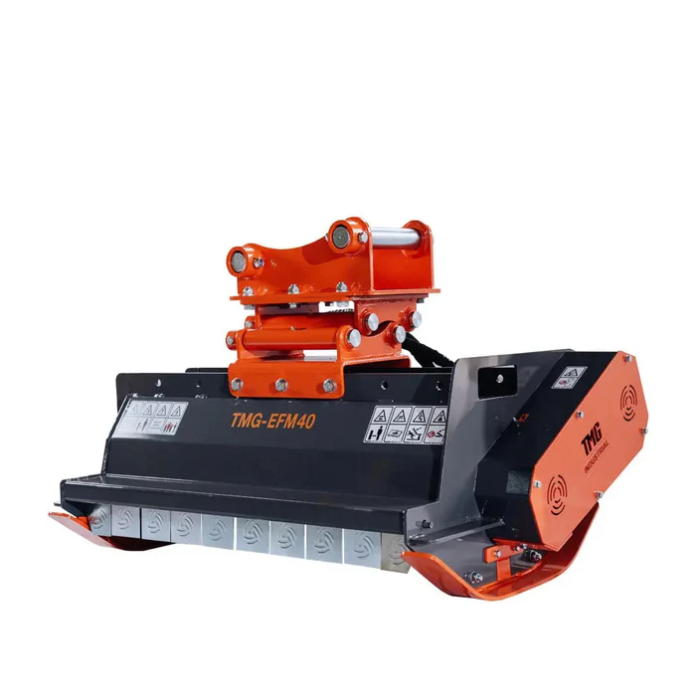
The tool many crews turn to instead is the excavator flail mower, a cutting head that hangs off the end of a hydraulic arm and lets the machine trim from a distance rather than from directly underneath.
The arm does the reaching so the tracks never have to
An excavator flail mower earns its keep because the arm can extend, curl, and slew while the undercarriage stays parked on level ground. The boom and dipper stretch the head out over a ditch or up a bank, and the house rotates to sweep an arc without the machine rolling forward at all.
That reach changes the whole safety equation. Rather than perching a tractor on a side slope where it might tip, the operator keeps both tracks flat and sends only the cutting head into the awkward ground.
A conservation crew clearing a drainage channel, for example, can sit the excavator on the level shoulder and lay the head down the full face of the bank, cutting ground that no wheeled mower could safely climb.
A hydraulic motor at the head replaces the tractor driveline
Where a towed or three-point machine draws power through a spinning shaft, an excavator flail mower is driven by a hydraulic motor bolted right behind the rotor. Oil from the excavator auxiliary circuit turns that motor, so power travels through flexible hoses instead of a rigid line.
This is what lets the head sit at any angle the arm commands. A shaft would bind if it bent too far, but a hose simply flexes, so the rotor spins the same whether the head is level, vertical, or tipped right over the lip of a bank.
The rotor carries rows of small blades on pins that swing back when they strike heavy stems, and the hydraulic feed lets the motor lug down under a thick patch and recover as it clears. The flow, not a gearbox, sets how hard the head can pull.
Running on oil also gives the operator fine control from the same joystick that already works the arm. Feathering the flow eases the rotor into a dense clump instead of stalling it, and backing off lets a jam clear before the head is forced through it.
Matching the head posture to the face being cut
The real skill lies in reading the ground and rolling the head to suit it. The wrist of the arm can turn the rotor axis so it runs parallel to the slope, letting the blades graze the surface evenly instead of gouging one spot and skipping the next.
On a ditch the operator lays the head along the bank and draws it up the face in one steady sweep; on a flat verge the head sits level and mows much like an ordinary deck. Reading the face and setting that posture is most of the craft.
Because the arm holds the head at a constant standoff, the cut stays even from the top of a bank to the toe of the slope. The operator watches the rotor rather than the wheels, adjusting height by the boom instead of by the lay of the ground beneath the machine.
• Slew: sweeps an arc without moving the tracks
• Wrist roll: hugs the rotor to the slope
• Boom reach: trims well beyond the shoulder
• Hydraulic feed: keeps the rotor turning at angle
Reach is leverage, and leverage has its limits
All that reach loads the arm. A forty inch head packed with wet brush hangs at the end of a long lever, and the further it extends the more it pulls the balance of the machine toward the work.
Operators counter this by keeping the heaviest cuts closer in and by matching the excavator flail mower to a machine heavy enough to anchor it, which for this head means a carrier in the six to eight tonne class. Sizing the pair correctly is what keeps the reach honest.
• Long reach: raises the tipping load on the arm
• Wet brush: adds weight at the worst moment
• Right pairing: sized for six to eight tonnes
• Smooth slew: avoids swinging a loaded head
Taken together, the reaching arm, the hydraulic head, and the control over posture let one machine work ground that used to be left to hand crews and string trimmers. Each element exists so the operator can cut steep, distant, and awkward growth while staying safely on firm footing.
For Canadian crews facing a summer of ditch banks and brushy shoulders, an excavator flail mower turns terrain that was once too steep to touch into simply another pass made from the seat, making ditch bank maintenance more manageable.