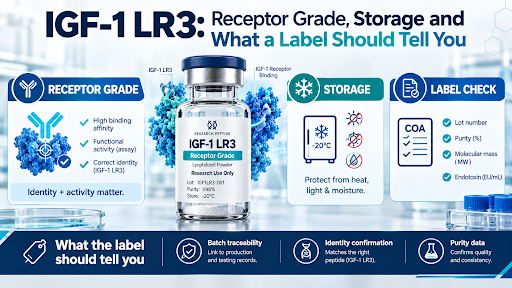

The IGF-1 LR3 cluster is one of the strangest gaps in the peptide market. It spans roughly forty distinct search queries, the great majority of which sit between positions 63 and 91, and the reason is not competition. It is that almost nobody has explained the two things buyers actually want to know: what “receptor grade” means, and how the compound has to be stored.
What exists instead is a wall of product pages, each asserting a purity figure, none addressing the distinction that gives the category its name. This piece fills that gap.
What IGF-1 LR3 actually is
Insulin-like growth factor 1 is a hormone produced largely in response to growth hormone, and it mediates many of the tissue-building effects attributed to GH itself. Native IGF-1 is a small protein with a short circulating half-life, because it binds readily to a family of carrier proteins — IGF-binding proteins — that regulate how much of it is free to act.
Long R3 IGF-1 is a modified analogue of that molecule, and the modification is deliberate. The “R3” refers to a substitution at the third position of the peptide chain, where an arginine residue is replaced, and the construct also carries an extended N-terminal sequence. Together, those changes reduce binding to the IGF-binding proteins substantially.
The consequence is a markedly longer half-life — commonly cited in the range of twenty to thirty hours, against a much shorter window for the native hormone — and a higher apparent potency per unit. That is the entire rationale for the analogue: not a different receptor, but a longer and less regulated presence at it.
It is worth being clear that this is a laboratory-designed molecule. It is not a purified natural hormone, and it is not approved for therapeutic use in humans.
What “receptor grade” means — and what it does not
Here is the honest answer, and it is the one the market avoids: receptor grade is not a formal standard.
There is no pharmacopoeial definition, no regulatory category, and no agreed analytical threshold that a product must meet to carry the term. It is a marketing descriptor, used to signal that a preparation is intended for receptor-binding research rather than for some cruder purpose, and it implies higher purity and preserved biological activity. Both of those things are desirable. Neither is guaranteed by the phrase.
What it usefully distinguishes is intent. A supplier selling receptor-grade material is claiming the product is suitable for assay work where binding behaviour matters — which is a higher bar than “it contains the peptide”. What it does not do is tell you anything checkable on its own, because the term has no definition to appeal to.
That matters because the phrase is doing load-bearing work in this category. Buyers searching for receptor grade igf-1 lr3 for sale are looking for reassurance about quality, and the term delivers the feeling of reassurance without the substance. The substance has to come from the documentation instead.
What a label should actually tell you
Since the grade designation carries no defined meaning, the analytical information carries the whole burden. A label worth trusting states five things.
The compound and its analogue designation. For this product, that means specifying Long R3 IGF-1 rather than just “IGF-1”, because the two are not the same molecule and do not behave the same way. A listing that does not distinguish them is either careless or is selling the wrong thing.
Identity confirmation by mass spectrometry. A purity percentage tells you how much of the material is a single substance; mass spectrometry tells you which substance. For an analogue defined by a specific sequence modification, identity confirmation is the difference between the product you ordered and a near neighbour.
Purity by chromatographic method, with the chromatogram. The number without the trace is a claim. The trace shows whether that number reflects a single clean peak or an average across several.
Batch number, and a certificate that matches it. The batch on the certificate has to be the batch on the vial. This is the check most often skipped and the one that most often fails.
Storage conditions and, for injectables, sterility and endotoxin results. These are covered below, because for this compound they are not footnotes.
Storage and handling
Peptides degrade, and IGF-1 LR3 degrades like any other. The handling rules are short and unforgiving.
Lyophilised powder — the freeze-dried form in which it is normally shipped — should be stored refrigerated, protected from light, and left sealed until it is needed. In that state it is stable for a long period, which is why the market settled on the format.
Reconstituted material is a different proposition. Once in solution, degradation accelerates with temperature and time. Refrigeration is the minimum, and the window is measured in days to weeks rather than months. Bacteriostatic water — not plain sterile water — is what extends that window, because the benzyl alcohol it contains inhibits bacterial growth. Substituting sterile water removes exactly the property the product is named for.
Repeated temperature cycling is the most common self-inflicted failure. A vial pulled out of the fridge and returned several times a day is being degraded by the routine itself, not by any single excursion.
Reconstitution technique matters more than it sounds. Directing the water at the vial wall rather than onto the powder avoids the shear forces that damage the peptide, and the foam layer that appears when this is done carelessly is the visible sign of it. A solution that will not clear after gentle swirling should not be forced.
Reconstitution, and the arithmetic that catches people out
Because the compound ships as a powder, the concentration you end up handling is a calculation you perform rather than a figure printed on the vial.
Total content divided by the volume of diluent gives concentration. A 1 mg vial reconstituted with 1 ml of bacteriostatic water yields 1 mg/ml; the same vial reconstituted with 2 ml yields 0.5 mg/ml. Both are correct, both come from the same product, and they are not interchangeable once the numbers are on a syringe.
Three consequences follow, and they matter more for this compound than for most.
The first is that the label states quantity, not concentration, and confusing the two is the most common error in this category. The second is that a more dilute solution means a larger volume to handle for the same amount of peptide, which is a practical consideration rather than a chemical one. The third is stability: the more dilute the preparation, the less forgiving the storage window, because degradation products accumulate in a smaller absolute quantity of peptide.
None of this is a dosing instruction, and it is not meant to be read as one. It is the arithmetic required to know what is in the vial, which is a prerequisite for any sensible conversation about the compound itself.
Why this cluster is easy to rank for and hard to buy in
The search data tells a consistent story: hundreds of pages competing on price and stock status, and very few explaining the properties that determine whether the product is what it claims.
That is a description of a market where the buyers cannot easily evaluate what they are offered, and where the sellers have little incentive to make evaluation easier. The phrase “receptor grade” is the clearest symptom — it sounds like a standard, it is used as though it were one, and it means whatever the seller wants it to mean.
The practical response is to stop treating the descriptor as information and start treating the documentation as information. If you are comparing igf-1 lr3 for sale listings, the useful question is not which one claims receptor grade — nearly all of them do — but which one publishes a batch-specific certificate with identity confirmation and a sterility result behind it.
The rest of the GH axis
IGF-1 does not act in isolation, and the compounds upstream of it are frequently discussed alongside it. Growth hormone release is stimulated by secretagogues, and two of them come up routinely in the same searches.
Sermorelin is a growth-hormone-releasing hormone analogue, working at the pituitary to prompt the body’s own GH release rather than supplying the hormone or the growth factor directly. It sits furthest upstream of the three. A buy sermorelin online listing is worth reading alongside an IGF-1 listing for the contrast in mechanism, not because they substitute for each other.
Ipamorelin is a shorter-chain secretagogue, notable in the research literature for selectivity — it is generally described as having less effect on cortisol and prolactin than earlier compounds in the same family. A buy ipamorelin listing sits in the same upstream position, with a different selectivity profile.
Understanding the axis in the right order matters for reading any of these listings sensibly: secretagogues act on the pituitary, growth hormone is the output, and IGF-1 is downstream of that. They are not three versions of the same intervention, and the documentation requirement is the same for all three — batch-level analysis, identity confirmation, and a sterility result for the injectable formats. The Dragon Pharma peptides catalogue sets them out in that order, which at least makes the relationship visible rather than implied.
The short version
IGF-1 LR3 is a deliberately modified analogue of IGF-1 with reduced binding to carrier proteins and a substantially longer half-life. “Receptor grade” is a marketing term with no formal definition behind it, which means the analytical documentation is the only quality signal available — and for an analogue defined by a sequence modification, identity confirmation matters more here than it does for most compounds.
Storage follows the usual rules and punishes carelessness: sealed and cold as powder, cold and time-limited once reconstituted, bacteriostatic water rather than sterile, and no repeated temperature cycling. None of that is exotic. All of it is more informative than the grade label.