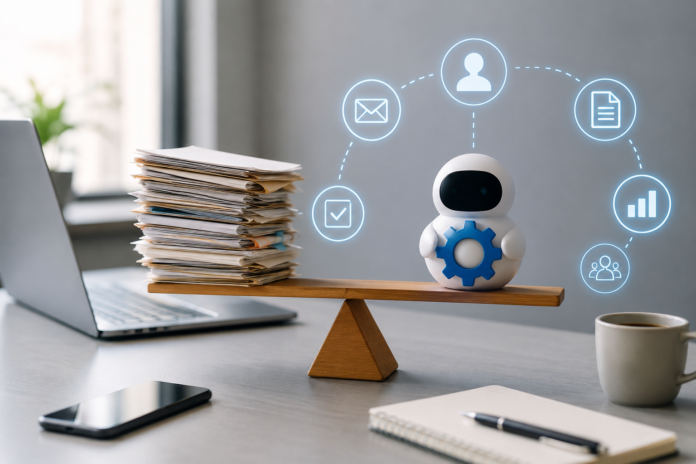

Ask a small business owner what eats up their week and the answer is almost never the interesting stuff. It’s the follow-ups. The status updates. The “did anyone reply to that email” loops. Boring, mostly. But it adds up.
The interesting shift, at least in the last year or two, is that companies aren’t necessarily hiring their way out of it anymore. Some are leaning on an ai system to handle the rote parts of a workflow. Others are just rethinking who does what. And a surprising number are doing something as simple as pulling apart a process nobody had looked at in five years.
There’s no one right answer. But a few patterns keep showing up.
Letting software handle the follow-through
This is the one everybody talks about, and honestly, it’s the one that’s changed the most. A few years ago “automation” meant a scheduled email. Now it means something closer to a coworker. McKinsey’s latest survey found that around 88% of organizations are using AI in at least one function, though only a third have actually scaled it beyond pilots. Which, fair enough. Scaling is hard.
The real value, from what it looks like, isn’t in the flashy customer-facing chatbots. It’s in the invisible stuff. Ticket routing. Case triage. Pulling data from three systems so a human doesn’t have to. Small things that compound.
Not every team needs this, of course. A five-person business probably doesn’t. But once you cross some fuzzy threshold, the manual work starts to bite.
Redesigning who does the boring parts
Look, some processes are just badly designed. That’s the whole issue.
A common pattern: something gets built by one person, they leave, and the process just… stays. Nobody questions it. Then three years later someone realizes half the steps existed because a specific old tool required them. The tool’s gone. The steps are still there.
Removing that kind of dead weight is unglamorous but it works. Businesses that trim it usually find their team suddenly has more capacity, without hiring anyone or buying anything new. There’s reason to think a lot of what looks like a “we need more people” problem is actually a “we need fewer steps” problem.
Side note. This is also where things like quick, responsive customer service start to matter, because the internal cleanup usually shows up on the customer side first.
Measuring the right thing (finally)
Here’s the one that’s less intuitive. A lot of companies still measure activity, not outcome. Hours logged. Tickets opened. Meetings held. But activity isn’t the same as progress, and pretending it is quietly rewards the wrong behavior.
The Bureau of Labor Statistics tracks output per hour across sectors, and productivity gains in recent years haven’t come from working harder. They’ve come from businesses figuring out what to stop doing. Which is a different skill entirely.
Some of this is cultural, arguably. It’s uncomfortable to tell a team that the report they’ve been running for years isn’t actually being read. But that’s often where the gains hide.
Anyway. None of this is a silver bullet. Every business is going to solve it differently, and honestly some of it comes down to just being willing to look at the boring stuff long enough to notice it.