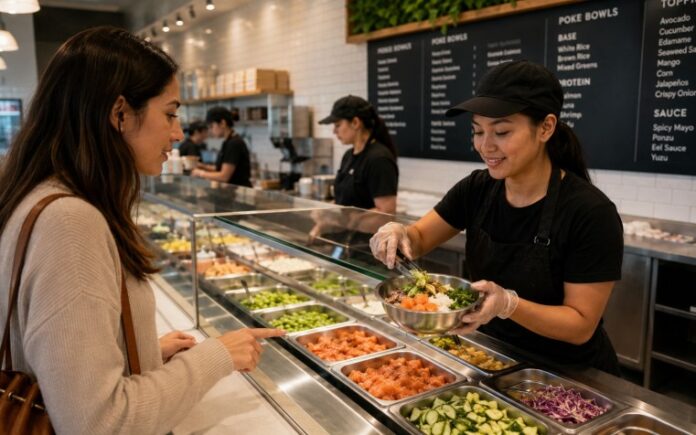

Restaurant concepts are usually judged by their food. Prospective owners taste the menu, consider whether the flavors have broad appeal, and try to gauge whether people will come back. That evaluation matters, but it addresses only one variable. The factor that most directly determines whether a location makes money is not what it serves but how it is built to serve it. Two restaurants can sell nearly identical food at nearly identical prices and produce completely different results, because one is structured around cooking to order and the other around assembling to order. The format sets the economics before the first customer arrives.
Cooking Versus Assembling
A traditional restaurant kitchen cooks each order after it is placed. That process requires trained cooks, coordinated timing across multiple stations, and equipment that carries significant cost to buy, power, and vent. It also introduces variability, since the same dish prepared by different cooks on different nights will differ, sometimes noticeably.
The assembly model reverses the sequence. Components are prepared in advance during dedicated prep periods, then combined to order at a service counter. Proteins are portioned, vegetables cut, bases cooked, and sauces made before service begins. When a customer orders, the work is selection and portioning rather than cooking. The output is fresh because the components are fresh, but the labor happens on a schedule the operator controls rather than in unpredictable bursts driven by customer arrivals.
This single structural difference cascades through nearly every part of the operation.
Labor Follows the Format
Labor is typically among the largest controllable costs a restaurant carries, and the format determines both how much is needed and how skilled it must be. A cooking line requires people who can execute techniques under time pressure, which means higher wages, longer training, and greater exposure when an experienced cook leaves. Replacing that person takes time, and performance dips during the gap.
An assembly counter requires accuracy, speed, and consistency rather than culinary technique. Training a new employee to work the line competently takes days rather than months, because the tasks are defined and repeatable. That shortens the cost of turnover, which matters in an industry where turnover is persistently high. It also means an operator can staff up for a busy season or cover an unexpected absence without a lengthy ramp.
The scheduling implication is equally significant. Prep work can be concentrated in predictable blocks, and service staffing can be matched closely to known traffic patterns, since the service task does not require a full kitchen brigade to be present regardless of volume.
Throughput as the Central Metric
Fast-casual locations are often small, and small footprints mean limited seating and limited hours of peak demand. Under those conditions, the metric that governs revenue is throughput: how many customers can be served during the concentrated windows when demand actually appears. A lunch rush may deliver the majority of a day’s sales in ninety minutes. What happens during those ninety minutes largely determines the day.
Assembly formats are built for exactly that pattern. Because components are ready, service time per customer is measured in a couple of minutes rather than the ten or more a cooked-to-order meal requires. A line moves continuously instead of backing up behind the kitchen. During a compressed peak, this difference translates directly into how many transactions a location can complete, which is why format matters more to revenue than seat count in this category.
Cost Control Through Portioning
The assembly model also changes how food cost behaves. When each order is built from measured components, portions are visible and controllable at the moment of service. Variance, the gap between what a recipe should cost and what it actually costs, narrows because the portioning is explicit rather than embedded in a cooking process.
Bowl-based concepts illustrate this clearly. An operator considering a Poke House fast casual franchise or any comparable assembly-driven concept is evaluating a model where the base, protein, vegetables, and toppings each have a defined portion, and where the cost of any given bowl can be calculated precisely. Inventory usage tracks closely to sales, waste becomes measurable rather than estimated, and deviations show up quickly enough to correct.
Site Requirements and Buildout
Format also determines what kind of real estate a concept needs. A full cooking line requires substantial square footage, heavy equipment, ventilation, and the utility capacity to support it. Those requirements narrow the pool of viable sites and raise buildout costs considerably.
Assembly formats need prep space, refrigeration, and a service counter. The reduced equipment load lowers both the buildout investment and the ongoing utility expense, and it opens up smaller spaces that a traditional restaurant could not occupy. That flexibility matters because it allows placement in dense, high-traffic locations where square footage is expensive and scarce, which are precisely the locations where the compressed-lunch demand pattern is strongest.
The Consistency Question
Multi-location concepts live or die on consistency, since a customer’s expectation is set by whichever location they visited first. Cooking-to-order formats depend on skilled execution to maintain that consistency, and skill varies across people and locations. Assembly formats encode consistency into the components and the portioning standards. When the prep specifications are followed, the output is similar regardless of who assembles it.
This is why assembly-based concepts tend to scale more predictably. The knowledge required to reproduce the product lives in documented procedures rather than in the hands of individual cooks, which makes each additional location less dependent on finding rare talent.
Evaluating the Structure, Not Just the Menu
For anyone assessing a restaurant opportunity, the practical implication is to examine the operating structure with the same seriousness applied to the food. How long does a transaction take at peak. How many people are required to run service. How much training does a new hire need before being productive. How precisely can food cost be controlled. What does the buildout require, and what site sizes does that allow.
The answers to those questions describe the economics of the business more accurately than the menu does. A concept with excellent food and a slow, labor-heavy structure will struggle in a small footprint with a compressed peak. A concept with good food and a structure built for speed, portion control, and fast training is working with the format rather than against it. Understanding which one is being offered is the substance of the evaluation.