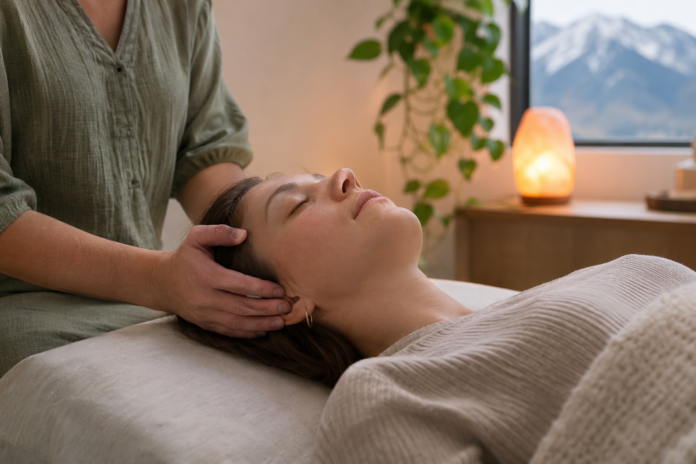

A woman walks into a converted office in Salt Lake City, lies down fully clothed, and hears her own heartbeat slow within about six minutes. No oil. No deep tissue pressure. No music with whale sounds, at least not on the day I tagged along. Her therapist’s hands rest barely touching her skull and lower spine, and by the end of the hour she’s crying about her father. That’s a fairly standard Tuesday for practitioners of craniosacral work, a light-touch discipline that has pulled off something unusual: it went from fringe to mainstream without advertising much of anything.
You’ve probably seen the phrase on a spa menu between hot stone and reflexology and skimmed past it. Fair enough. But the practice has been quietly gathering bookings from people who don’t otherwise do wellness anything, including construction managers, new parents, and runners who’ve stalled out on recovery. The reason is simpler than the marketing. Sessions are gentle, they’re clothed, and they leave room for the nervous system to do whatever it was already trying to do. If you want to see how this looks in practice, craniosacral therapy utah offers a useful window into how a full practice runs it, from adult sessions to infant work and orthodontia follow-ups.
So here’s the honest version of what’s driving the trend, what a session actually feels like, and how to decide whether it deserves a slot on your calendar.
What is craniosacral therapy, in plain terms?
Practitioners describe it as a way of reading and supporting the body’s internal rhythm through very light contact, mostly at the head, the base of the spine, and the sacrum. You keep your clothes on. There’s no cracking, no kneading, no heat lamp. The therapist’s hands stay still or move a millimeter at a time, and the whole point is to follow the body rather than direct it.
The field’s own vocabulary gets mystical fast, and I’d rather be blunt: the explanations vary widely from one practitioner to the next, and some of them lean hard on fluid dynamics language that’s hard to verify. What’s less contested is the experience on the table. Clients report deep stillness, emotional release, and a strange sense of time collapsing. Whether you credit that to cerebrospinal fluid or to an hour of uninterrupted, phone-free stillness, the hour happens either way.
For context on the broader wellness market, the NIH Office of Dietary Supplements publishes background material on how Americans approach complementary practices more generally, which helps explain why light-touch modalities keep finding new audiences.
Who actually books these sessions?
More varied a crowd than you’d guess. In a practice that runs adult, child, and infant sessions, the booking mix tends to look like this:
- Adults carrying chronic tension in the jaw, neck, or lower back who have already tried massage and found it too intense
- Parents bringing newborns for gentle work, often alongside other family members
- Teens dealing with orthodontic pressure and the headaches that sometimes accompany it
- People in talk therapy who want a body-based complement to the conversational work
Notice what’s missing from that list: nobody’s coming in for a quick fix. These are people willing to lie still for an hour and let something shift without forcing it. In my experience the personality type that gets the most out of this work is the one who has already tried pushing harder and discovered it doesn’t help.
The hour, described honestly
Most sessions run between sixty and ninety minutes. The room is warm. You keep your clothes on and lie on a padded table, usually face up. The therapist makes contact at your head or feet and then, largely, stops moving. Sounds like nothing. Feels like a lot.
The first ten minutes are the hardest part for most first-timers. Your brain keeps filing status reports about your inbox. Somewhere around minute fifteen, that chatter quiets down, and a fair number of clients find emotions showing up uninvited. One person I spoke with described sudden grief about a decade-old move. She wasn’t upset about it. She was just surprised.
Afterward, you might feel foggy for an hour or two, or unusually alert. Both are common. My advice: don’t schedule anything demanding right after your first session. Drive home the slow way.
How to prepare for your first session
This part rarely makes it onto spa menus, so treat it as a practical checklist:
- Book when you have buffer time after. An hour of open calendar post-session is worth more than any pre-session ritual.
- Wear soft, comfortable clothing. Nothing with a stiff collar or tight waistband.
- Skip the coffee an hour before. You’re trying to downshift, not sprint.
- Bring a short list of what’s going on. Three sentences on your body and mood is plenty. The therapist will ask anyway, but having it ready helps.
- Say something if touch placement feels off. Good practitioners want the correction. They’ll adjust without drama.
The National Center for Complementary and Integrative Health is a reasonable place to read neutral background on manual therapies before you book anything, especially if you’re the type who wants citations before committing an hour of your Saturday.
What it costs, and whether that’s reasonable
Adult sessions in Utah commonly land somewhere in the range of a good dinner for two, though infant and family sessions often price differently because they include more than one person. Compared with a weekly massage habit, the math is roughly similar per hour. The difference is frequency: many people book monthly rather than weekly, which changes the annual number considerably.
The Bureau of Labor Statistics tracks how service-sector spending patterns shift as wellness categories mature, and bodywork sits squarely in that trend. Spend your money where you’ll actually show up, though. A discounted session you dread is worth less than a full-price one you look forward to.
Does it work? My honest read
The evidence base for craniosacral work is thin and mixed, and any practitioner who tells you otherwise is overselling. What’s better established is that an hour of quiet, attentive human contact, with no screens and no demands on your attention, does something measurable to how a person feels afterward. Whether that something is specific to the technique or comes from the stillness itself, you still walk out lighter.
Here’s the framework I’d use to decide, and I call it the Three Questions because naming things poorly is a habit:
| Question | Good sign | Walk away |
| Can they explain the session without buzzwords? | Plain language about touch, pace, and what you’ll feel | Vague claims about unlocking your system |
| Do they ask what brought you in? | A real conversation before the table | Straight to the room with no intake |
| Is the pace collaborative? | You can change position, ask questions, or stop | You’re told the work “does what it does” |
Run those three and you’ll avoid the practitioners who treat subtlety as a license to be vague. I’d pick a slower, plainer session over an elaborate one every time.
Where this leaves you
Light-touch bodywork isn’t magic and it isn’t nonsense. It’s an hour of deliberate stillness with someone paying close attention to your body, and in a state where the average day is loud, that arrangement has real appeal. If you’ve been meaning to try something gentler than the deep-tissue circuit, this is the version that won’t leave you sore for two days.
Book one session. Go in with no expectations and a free afternoon behind it. Then decide, with your own nervous system as the witness, whether you’d do it again.