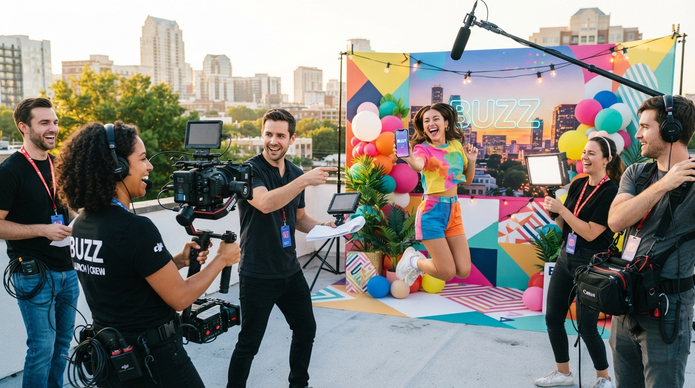

The question every video production agency is now asked in the first meeting — can’t we just generate this? — is the right question asked the wrong way. The useful version isn’t whether AI can produce the shot. It obviously can. The question is what the shot is supposed to prove, and whether a generated one can prove it.
The Baseline Has Moved
Video adoption is no longer a strategic decision. Wyzowl’s 2026 State of Video Marketing report puts business usage at 91%, with an average 31% of total marketing budget allocated to it. In the same research, 63% of video marketers reported using AI tools to help create or edit their videos.
Discovery has shifted with it. Google’s AI Overviews sit above organic results on a large share of commercial queries, and Ahrefs Brand Radar analysis from June 2026 found YouTube holding roughly a 21% share of all AI Overview citations — the largest single domain in the set. The asset most likely to be surfaced on a how-to query is increasingly a video with a clean transcript.
So both tools are now table stakes. The differentiator is knowing which job each one is doing.
Generation Produces Plausibility. Capture Produces Evidence.
This is the distinction that matters, and almost nobody briefs against it.
An AI generator produces something that looks like it happened. A camera produces proof that it did. For a stylised product visualisation, a concept sequence or an abstract explainer, plausibility is entirely sufficient — no one believes the floating exploded-view of your device was filmed. For a customer testimonial, a factory walkthrough, a founder explaining why the company exists, or anything making a claim about the real world, plausibility is worthless. The entire value is that it is real.
Brands that blur this line don’t just risk embarrassment. They risk the one asset that can’t be rebuilt quickly.
Where AI Is Already Winning — and It Isn’t the Hero Film
The most valuable AI use cases in video are unglamorous and mostly invisible to the audience.
Pre-visualisation: storyboards and animatics that used to cost a week now cost an afternoon, which means clients approve concepts they can actually see instead of concepts they imagined differently.
Versioning and localisation: one shoot, forty market variants, synthetic dubbing that preserves the speaker’s cadence.
Personalisation at scale: outbound and onboarding video assembled per account — a use case that was economically impossible eighteen months ago.
Post-production: transcription, rough assembly, caption generation, b-roll fill. Transcripts alone carry real SEO weight, supplying 300 to 400 words of indexable customer language per two-minute video.
Notice the pattern. AI is collapsing the cost of the supporting layer, not the signature one.
The Convergence Problem
Here is the argument most vendors won’t make: generated aesthetics converge. A finite number of models, trained on overlapping data, prompted by people using the same reference language, produce a recognisable house style that belongs to the model — not to you.
In a saturated category, that is a positioning disaster. Differentiation requires specificity: your actual office, your actual engineer with the regional accent, the specific ugly-beautiful detail no prompt would invent. As competent mid-tier video becomes abundant and effectively free, the scarce inputs become taste, access and narrative judgment — the things a videographer with a point of view supplies and a generator cannot.
Trust, Disclosure and the Regulatory Floor
Platforms have already moved. YouTube requires creators to disclose realistic synthetic or altered content, and major social platforms apply AI labelling. Provenance standards like C2PA are being embedded into capture and editing tools.
Plan for a near future where synthetic media is labelled by default. If your brand film carries a disclosure badge and your competitor’s doesn’t, that badge becomes a positioning statement whether you intended it or not. For regulated industries — health, finance, legal — this isn’t a brand preference. It’s a compliance question with a short fuse.
Performance Versus Brand, Revisited
Performance video answers a question someone already asked. Brand video creates the preference that makes them ask for you by name. AI is disproportionately useful on the performance side, where volume, iteration and search coverage matter more than singular craft. It is weakest exactly where brand is built: in moments of demonstrated humanity.
The integrated pipeline is not “choose one.” It’s capture the irreplaceable, generate the supporting layer, and let the second multiply the first. One real shoot day plus an AI post-production workflow now yields what a full production calendar used to.
Where Programs Break
Overproduction of the disposable — a six-week edit for a format that changes quarterly.
Underproduction of the durable — shipping generated footage as your primary brand statement to save money, and paying for it in positioning.
No narrative spine — most corporate video fails in the first four seconds because it opens with context instead of tension. AI does not fix this. It industrialises it.
Distribution as afterthought — Wistia’s 2026 research found 57% of teams spend more time creating videos than promoting them. Generative tools make this worse by removing the last natural constraint on output volume.
The Real Shift
Short-form is the leading ROI format for 49% of marketers in HubSpot’s 2026 research, and the cost of producing it is falling toward zero. When production stops being the bottleneck, the bottleneck becomes judgment: what deserves to exist, what must be captured rather than generated, and what the library is worth three years out.
Stop budgeting video campaign by campaign. Build an owned, indexed, transcribed library — part captured, part generated — and treat it the way you already treat your website or CRM. Campaigns depreciate; assets compound.
If you’re building that capability rather than buying another one-off deliverable, a strategy-led creative video production partner like Sunday Treat is the difference between content you publish and an asset you own. Ask your next agency not what the video costs, but which parts of it could never be generated — because those are the only parts your competitors can’t copy by Friday.