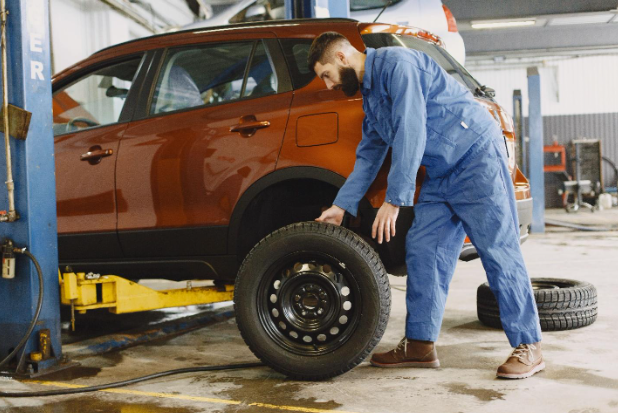

There is never a convenient time to find yourself with a flat tire. It may occur during a commute to work, on a family trip, or late at night on your way home. Temporary repair products can help drivers regain mobility, but it is important to know that it does not substitute for a professional service. Understanding what these solutions can and cannot do is essential for making safe decisions after tire damage.
What Counts as a Temporary Repair?
The role of a temporary tire repair is to help a vehicle travel a limited distance after a puncture. Common options for repairs include sealant kits, plug-style emergency tools, and compact spare tires. Some vehicles also use run-flat tires, which can support short-distance driving after a loss of pressure.
Each option works differently, so drivers should review the instructions supplied with their vehicle or repair kit. There are a few tire repair guidelines that drivers need to understand. Some range from understanding the recommended speed for their repair, or the maximum travel distance advised by the repair kit. These limits matter because a repair that appears secure at low speed may not remain stable under highway heat and pressure.
Know When a Repair May Help
A temporary repair works best if the object is small that has created the puncture, like a nail in the center are of the tread.
If the tire has not been driven while fully deflated and the internal structure remains intact, an emergency solution may provide enough support to reach a service facility.
However, drivers should not assume that every leak can be sealed. Damage near the shoulder or sidewall is more serious because these areas flex as the tire rotates.
A large puncture, visible cut, bulge, exposed cord, or damaged wheel also requires immediate professional attention. In these situations, continuing to drive can worsen the damage and increase the possibility of tire failure.
Why Sealant Kits Have Limitations
Sealant kits are convenient because they can be used without removing the wheel. The material enters through the valve stem, coats the tire interior, and may close a small puncture. A compressor then restores enough pressure for limited travel.
Still, sealant is not a universal fix. It may be ineffective if the opening is too large or if the tire has separated from the rim. Some sealants can also complicate inspection, so the technician should be told what product was used. After applying sealant, drivers should monitor pressure and avoid treating the result as permanent.
Use Spare Tires With Care
A compact spare offers another temporary solution, but it changes how the vehicle handles. These tires are usually narrower than standard tires and are built for restricted speed and distance. Braking response, cornering stability, and traction may feel different, especially in rain or during sudden maneuvers.
Before relying on a spare, check its air pressure periodically. A spare can lose pressure while stored, leaving it unusable during an emergency. Drivers should also make sure the jack, lug wrench, and wheel lock key are present and understand where the vehicle’s approved lifting points are located.
Professional Inspection Still Matters
Even when a temporary repair works, the tire should be inspected as soon as possible. A technician can remove the tire from the wheel and examine its surface for hidden damage. This step is important because driving with low pressure can weaken internal components without leaving obvious signs outside.
If the tire is suitable for permanent repair, the technician may use a combination patch and plug from inside the casing. If the damage falls outside repairable limits, replacement is the safer choice. The decision should account for puncture location, size, tread condition, and evidence of heat or structural damage.
Prepare Before Trouble Happens
Drivers can reduce their stress by learning more about their vehicle’s emergency set up well before a flat ever occurs. Make sure to read owner manuals, locate the equipment needed and make sure to check tire pressure on a regular basis and this should include checking the spare tire if you have one.
Other safety troubleshoots you should have prepared in your vehicle, is a flashlight, a reflective warning device, a pair of gloves, and a pressure gauge. Having these in a vehicle can help you in those instances when you have a roadside situation.
Temporary tire repairs are valuable when used for their intended purpose: helping drivers reach service. The safest approach is to respect all stated limits, avoid unnecessary driving, and arrange an inspection promptly. A fix can restore mobility, but informed judgment is what protects the vehicle and everyone traveling in it.