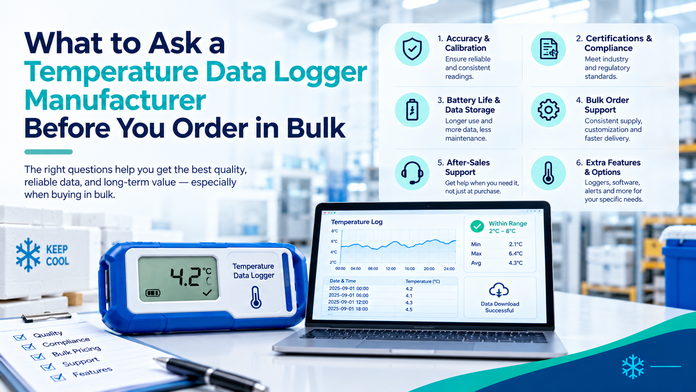

Ordering temperature data loggers in bulk is a very different decision from buying a handful for occasional use. At volume, small issues in accuracy, support, or documentation get multiplied across every shipment you send, so it’s worth interrogating a manufacturer properly before committing to a large order.
What Calibration Standard Do You Certify To?
Ask specifically which standard the manufacturer’s calibration is traceable to, and request a sample certificate before ordering. A manufacturer who can’t clearly answer this, or who provides vague reassurance rather than a specific traceable standard, is a red flag regardless of how competitive their pricing looks.
What’s Your Lead Time and Minimum Order Quantity at Scale?
Bulk orders often come with longer lead times than the manufacturer’s website suggests, particularly for customised configurations. Get a firm, written lead time for your specific order size before you factor a delivery date into your own supply chain planning, rather than relying on general turnaround estimates that apply to smaller orders.
Can You Customise Range, Interval, or Branding?
For companies with specific regulatory or operational requirements, ask whether the manufacturer can adjust temperature range, sampling interval, or memory capacity for a bulk order, and whether private branding or custom packaging is available. This matters more than it might initially seem — a generic off-the-shelf configuration that’s slightly wrong for your actual shipping conditions creates ongoing data quality problems across every single unit in the order.
What Happens If a Batch Has a Fault?
Ask directly what the manufacturer’s process is if a defect is discovered across a batch — replacement policy, timeframe, and whether they proactively test batches before shipment or rely on customers to report issues after the fact. A manufacturer with a clear, specific answer here has clearly dealt with this before; one who seems surprised by the question likely hasn’t had robust quality processes tested at scale.
Do You Provide Ongoing Software and Data Support?
Bulk logger purchases usually come with accompanying software for data retrieval and reporting, and it’s worth asking how long that software will be supported, whether updates are included, and what happens if you need to retrieve historical data years after a shipment using a version of software the manufacturer has since discontinued. This is a genuinely common problem for companies with long document-retention requirements.
What Validation Testing Have You Done?
Ask for actual validation data — how the logger performs under vibration, humidity extremes, and temperature cycling that mimics real transport conditions — rather than accepting laboratory bench specifications alone. Manufacturers who’ve done this testing are typically happy to share it; those relying purely on component-level specifications from their sensor supplier often haven’t validated performance at the finished-product level.
What’s Included in the Unit Price, and What Isn’t?
Bulk pricing quotes can hide costs that only surface later — calibration certificates issued as a paid add-on rather than included, software licensing charged separately per user or per site, or shipping and duties on top of the unit price for international orders. Get a fully itemised quote before comparing pricing across manufacturers, since a lower headline price can end up more expensive once every necessary component is actually included.
How Do You Handle Firmware or Design Updates Mid-Contract?
For long-term supply agreements, ask whether the manufacturer plans any firmware or hardware design changes during the contract period, and how they’ll communicate and manage that transition if it happens. Receiving a shipment of loggers with a firmware version that behaves differently from the batch you validated months earlier — without warning — can quietly undermine the consistency of your monitoring data across a supply chain that depends on every unit behaving identically.
What’s Your Environmental and Sustainability Position?
For companies with sustainability commitments or customers who ask about supply chain environmental impact, it’s increasingly relevant to ask about the manufacturer’s approach to single-use logger disposal, recyclability of components, and whether reusable options are available as an alternative for applicable routes. This isn’t purely a compliance question anymore — for many businesses, it’s becoming a genuine procurement criterion.
Can You Support Multiple Product Lines or Regulatory Regions at Once?
If your business ships different product types — pharmaceuticals alongside food products, for example — or operates across multiple regulatory regions with different documentation standards, ask whether a single manufacturer relationship can realistically support all of those requirements, or whether you’ll need different suppliers for different product lines. Consolidating with one manufacturer who can flex across your full range simplifies procurement, but only if they can genuinely deliver the compliance documentation each product line actually requires.
What’s Your Documentation Package for Regulated Industries?
If you’re shipping pharmaceuticals, vaccines, or other regulated goods, confirm whether the manufacturer’s documentation package meets your specific regulatory requirements — including formats like 21 CFR Part 11 compliant reporting where relevant — before ordering, not after your first regulatory submission gets flagged for insufficient documentation.
Can You Provide References at Comparable Volume?
Finally, ask for references from other companies ordering at a similar scale, ideally in a comparable industry. A manufacturer confident in their bulk order process should have no hesitation connecting you with an existing customer who can speak to lead times, defect rates, and support responsiveness at volume.
Evaluating Manufacturers Directly
Comparing manufacturers on these specifics — rather than unit price alone — is what actually determines whether a bulk order goes smoothly. Companies such as TempNote list detailed specifications for their Temperature Data Logger Manufacturer range, and their combined thermal covers and data logger offering is a useful benchmark when comparing bulk order terms, calibration documentation, and customisation options across suppliers.
A bulk order is a long-term relationship with a manufacturer, not a one-off transaction — the questions above are what separate a supplier who can support that relationship from one who’s only equipped to handle small, occasional orders.