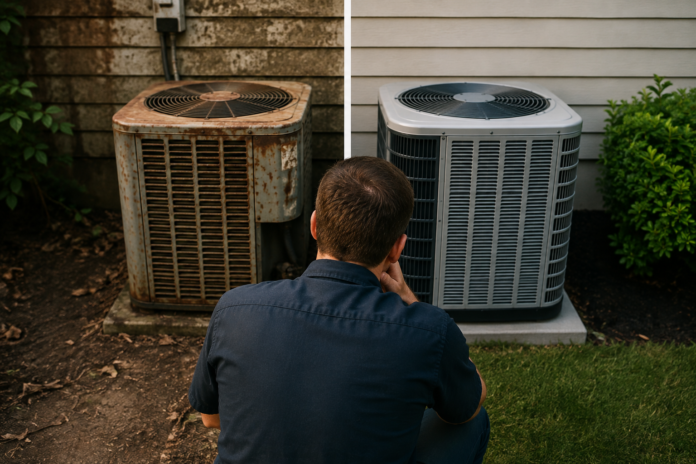

Your furnace dies on the coldest night of the year. Your AC quits on a 95-degree August afternoon. In those moments, the impulse is to fix it fast and stop thinking about it. But that reaction can cost you thousands more than it should. The repair-or-replace decision is actually one of the most consequential choices a homeowner makes, and most people get it wrong simply because they never had a framework for it.
This guide gives you that framework. By the end, you’ll know exactly what to look at, what numbers to run, and how to stop making this call on pure stress and gut instinct.
Why Your HVAC System Is Worth Taking Seriously
Most homeowners think of heating and cooling as background infrastructure. It runs, you don’t notice it. It fails, you panic. But the scale of what your system does is significant.
According to the U.S. Energy Information Administration’s 2020 Residential Energy Consumption Survey, more than half of a household’s annual energy consumption, precisely 52%, goes to just two end uses: space heating and air conditioning. That’s the single largest slice of your home energy budget, bigger than water heating, lighting, and appliances combined.
When your system is aging and running inefficiently, you’re not just risking a breakdown. You’re paying a quiet monthly penalty on every utility bill. That context matters a lot when you’re deciding whether a repair is “worth it.”
A link to the EIA’s residential energy use data gives you the full picture on how home energy breaks down by end use, as reported in the 2020 RECS survey.
The Age Threshold That Changes Everything
Before you even look at repair costs, check your system’s age. This single number reframes the entire conversation.
The U.S. Department of Energy’s Technical Support Documents for appliance efficiency standards define average product lifetime assumptions used in federal cost-benefit analyses: central air conditioners are rated at 15 years, heat pumps at 14 years, and gas furnaces at 18 years. Those aren’t the outer edges of what’s possible. They’re the averages the federal government uses when modeling national energy savings.
So here’s how to use that information. If your system is under 10 years old, repair is almost always the right answer unless the failure is catastrophic. If it’s between 10 and 15 years old, you’re in judgment territory, and the cost of the repair becomes critical. If it’s pushing past 15 years, every repair you make is effectively a down payment on a replacement that’s coming anyway, probably soon.
A 17-year-old furnace that needs a $1,100 heat exchanger repair is a great example of a trap. The repair is technically cheaper than a new unit. But you’re putting over a thousand dollars into a system one or two winters away from failure, and you haven’t solved the efficiency problem bleeding money from your monthly bills.
The Repair-or-Replace Cost Threshold Framework
Here’s a simple decision tool worth keeping. Multiply your system’s age (in years) by the estimated repair cost. If that number exceeds $5,000, replacement is almost always the smarter financial move. If it’s under $5,000, repair likely makes sense, assuming the system is under 15 years old.
| System Age | Repair Cost | Age x Cost | Recommended Action |
| 6 years | $600 | $3,600 | Repair |
| 10 years | $800 | $8,000 | Lean toward replace |
| 14 years | $450 | $6,300 | Borderline, get a quote |
| 16 years | $1,200 | $19,200 | Replace |
This isn’t a rigid law. It’s a starting point that keeps emotion out of the equation. A $400 refrigerant recharge on a 12-year-old unit might be worth it. A $2,000 compressor replacement on a 16-year-old unit almost certainly isn’t.
What Efficiency Loss Actually Costs You
An aging system doesn’t just risk failure. It quietly works harder to deliver the same result. A furnace or AC that’s 15 years old often operates well below its original efficiency rating, which means it’s pulling more energy to heat or cool the same square footage.
“The best way to keep your system lasting closer to 15 years than 10 years is to have proper maintenance by a professional at least once a year.” That quote, from a residential HVAC contractor cited in industry reporting, captures the straightforward math of proactive upkeep: one annual service call is far cheaper than one emergency replacement.
The efficiency gap between a 15-year-old system and a modern high-efficiency unit can be substantial, and it shows up on your bill every month. New gas furnaces carry AFUE ratings of 95% or higher, meaning 95 cents of every fuel dollar produces usable heat. Many older systems running today deliver closer to 80%, sometimes less. That 15-point gap multiplies across every winter month.
Pennsylvania Winters Add an Extra Urgency
The repair-or-replace timeline is more urgent in climates that actually push equipment hard, and Harrisburg, Pennsylvania qualifies. The region sits squarely in USDA Hardiness Zone 7, with winter lows regularly dropping into the teens and summers that routinely hit the upper 80s and 90s with heavy humidity. That’s a system running hard on both ends of the calendar, cutting years off equipment life compared to a mild Southern climate.
A homeowner in Harrisburg running a 14-year-old heat pump through another brutal winter is betting a lot on a system that’s already past the DOE’s average replacement threshold. If that system fails in February, they’re looking at emergency service pricing on top of replacement costs, with no time to shop for better options. Scheduling a professional assessment before the season hits is the single easiest way to avoid that outcome.
Local contractors who know the region’s seasonal demands are the right starting point here. A provider offering HVAC Services Harrisburg residents can rely on will assess your current system’s age, efficiency, and condition before you hit the repair-or-replace breaking point rather than after.
The Maintenance Factor Nobody Talks About Enough
There’s a third option that sits between “repair” and “replace” and it’s the one most homeowners skip entirely: consistent maintenance that extends equipment life and catches problems before they become failures.
Many factors affect how quickly HVAC filters get dirty. Manufacturers typically recommend replacement every 60 to 90 days. If filters appear heavily soiled at replacement time, changing them more frequently is advisable, according to the U.S. Environmental Protection Agency.
A link to the EPA’s guide to air cleaners and HVAC filtration covers manufacturer filter replacement recommendations and how proper filtration affects system performance and indoor air quality.
Filter neglect is genuinely one of the most common reasons systems fail early. A clogged filter forces the blower motor to work harder, raises operating temperatures inside the unit, and stresses components that aren’t designed to absorb that load. Over a few years, that adds up to a system that hits the wall at 11 years instead of 16.
Annual professional tune-ups catch the things a filter swap can’t. Refrigerant levels, electrical connections, heat exchanger cracks, drain line blockages. A technician finding a $200 problem in May is doing you a much bigger favor than the same technician finding a $2,000 problem in January.
How to Make the Final Call
Work through this in order before you spend anything:
- Pull the system’s age from the data plate or installation records. If you don’t know it, a technician can help you find it.
- Get a written repair estimate, not a phone ballpark. You need a real number.
- Run the age-times-cost calculation from the table above. If it clears $5,000, take the replacement quote seriously.
- Ask for a replacement quote at the same visit. Comparing both on paper, in the same conversation, removes the anchoring bias that makes repairs feel cheap and replacements feel expensive.
- Factor in energy savings from a modern high-efficiency unit, especially if your current system is 15-plus years old. The monthly bill reduction often shortens the payback period significantly.
The goal isn’t to replace your system sooner than necessary. A well-maintained system that’s only 8 years old and needs a $400 fix should absolutely be repaired. But a tired, aging unit limping through its 16th winter on a series of patches is costing you more than you realize, in bills, in risk, and in the premium you’ll pay when it finally quits on a day you can’t afford it.
Make the call before the system makes it for you.
Also Read: How to Know When Your Home Heating System Needs Replacing